
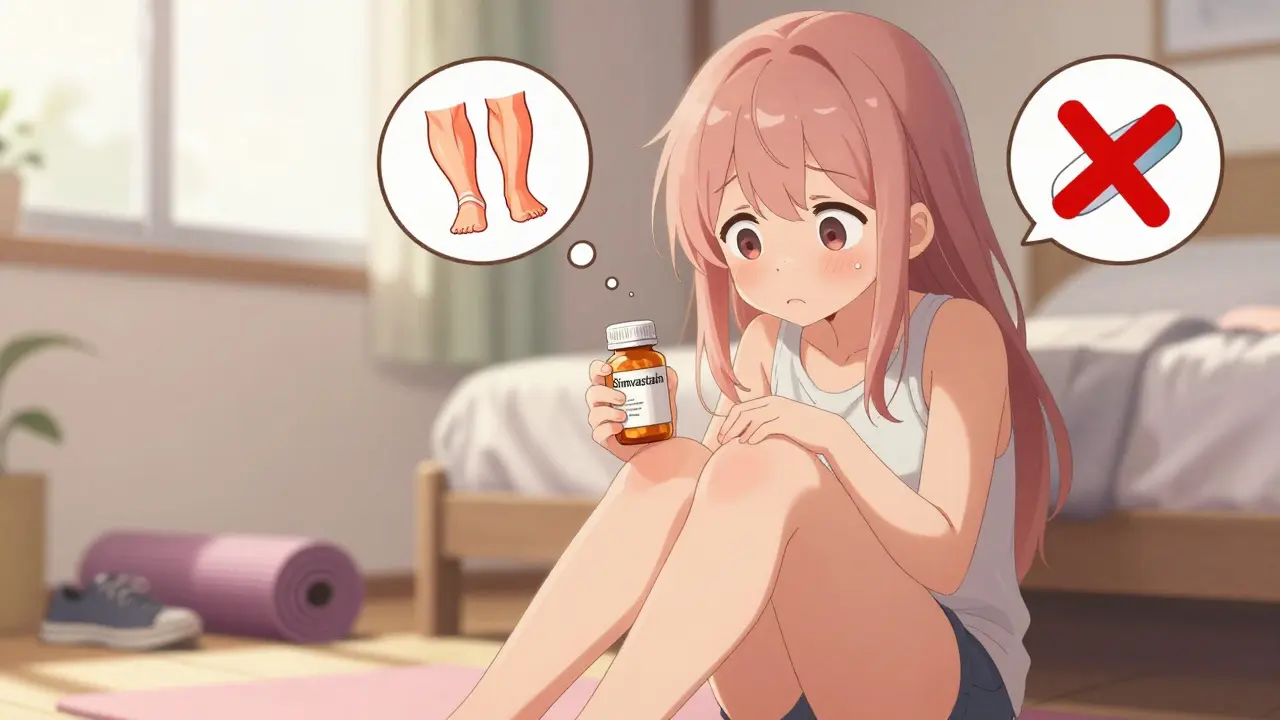
Statin Muscle Pain Risk Calculator
Which statin are you taking?
Your Muscle Pain Risk
More than 30 million people in the U.S. take statins every day. They’re one of the most prescribed drugs in history, and for good reason: they cut heart attacks and strokes by up to 30%. But if you’ve ever heard someone say, "I can’t take statins-they wreck my muscles," you know the big problem. Muscle pain is the #1 reason people quit. The question isn’t whether statins cause muscle pain. It’s: which ones actually do-and how much of that pain is real?
It’s Not What You Think
For years, doctors and patients believed statins were the main cause of muscle aches, cramps, and weakness. If you started taking one and your legs felt heavy, you blamed the pill. But a massive 2022 study from Oxford University, tracking over 120,000 people across 23 trials, turned that idea upside down. The researchers found that 90% of muscle pain reported in the first year of statin use had nothing to do with the drug. Patients taking statins reported muscle pain at almost the exact same rate as those taking sugar pills-27.1% versus 26.6%. That’s a difference of just 11 extra cases per 1,000 people. For most, the pain was coincidence, not causation.This isn’t just a statistical quirk. It’s the nocebo effect in action. If you’ve been told statins cause muscle pain, your brain starts looking for it. You feel a twinge in your calf after walking the dog? Must be the statin. You wake up stiff? Statins again. But when patients were tested in blinded trials-where neither they nor their doctors knew if they were taking the real drug or a placebo-the symptoms showed up just as often on the sugar pill. Your expectations can trick your body.
Not All Statins Are Created Equal
Even if only a small fraction of muscle pain is truly caused by statins, some are more likely to trigger it than others. The risk isn’t random-it’s tied to how the drug behaves in your body. Statins fall into two categories: water-soluble and fat-soluble. Fat-soluble ones (like simvastatin and atorvastatin) easily slip into muscle tissue. Water-soluble ones (like pravastatin and fluvastatin) mostly stay in the liver, where they’re supposed to work.Here’s how the major statins rank by muscle pain risk, based on clinical data from multiple studies:
| Statin | Risk Level | Key Fact |
|---|---|---|
| Simvastatin | Highest | 2.5x more likely than pravastatin to cause muscle pain; highest lipophilicity |
| Atorvastatin | High | Commonly prescribed; moderate muscle penetration; higher doses increase risk |
| Rosuvastatin | Moderate | Strong cholesterol-lowering power; lower muscle risk than simva or atorva |
| Pravastatin | Low | Water-soluble; least likely to enter muscle tissue; often used as first switch |
| Fluvastatin | Lowest | Least muscle-related side effects; lowest odds ratio in comparative studies |
Simvastatin is the biggest offender. Studies show it’s nearly twice as likely to cause muscle pain as pravastatin. Atorvastatin is next, especially at higher doses (40mg or 80mg). Rosuvastatin is powerful but better tolerated. Pravastatin and fluvastatin? They’re the quiet ones. They work just as well for lowering LDL cholesterol-but with far fewer muscle complaints.
What If You’re Already in Pain?
If you’re struggling with muscle pain and think it’s the statin, don’t just quit. Most people who stop never go back-even though 70% of them could have stayed on a different statin. The American College of Cardiology recommends a simple 3-step process:- Stop the statin for 2-4 weeks. This is called a "statin holiday." If your pain fades, it’s worth investigating further.
- Re-challenge with the same statin. If the pain comes back quickly, it’s likely the drug. If it doesn’t? Probably not.
- Switch to a lower-risk statin. Pravastatin or fluvastatin are the top picks. Many patients switch and never look back.
One patient from Perth told me (in a clinic last year) he’d stopped simvastatin after three months because his thighs ached constantly. His doctor switched him to pravastatin 10mg. Six months later, he was hiking in the Darling Scarp with no pain. He didn’t even know he’d been misdiagnosed.
Genes Can Play a Role
A small group of people-less than 3%-have a genetic variation in the SLCO1B1 gene that makes it harder for their bodies to clear statins. This can lead to higher drug levels in the blood and a real risk of muscle damage. This isn’t the nocebo effect. This is biology. If you’ve had severe muscle pain on multiple statins, your doctor might test for this. But don’t assume it’s your genes. Most people don’t need the test. The simple re-challenge approach works for nearly everyone.What About Alternatives?
If you truly can’t tolerate any statin, there are other options. Ezetimibe is a pill that blocks cholesterol absorption in the gut. It’s not as strong as statins, but it lowers LDL by 15-20% with almost no muscle side effects. PCSK9 inhibitors (like evolocumab) are injectables that slash LDL by 60%. They’re powerful-but they cost over $5,800 a year. Statins? Generic versions cost as little as $4 a month.And here’s the thing: even if you take an alternative, your heart risk doesn’t drop as much. Statins prevent about 3 major heart events for every 100 people treated over five years. No other single drug comes close. Avoiding statins because of fear of muscle pain isn’t just inconvenient-it’s dangerous.

Why Do So Many Quit?
A 2021 survey found that 78% of people who stopped statins due to muscle pain never talked to their doctor. They just stopped. Maybe they read a post online. Maybe a friend said, "I had the same thing." But without a proper check-in, they’re throwing away protection they don’t even know they need.Doctors aren’t perfect. Sometimes they don’t explain the nocebo effect clearly. Patients don’t always ask the right questions. But the data is clear: if you have muscle pain, it’s probably not the statin. And if it is? There’s almost always a solution that lets you keep your heart safe.
Bottom Line: Don’t Quit Without a Plan
The truth is simple: simvastatin causes the most muscle pain. Pravastatin and fluvastatin cause the least. And over 90% of muscle pain isn’t caused by statins at all. If you’re having trouble, don’t assume the worst. Talk to your doctor. Try a switch. Do a re-challenge. You might find that the pain you thought was from the drug was just noise.Statins save lives. The muscle pain myth is costing people theirs. Don’t let fear make the decision for you. Use the data. Make a plan. Protect your heart.
Do all statins cause muscle pain?
No. While muscle pain is commonly blamed on statins, studies show that over 90% of cases aren’t caused by the medication. Among the statins that do carry a slightly higher risk, simvastatin is the most likely, while pravastatin and fluvastatin have the lowest rates of muscle-related side effects.
Is muscle pain from statins dangerous?
In most cases, no. Mild soreness or fatigue is common and harmless. True statin-induced muscle damage-called rhabdomyolysis-is extremely rare, occurring in fewer than 1 in 10,000 patients. It’s usually only a concern if you have very high levels of creatine kinase (CK) in your blood, along with severe pain and dark urine. If you have those symptoms, see a doctor immediately.
Can I switch from simvastatin to pravastatin safely?
Yes, switching from simvastatin to pravastatin is a common and effective strategy for patients experiencing muscle pain. Pravastatin is water-soluble, so it’s less likely to enter muscle tissue. Many patients report complete relief of symptoms after the switch, with no loss of cholesterol-lowering effectiveness.
How do I know if my muscle pain is really from statins?
The gold standard is a "statin challenge"-stop the statin for 2-4 weeks, then restart it under medical supervision. If symptoms disappear and return upon restarting, it’s likely the statin. If symptoms don’t change, they’re probably unrelated. Blinded trials (where neither you nor your doctor knows if you’re on the real drug) are the most accurate way to confirm this.
Are there natural alternatives to statins for lowering cholesterol?
Diet, exercise, and weight loss help-but they don’t replace statins for people at high risk of heart disease. Supplements like red yeast rice contain a natural form of lovastatin and carry the same risks. Ezetimibe and PCSK9 inhibitors are proven alternatives, but they’re either less effective or much more expensive. Statins remain the most effective, affordable, and evidence-backed option for preventing heart attacks and strokes.