

Traveling with diabetes doesn’t have to be stressful-if you pack smart. Whether you’re flying to Europe, hiking in the mountains, or taking a road trip across the country, your blood sugar won’t take a vacation. And neither should your supplies. The key isn’t just bringing enough insulin and sensors-it’s bringing the right stuff, in the right way, so you’re ready for anything.
Bring Double What You Think You’ll Need
Here’s the rule no one skips: pack twice as much as you think you’ll use. That means if you’re gone for a week, bring two weeks’ worth of insulin, sensors, test strips, and lancets. Why? Because flights get delayed, luggage gets lost, and sometimes your CGM sensor stops working on day three. You don’t want to be stuck in a small town in Italy with no access to your meds.
Insulin? Double it. CGM sensors? Bring at least three for a seven-day trip. Test strips? Pack 50% more than your usual daily count. And don’t forget backup lancets-those tiny needles wear out faster than you think. One traveler on Reddit ran out of strips during a layover in Chicago and had to borrow from a stranger. Don’t be that person.
Insulin Storage: Heat Is Your Enemy
Insulin doesn’t like extreme temperatures. It works best between 40°F and 86°F. Too cold? It freezes and loses effectiveness. Too hot? It breaks down. Checked baggage can drop below freezing on the tarmac. That’s why insulin must go in your carry-on. Always.
For hot climates or long flights, use a cooling solution. The Frio Insulin Cooling Sleeve is a popular choice-it uses water-activated crystals to keep insulin cool for up to 45 hours. No batteries, no ice packs. Just soak it in water, shake it off, and slip your insulin vials or pens inside. Many travelers swear by it. One user took it to Dubai in July and kept their insulin perfectly stable during a 12-hour flight.
There’s new hope, too. Tresiba U-200, approved by the FDA in May 2023, stays stable at room temperature for up to eight weeks. If you’re on this insulin, you can skip the cooling sleeve on shorter trips. But still carry a backup-just in case.
CGM Sensors: Bring Spares and Tape
Your Dexcom or FreeStyle Libre isn’t just a gadget-it’s your lifeline. But sensors fail. They come loose. They get damaged during security checks. That’s why you need at least two or three extra sensors for any trip longer than three days.
Use Skin Grip CLEAR tape or similar adhesive patches to keep sensors locked in place during swimming, sweating, or showering. Regular tape doesn’t cut it. One traveler lost two sensors in a week on a beach vacation because they didn’t reinforce them. After that, they switched to Skin Grip-and never had another issue.
Don’t forget the transmitter. If your Dexcom transmitter dies, your whole system stops. Bring a spare. Some users keep an old one in their bag just for emergencies. And always carry a backup glucose meter and test strips. CGMs can glitch. Your meter won’t.
Insulin Pumps: Have a Backup Plan
If you use an insulin pump, you’re already ahead of the game-but you’re also more vulnerable if it breaks. Bring at least two extra infusion sets and three reservoirs. That’s the minimum. And always pack backup insulin vials and syringes. Even if you’ve never used them before, you need them.
Companies like Tandem and Insulet offer free loaner pumps if yours fails overseas. Call them before you leave. They’ll ship one to your hotel or hospital. But don’t wait until you’re stranded. Plan ahead.
Some travelers switch to injections for the trip just to avoid pump risks. It’s not ideal, but it’s safer than risking a full system failure in a remote area. One hiker in Costa Rica had his pump fail mid-trail. He didn’t have syringes. He ended up in the ER. Don’t let that be you.
Snacks and Low Treatments: Think Beyond Glucose Tablets
Glucose tablets? Fine. But they’re bulky, messy, and not always tasty. Many experienced travelers switch to fruit leathers-like Pure Organic Fruit Leathers. They’re thin, lightweight (just half an ounce each), and work just as fast. One survey found travelers using fruit leathers had 37% fewer low-blood-sugar emergencies than those relying on tablets.
Bring a mix: fruit leathers, juice boxes, and a few hard candies. Don’t rely on vending machines. They often don’t have the right stuff. And always keep snacks in your carry-on, not your checked bag. You never know when you’ll get stuck at the airport for hours.
Documentation: The One Thing Everyone Forgets
You wouldn’t travel without your passport. Don’t travel without your doctor’s letter. This isn’t optional. It’s critical.
Your letter should include:
- Your diagnosis (Type 1 or Type 2 diabetes)
- Your insulin regimen (dose, timing, type)
- Your insulin-to-carb ratio and correction factor
- Your CGM settings and alarm thresholds
- Emergency contacts and your endocrinologist’s info
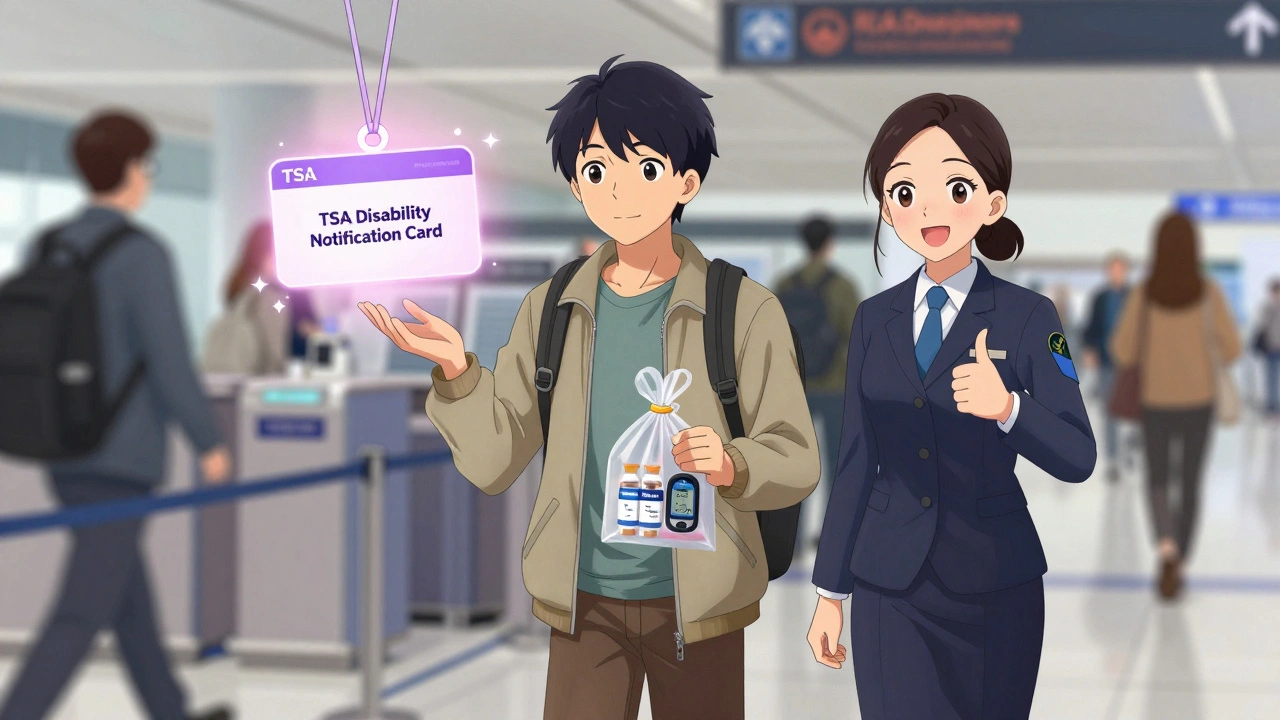
Print two copies. Keep one in your wallet, one in your carry-on. Some travelers also carry a TSA Disability Notification Card-it’s free to download from diabetes.org. Travelers with this card report 42% fewer delays at security. TSA agents know what to look for. It saves time, stress, and sometimes your dignity.
Security Screening: Know Your Rights
TSA allows all diabetes supplies through checkpoints-no exceptions. That includes insulin, syringes, CGMs, and liquids over 3.4 oz. But you have to declare them. Don’t wait until they ask. Walk up to the agent and say, “I have diabetes supplies in my bag.”
Put everything in a clear, sealable plastic bag. Separate it from your clothes and electronics. This cuts screening time by almost half. One traveler went from 8 minutes to 4 minutes just by organizing their bag.
Insulin pumps and CGMs don’t need to be removed. But if an agent asks, you can say, “This is a medical device. It’s not a weapon.” Most will accept that. If they push back, ask for a supervisor. You have the right to carry these supplies.
International Travel: Watch the Insulin Concentration
This is a silent killer. In the U.S., insulin is U-100. That means 100 units per milliliter. In some countries, it’s U-40 or U-80. If you accidentally buy the wrong one, you could overdose-badly.
Never buy insulin abroad unless you’re 100% sure of the concentration. Bring all your insulin with you. If you run out, call your pump company or a U.S.-based pharmacy that ships internationally. Some pharmacies like InsulinHelp.org can mail insulin overseas.
Also, check if your CGM works abroad. Dexcom and FreeStyle Libre are approved in many countries, but not all. Make sure your phone’s Bluetooth works with your sensor overseas. Some travelers carry a backup meter just in case.
Time Zones and Insulin Timing
When you cross time zones, your insulin schedule gets messy. You can’t just take your morning dose at the same clock time. You need to adjust based on your body’s rhythm, not the clock.
Dr. Anne Peters recommends planning 15-20 minutes per time zone crossed. If you’re flying from New York to Tokyo (13 hours ahead), you’ll need to adjust your basal rates and meal boluses gradually. Use your pump’s time zone feature if it has one. If not, write out a new schedule before you leave.
Some travelers switch to a fixed schedule-taking insulin at the same local time every day, regardless of when they ate. It’s not perfect, but it’s simpler than trying to sync with jet lag.
Final Checklist: Before You Leave
Here’s what to double-check:
- Insulin: double the amount, in carry-on, with cooling sleeve if needed
- CGM sensors: 2-3 extras, with Skin Grip tape
- Transmitter: backup included
- Glucose meter: extra batteries and 50+ test strips
- Lancets: 2-3 extra packs
- Insulin pump supplies: 2+ infusion sets, 3+ reservoirs
- Backup syringes and vials: even if you never use them
- Snacks: fruit leathers, juice, hard candies
- Doctor’s letter: printed, with emergency info
- TSA card: downloaded and printed
- Travel insurance: that covers medical emergencies
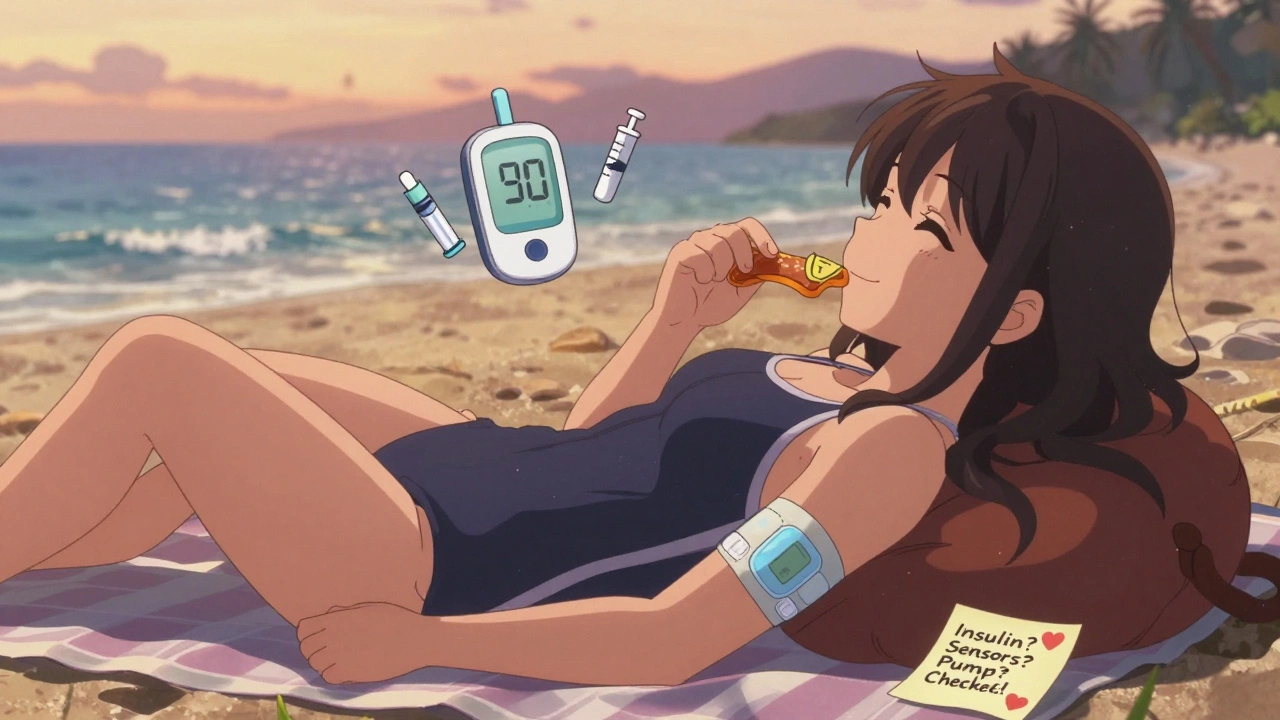
And one last trick: stick a Post-It note on your front door that says, “Insulin? Sensors? Pump? Checked.” It sounds silly-but it’s saved more than one person from walking out the door without their meds.
What to Do If Something Goes Wrong
Even with perfect planning, things happen. Here’s what to do:
- Lost luggage? Call your insulin or CGM company. Most have emergency supply programs.
- Low blood sugar? Use your fruit leathers or juice. Don’t wait for a snack bar.
- CGM stops working? Use your meter. Test every 2 hours until it’s fixed.
- Pump fails? Switch to injections. Use your backup vials and syringes.
- Need help abroad? Search for “diabetes clinic near me” or call your embassy. Many have lists of local providers.
Traveling with diabetes isn’t about being perfect. It’s about being prepared. The goal isn’t to avoid all problems-it’s to know you can handle them.
Can I bring insulin through airport security?
Yes. The TSA allows all diabetes supplies-including insulin, syringes, CGMs, and liquids over 3.4 oz-through security. You must declare them and separate them from other items in a clear bag. Insulin must stay in your carry-on; never pack it in checked luggage.
How many CGM sensors should I pack for a week-long trip?
Pack at least three sensors for a week-long trip. Sensors can fail, come loose, or get damaged. Having extras prevents emergencies, especially when you’re far from a pharmacy. Always bring extra adhesive tape like Skin Grip to keep them secure.
Is it safe to store insulin in a cooler with ice packs?
It’s risky. Ice packs can freeze insulin, which damages it. Instead, use a Frio cooling sleeve or similar water-activated product. It keeps insulin cool without freezing. If you must use ice, wrap the vials in a towel and keep them away from direct contact with ice.
What should I do if my insulin pump breaks overseas?
Call your pump manufacturer immediately. Companies like Tandem and Insulet offer free loaner pumps shipped to your location. Always have backup insulin vials and syringes with you. Switch to injections until your pump is replaced.
Can I buy insulin in another country if I run out?
Only if you’re certain of the concentration. In the U.S., insulin is U-100. In some countries, it’s U-40 or U-80. Using the wrong one can cause a dangerous overdose. Never buy insulin abroad unless you’re 100% sure. Bring enough with you, or arrange for international shipping through a U.S.-based pharmacy.
Do I need a doctor’s letter to travel with diabetes?
Yes. A doctor’s letter listing your diagnosis, medications, insulin doses, and emergency contacts is essential. It speeds up security screening and helps medical staff abroad if you need help. Include your insulin-to-carb ratio and correction factor. Print two copies-one in your wallet, one in your carry-on.
Courtney Black
December 8, 2025 AT 12:22Bringing double the supplies? Yeah, I learned that the hard way in Lisbon when my CGM died and my insulin got left in checked luggage. Never again. I now pack like I’m preparing for a zombie apocalypse-but with more glucagon.
Also, Skin Grip is magic. I used to lose sensors on hikes. Now I tape them like they’re winning a prize. Best $10 I ever spent.
iswarya bala
December 10, 2025 AT 04:26omg this is so helpful!! i was so scared to travel after my last trip where i had a low at 3am in delhi and no juice anywhere 😭 i got fruit leathers now and they’re a game changer!! also i always forget my doctor letter but now i keep it in my phone and printed so yessssssss 🙌
Anna Roh
December 10, 2025 AT 21:29Okay but why are we treating diabetes like it’s a mission to Mars? I get it, planning matters-but do you really need three sensors, a backup transmitter, a cooling sleeve, AND fruit leathers? I just carry my insulin and eat carbs when I feel weird. It’s called living, not engineering.
Also, TSA doesn’t care. I’ve never been asked for a letter. Ever.
Raja Herbal
December 12, 2025 AT 12:41Anna, I feel you. But then again, I once had to walk 2 miles in the rain in Bangalore because my pump died and the nearest pharmacy didn’t have U-100. So yeah, maybe packing like a prepper isn’t crazy. It’s just… smart.
Also, fruit leathers? That’s a whole vibe. I tried one. Tasted like candy made by a sad unicorn. But hey, it worked.
Delaine Kiara
December 12, 2025 AT 15:32Okay, I need to address the elephant in the room: why is no one talking about the fact that insulin prices in the U.S. are a crime? We’re out here packing for international trips because we can’t afford to refill here, and now we’re being told to buy two weeks’ worth of something that costs $300 a vial?
And don’t even get me started on the Frio sleeve. It’s a $40 band-aid on a systemic wound. Meanwhile, my insulin is sitting in a drawer because my deductible ate my paycheck. This guide is great… if you have money. For the rest of us? We’re just trying not to die in an airport bathroom.
Also, yes, I’ve used duct tape to hold my sensor on. And I’m proud of it.
Noah Raines
December 12, 2025 AT 19:55Been there, done that. Got the T-shirt, the extra sensors, and the Frio sleeve that smells like wet gym sock now. But honestly? The TSA card? Game changer. I used to get pulled aside every time. Now I just say ‘diabetes’ and hand them the card. They nod. I walk through. 10/10 recommend.
Also, don’t sleep on the backup meter. My Dexcom glitched in Iceland and I was like ‘oh cool, I have a 2008 OneTouch’ and I felt like a genius. 😎
Lola Bchoudi
December 14, 2025 AT 18:54Let’s level-set on insulin storage: the thermal stability window is 40–86°F, per FDA guidelines. Anything outside that range induces conformational denaturation of the insulin hexamer, leading to loss of biological activity. The Frio sleeve works because it leverages evaporative cooling via phase-change hydrogels-no batteries, no ice, just entropy management.
Also, if you’re on Tresiba U-200, you’re not just saving weight-you’re optimizing pharmacokinetic consistency across circadian and geospatial variables. But still carry backup. Because even the most robust pharmacodynamics can’t override Murphy’s Law.
And yes, fruit leathers have a higher glycemic index velocity than tablets due to reduced particle size and increased surface area-to-volume ratio. That’s why they’re clinically superior for rapid correction. Just saying.
Morgan Tait
December 15, 2025 AT 23:26Have you ever wondered why insulin is so tightly controlled? It’s not just about safety-it’s about control. Big Pharma doesn’t want you to be able to make your own. They’ve been lobbying for decades to keep the supply chain locked down. You think the ‘U-100 vs U-40’ thing is an accident? Nah. It’s a barrier to entry.
And TSA? They’re not helping you. They’re scanning for bombs, but they’re also tracking your medical data. That ‘TSA Disability Card’? It’s a digital fingerprint. They know you’re diabetic. They know your insulin brand. They know you’re vulnerable.
Meanwhile, people are flying with backup pumps and fruit leathers like it’s a survivalist convention. Meanwhile, in the shadows, someone’s selling unregulated insulin on Telegram. I’ve seen it. It’s real. And it’s cheaper.
So yeah. Pack your gear. But ask yourself: who really benefits from you being this dependent?
…Also, Skin Grip is great. I use it on my dog’s harness. Works like a charm.