
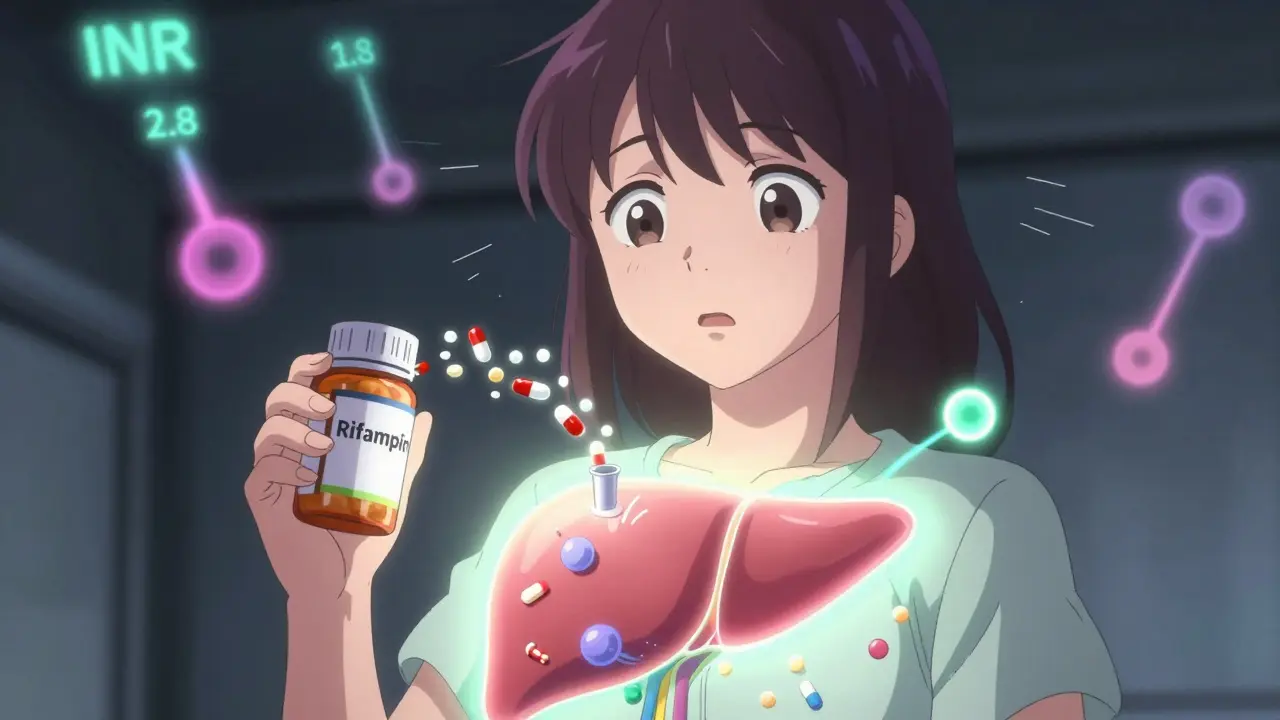
Rifampin Interaction Dose Calculator
Calculate adjusted anticoagulant or antiviral doses when rifampin is prescribed. Based on CYP enzyme induction data from clinical studies.
When you take rifampin for tuberculosis or to prevent meningitis, you’re not just fighting bacteria-you’re also triggering a chain reaction in your body that can silently weaken other life-saving medications. Rifampin doesn’t just kill germs. It turns on your liver’s drug-processing system like flipping a switch, causing powerful anticoagulants and antivirals to break down faster than they should. The result? Blood thinners stop working. HIV meds lose their punch. And suddenly, you’re at risk for clots, strokes, or viral rebound-all because of an interaction most patients never hear about.
How Rifampin Turns Up Your Liver’s Drug Factory
Rifampin doesn’t directly block or boost enzymes. Instead, it activates a master switch in your liver cells called the pregnane X receptor (PXR). Once activated, PXR tells your liver to make more of a group of enzymes called CYP3A4 and CYP2C9. These enzymes are responsible for breaking down over half of all prescription drugs. When rifampin flips this switch, your body starts chewing up anticoagulants and antivirals like they’re junk food.
The effect starts within 24 to 48 hours. By day five or seven, enzyme levels peak. Even after you stop rifampin, it takes two to three weeks for your liver to calm down. That means if you stop rifampin but keep your usual dose of warfarin or rivaroxaban, you could end up with dangerously high drug levels-leading to bleeding risks. This isn’t a minor concern. It’s a clinical emergency waiting to happen.
Warfarin and Other Vitamin K Antagonists: A Dangerous Game of Numbers
Warfarin has been the go-to blood thinner for decades. But it’s extremely sensitive to rifampin. Studies show that when taken together, rifampin can slash warfarin’s blood levels by 15% to 74%. The more potent effect happens on S-warfarin, the isomer that does most of the anticoagulant work, because it’s broken down by CYP2C9-a key enzyme rifampin strongly induces.
One real-world case involved a 57-year-old woman with a mechanical heart valve. She was stable on phenprocoumon, another vitamin K antagonist. When she started rifampin for suspected endocarditis, her INR-normally around 2.8-plummeted to 1.2. Her blood wasn’t thin enough anymore. She was at high risk for a clot forming on her valve. Doctors had to switch her to heparin injections until rifampin cleared from her system. Fifteen days later, her INR finally returned to therapeutic range.
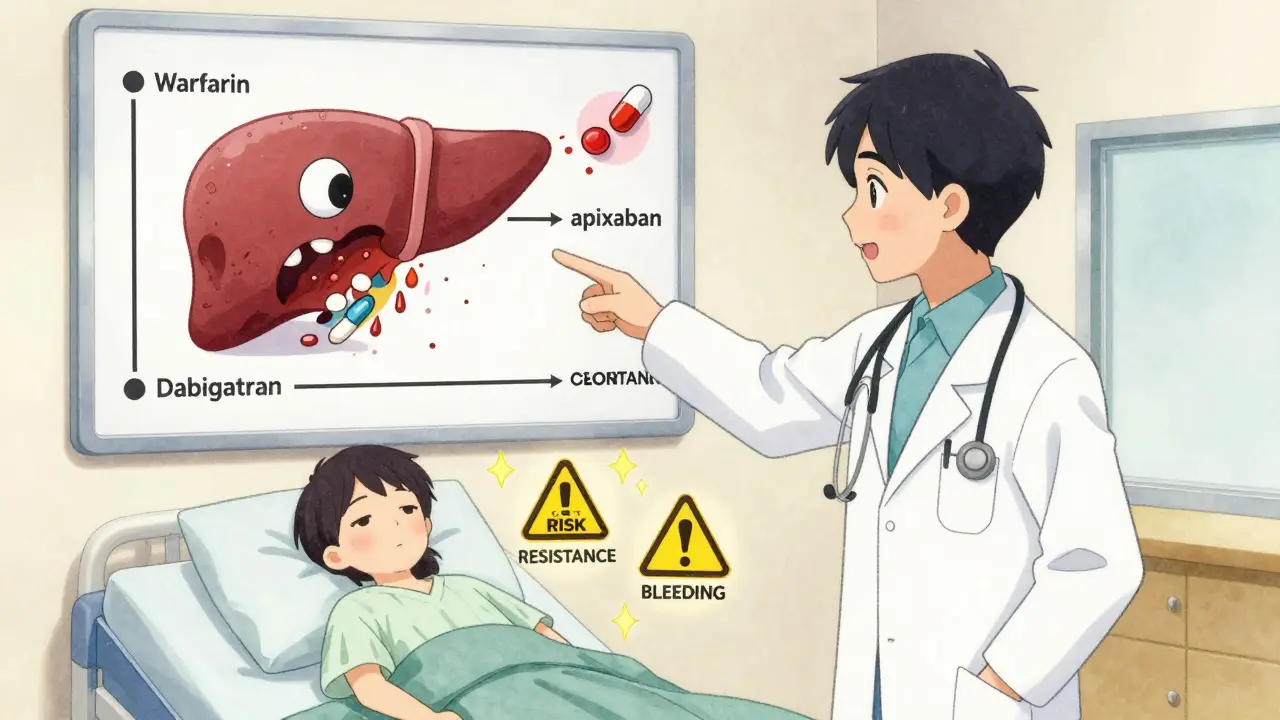
That’s why guidelines from the American College of Chest Physicians recommend switching patients from warfarin to low molecular weight heparin (LMWH) during rifampin treatment. No oral anticoagulant works reliably with rifampin. You can’t just up the warfarin dose and hope for the best. The variability is too high. One patient might need a 3-fold increase. Another might need five times more. And even then, monitoring is unreliable.
Direct Oral Anticoagulants (DOACs): The New Challenge
DOACs like apixaban, rivaroxaban, dabigatran, and edoxaban were supposed to be easier to use than warfarin. No more frequent blood tests. No dietary restrictions. But rifampin breaks them too-sometimes even harder.
Research shows:
- Dabigatran: AUC drops by 67%
- Apixaban: AUC drops by 50-55%
- Rivaroxaban: AUC drops by 50-67%
- Edoxaban: AUC drops by 35%, but active metabolites increase, making the outcome unpredictable
There’s no reliable way to monitor DOAC levels in real time like you can with INR for warfarin. That’s why the European Heart Rhythm Association says: avoid combining DOACs with rifampin entirely. If you absolutely must use them together-say, a patient with a prosthetic joint infection needs both antibiotics and anticoagulation-dose adjustments are non-negotiable. One study tracked six patients on rivaroxaban and rifampin. They found that simply doubling the rivaroxaban dose wasn’t enough. You need gradual titration, close follow-up, and a plan for what happens when rifampin stops.
And here’s the kicker: only 12% of U.S. hospitals had formal protocols for managing this interaction as of 2022. Most clinicians are winging it.
Antivirals in the Crosshairs: HIV and Hepatitis C
Rifampin doesn’t just mess with blood thinners. It’s equally ruthless with antivirals. For people with HIV, drugs like darunavir, atazanavir, and rilpivirine rely on CYP3A4 to stay in the system. When rifampin is added, their concentrations can crash by 70-90%. That’s not just a drop in effectiveness-it’s a direct path to drug resistance.
For hepatitis C, sofosbuvir and other direct-acting antivirals (DAAs) are also affected. A 2021 study showed that rifampin reduced sofosbuvir exposure by over 50%, which could mean treatment failure in patients with chronic HCV.
The CDC and WHO both warn against combining rifampin with most HIV regimens. The only exceptions are some newer regimens like dolutegravir-based therapy, which can be used with careful monitoring. But even then, you’re playing with fire. The risk of resistance is real, and resistance doesn’t just hurt the individual-it spreads to the community.
What Should You Do If You Need Both?
If you’re on an anticoagulant or antiviral and your doctor prescribes rifampin, don’t panic-but don’t ignore it either. Here’s what works:
- For warfarin users: Switch to LMWH (like enoxaparin) during rifampin treatment. Resume warfarin only after rifampin has been stopped for at least two weeks. Retitrate slowly with daily INR checks.
- For DOAC users: Avoid combination if possible. If no alternative exists, switch to LMWH. If you must keep the DOAC, consult a clinical pharmacist. Dose increases of 50-100% may be needed, but only with frequent follow-up and no gaps in coverage.
- For HIV patients: Switch to a rifampin-compatible regimen. Dolutegravir or raltegravir are preferred. Avoid boosted protease inhibitors entirely.
- For HCV patients: Delay rifampin until after HCV treatment is complete. If you can’t wait, consider alternative TB regimens like rifabutin, which is a weaker inducer.
There’s one exception: rifabutin. It’s a cousin of rifampin, used sometimes for TB in HIV patients. It’s a much weaker enzyme inducer-about 10 times less potent. If you need an antibiotic that won’t wreck your antiviral, rifabutin might be your best bet. But it’s not always available, and it has its own side effects.

The Future: New Anticoagulants Built to Resist Induction
Pharmaceutical companies are finally listening. A 2023 study in Nature Scientific Reports looked at milvexian, a new anticoagulant that targets factor XIa instead of thrombin or factor Xa. Early data suggest it’s not metabolized by CYP3A4. That means it might survive rifampin’s enzyme blast.
The FDA now requires all new drugs to be tested against strong inducers like rifampin before approval. That’s why newer anticoagulants have clearer labels. But for the drugs we’re using today-warfarin, rivaroxaban, apixaban, HIV meds-the problem remains. And until safer alternatives become widespread, clinicians have to be the guardians of these dangerous interactions.
Why This Matters More Than You Think
Between 2010 and 2020, the use of DOACs over warfarin jumped from 15% to 85% in patients on rifampin. That’s not because doctors ignored the risk. It’s because DOACs are convenient. But convenience doesn’t cancel out biology. The same patients who switched to DOACs for easier dosing are now at higher risk of silent treatment failure because no one checks their drug levels.
And it’s not just about blood clots. In one study, patients on rifampin and anticoagulants had a 3.7-times higher risk of major bleeding after rifampin was stopped-because their doses weren’t adjusted down fast enough. The timing matters as much as the dose.
This isn’t theoretical. It’s happening in hospitals, clinics, and homes every day. Patients don’t know. Doctors are overwhelmed. Pharmacies don’t always flag it. And the consequences? Stroke. Pulmonary embolism. Death.
The solution isn’t just better drugs-it’s better awareness. Every patient starting rifampin needs a medication review. Every prescriber needs to ask: What else are they taking? And every pharmacist needs to speak up-even if it’s the third time they’ve had to remind the team.
Bottom Line: Don’t Assume It’s Safe
If you’re on a blood thinner or antiviral, rifampin is not a neutral add-on. It’s a chemical grenade. It doesn’t just reduce drug levels-it erases them. And the damage can be irreversible.
There’s no safe way to combine rifampin with most anticoagulants. There’s no reliable way to monitor DOACs. There’s no room for guesswork. The only safe path is to switch therapies, plan ahead, and never assume the interaction isn’t happening just because you feel fine.
The next time you or someone you know starts rifampin, ask: What else is being broken by this? Because sometimes, the cure is worse than the disease-if you don’t see the hidden damage coming.
chandra tan
January 11, 2026 AT 13:55Bro this is wild. I was on rifampin for TB last year and my doc just told me to keep taking my blood thinner like nothing. Lucky I googled it myself. Could’ve died.
Ted Conerly
January 13, 2026 AT 02:59This is exactly why we need better pharmacist involvement in primary care. I’ve seen this happen three times in my clinic alone. Patients assume ‘new drug = safe add-on.’ It’s not. We need mandatory alerts in EHRs and mandatory med reviews before rifampin scripts go out. No exceptions.
Lisa Cozad
January 14, 2026 AT 04:42I’m a nurse in an ICU and we had a patient last month with a mechanical valve who got rifampin for suspected endocarditis. His INR dropped to 0.9. He coded. Turned out no one checked his meds. This isn’t rare. It’s systemic.
Saumya Roy Chaudhuri
January 15, 2026 AT 21:34Of course rifampin wrecks everything. It’s a nuclear-grade enzyme inducer. Anyone who’s taken pharmacology 101 knows this. The real tragedy is that most prescribers are still using 1990s-era mental models. We’re in 2024. This should be common knowledge.
Dwayne Dickson
January 17, 2026 AT 09:09Let’s be clear: this isn’t a ‘drug interaction.’ It’s a pharmacokinetic demolition derby. Rifampin doesn’t ‘interfere’-it reprograms hepatic gene expression via PXR agonism, inducing CYP3A4 and CYP2C9 transcription to supraphysiological levels. The result? Subtherapeutic concentrations of substrates with narrow therapeutic indices. This isn’t a footnote. It’s a Class I black box warning waiting to be enforced.
Ian Cheung
January 17, 2026 AT 09:29So many docs think DOACs are magic bullets but they’re just as fragile as warfarin if not more so because you cant even check levels. I had a guy on rivaroxaban who got rifampin for a joint infection. Two weeks later he had a PE. No one told him to stop or adjust. Just assumed ‘it’s fine’
Aurora Memo
January 18, 2026 AT 03:18Thank you for writing this. I’m a patient with HIV and TB coinfection. My doctor switched me from darunavir to dolutegravir when they put me on rifampin. I was terrified. But the change saved me. I’m alive because someone listened. Please, if you’re reading this and you’re on antivirals-speak up. Ask for alternatives. You deserve to be heard.
Jay Amparo
January 18, 2026 AT 18:46Just want to add-rifabutin isn’t perfect but it’s a lifeline. My cousin in Delhi was on rifampin for TB and his HIV meds were failing. Switched to rifabutin and his viral load dropped back to undetectable. It’s not available everywhere but if you’re in a place that has it, push for it. It’s the lesser evil.
Faith Edwards
January 19, 2026 AT 23:54It is profoundly disconcerting that in an era of precision medicine, we continue to permit the conflation of convenience with clinical safety. The casual disregard for pharmacodynamic principles by clinicians who presume DOACs are ‘immune’ to induction phenomena is not merely negligent-it is an affront to the very ethos of evidence-based practice. The fact that only 12% of hospitals maintain protocols for this interaction speaks not to ignorance, but to institutional complacency. We are not merely failing patients; we are betraying the covenant of care.