
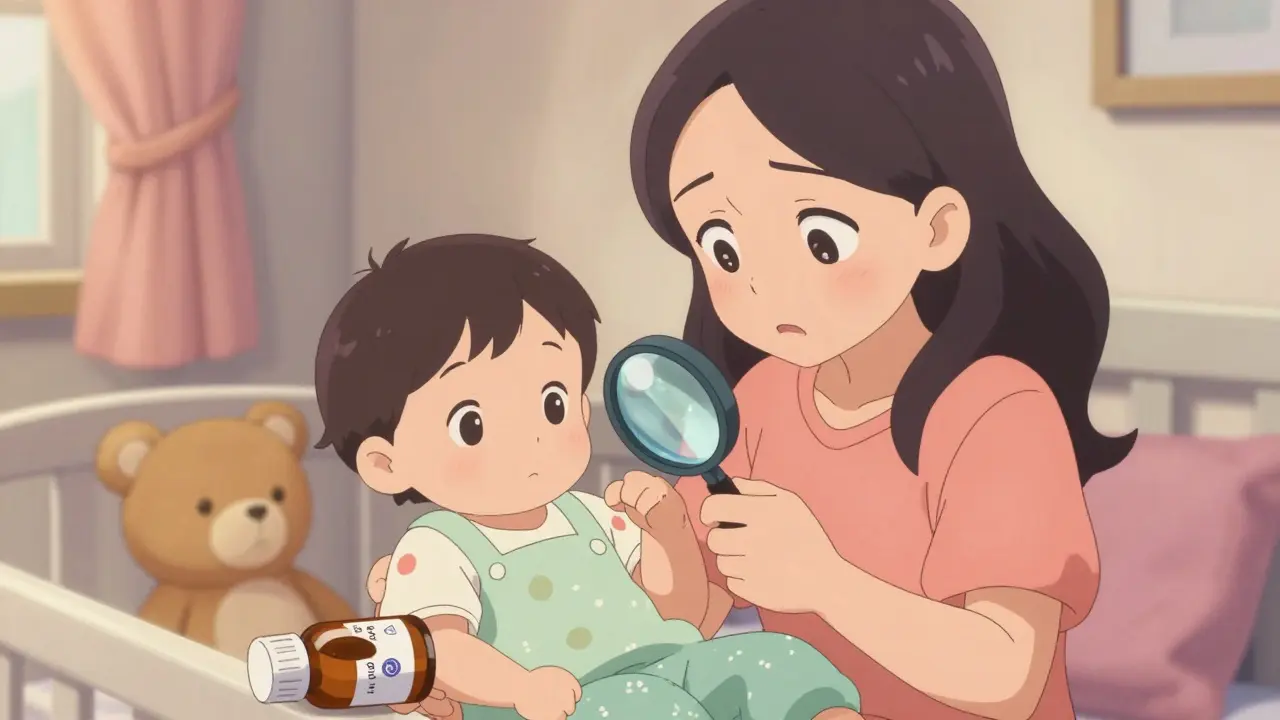
When a child gets sick, parents want the best care - and often, that means choosing a generic drug to save money. But what many don’t realize is that generic drugs for children aren’t always interchangeable with their brand-name versions. The same active ingredient doesn’t mean the same safety profile. In fact, for kids, especially those under 2, even small differences in inactive ingredients, taste, or concentration can lead to serious harm.
Why Kids Are Different
Children aren’t just small adults. Their bodies process drugs differently. Organs like the liver and kidneys, which break down and remove medicines, aren’t fully developed in babies and toddlers. That means a dose that’s safe for an adult might be toxic for a 6-month-old. The FDA’s 2019 guidance on pediatric drug safety highlights this clearly: drugs like aspirin, lamotrigine, and verapamil can behave unpredictably in children. Aspirin, for example, is linked to Reye’s syndrome - a rare but deadly condition that causes swelling in the liver and brain. That’s why it’s banned for anyone under 19.
Even something as common as acetaminophen works differently in young kids. Babies under 1 year produce more glutathione, a natural detoxifier, which makes them less likely to suffer liver damage from accidental overdose. But that doesn’t mean you can give them adult doses - their tiny bodies still can’t handle too much. And when you switch from a brand-name liquid to a generic version, the concentration might be different. One bottle might be 160 mg per 5 mL, another 160 mg per 1 mL. Mix that up, and you’re giving a 10x overdose.
The Hidden Dangers in Inactive Ingredients
Generic drugs must have the same active ingredient as the brand name. But they can use completely different fillers, dyes, preservatives, and sweeteners. For kids, these extras aren’t harmless. The KIDs List - a safety guide from the Pediatric Pharmacy Association - flags dozens of generic drugs because of these additives.
Take benzocaine, a numbing agent found in teething gels. It’s safe for adults, but in children under 2, it can cause methemoglobinemia - a condition where blood can’t carry oxygen properly. There have been cases of infants dying after parents applied it to soothe teething pain. The same goes for lidocaine viscous, used for mouth sores. It’s been linked to seizures in young kids because of how it’s absorbed through the gums.
Preservatives like benzalkonium chloride in nasal sprays or eye drops can trigger allergic reactions. One parent on Reddit shared that her 5-month-old broke out in a rash after switching from brand-name cetirizine to the generic - the preservative was different. The doctor confirmed it: the generic version used a dye and preservative not tested for infant use.
Off-Label Use Is the Norm - and It’s Risky
Here’s a startling fact: 40% of all drugs given to children in the U.S. are used off-label. That means they were never tested or approved for kids. And 90% of those prescriptions are for generic versions. Why? Because manufacturers rarely bother to study their drugs in children. The FDA’s Best Pharmaceuticals for Children Act helped, but in 2021, the Government Accountability Office found that 60% of generic drugs still lack pediatric dosing instructions - compared to only 35% of brand-name drugs.
Doctors often guess the dose based on weight or age. But weight-based dosing is tricky. A 15-pound baby needs a completely different amount than a 40-pound toddler. One study found that 45% of medication errors in kids come from miscalculating these doses. And when you’re using a generic liquid that comes in a different concentration than what the doctor ordered? That error becomes deadly.
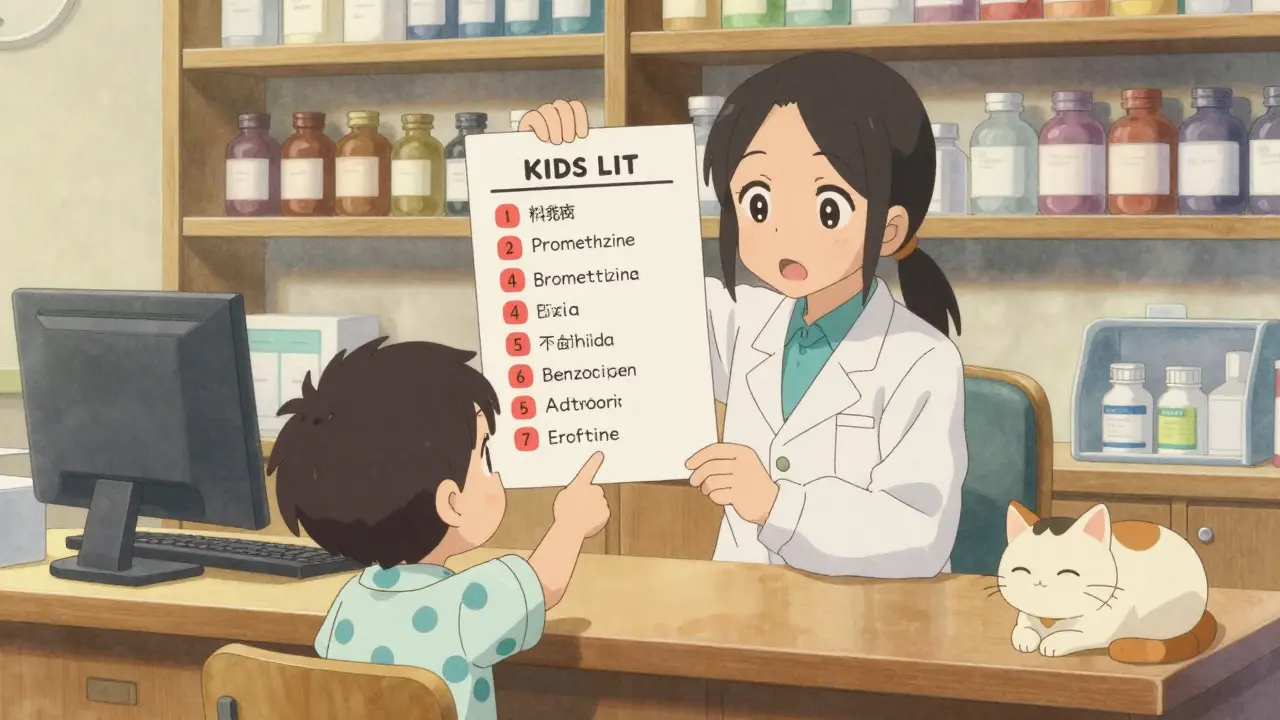
High-Risk Drugs and the KIDs List
The KIDs List (Key Potentially Inappropriate Drugs List) is the most trusted safety tool for pediatric pharmacists. Updated quarterly, it now includes over 4,100 drugs with known or suspected risks for kids. It doesn’t just say “avoid” - it tells you why and how strong the evidence is.
- Promethazine (a generic antihistamine): Avoid in kids under 2. Strong evidence links it to fatal breathing problems.
- Trimethobenzamide (an anti-nausea drug): Avoid in all patients under 18. It can cause severe muscle spasms and locking of the jaw.
- Linaclotide (a laxative): Use caution under age 2. Cases of death from dehydration have been reported.
- Guaifenesin (a cough expectorant): Avoid under age 4. No proven benefit, high risk of side effects.
These aren’t rare cases. In 2023, a pharmacy in Ohio intercepted 32% of pediatric errors because a parent was given a generic version of a drug on the KIDs List. The pharmacist caught it - but not every pharmacy has that expertise.
What Parents Can Do
You don’t need to be a pharmacist to keep your child safe. Here’s what works:
- Always ask: “Is this approved for my child’s age?” If the label doesn’t say, don’t assume it’s safe.
- Use oral syringes, not spoons. Household spoons vary wildly in size. A 5 mL syringe is precise. A teaspoon? Could be 3 mL or 7 mL.
- Never use adult medicine for a child. Even if you cut a pill in half, the concentration is wrong. Only use pediatric formulations.
- Check the concentration. Liquid drugs come in different strengths. Make sure the bottle says “160 mg/5 mL” - not “325 mg/5 mL.”
- Write down every drug your child takes. Include vitamins, herbal drops, and OTC meds. Bring this list to every doctor visit.
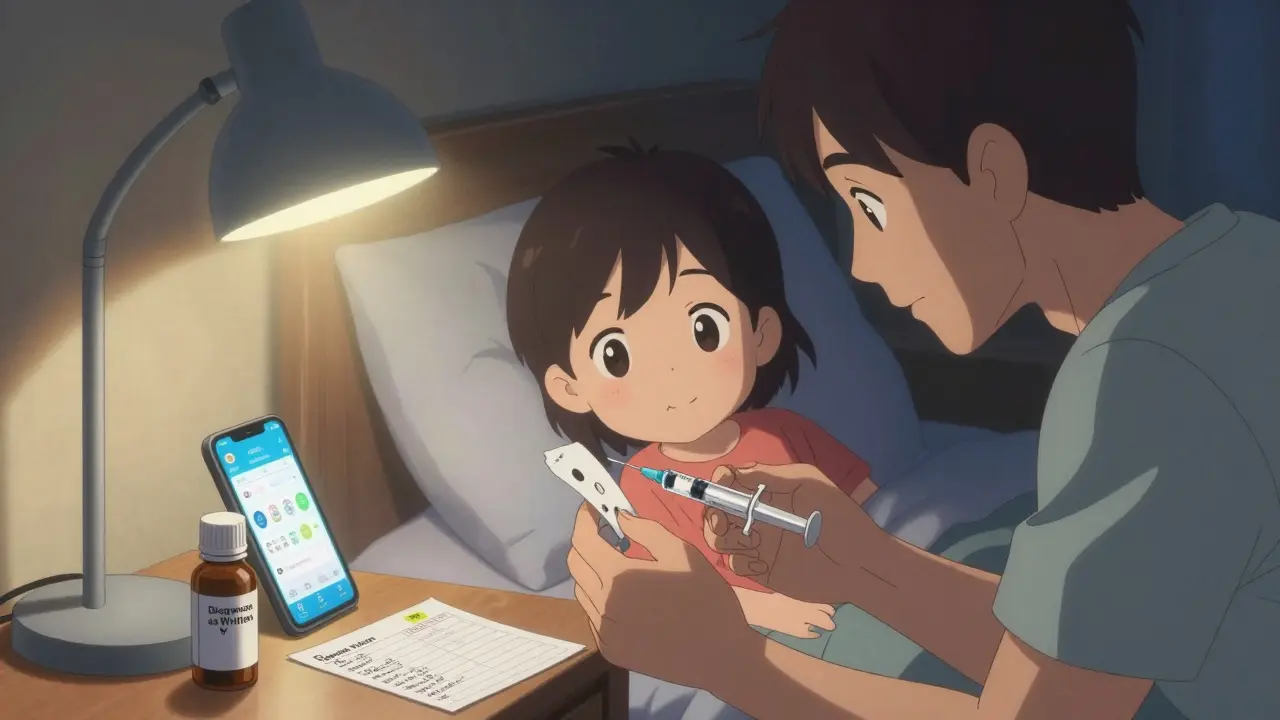
- Turn on the lights. Most dosing errors happen in dim rooms at night. Always measure under good lighting.
One mother in Perth told her story: Her 3-year-old had diarrhea after switching from brand-name loperamide to the generic. She didn’t know the generic had a different filler that irritated her child’s gut. The doctor confirmed it - the inactive ingredient wasn’t tested for toddlers.
When to Say No to Generics
There are times when you should insist on the brand name. The American Academy of Pediatrics says you can ask your doctor to write “Dispense as Written” on the prescription. This stops pharmacies from automatically substituting a generic.
This is especially important for drugs with a narrow therapeutic index - where a tiny change in dose causes big effects. Examples:
- Levothyroxine (for thyroid disorders): Even a 5% difference can affect growth and brain development.
- Phenytoin (for seizures): Too little = seizures. Too much = toxicity.
- Cyclosporine (for transplant patients): Small changes can lead to organ rejection.
If your child is on one of these, ask for the brand name. Insurance might push back - but your child’s safety comes first.
What’s Changing - and What’s Coming
There’s progress. In 2024, the FDA required all generic drug manufacturers to include pediatric dosing info when available - and by December 2025, this will be mandatory. The KIDs List is now updated every 3 months. And the AAP is rolling out a mobile app in late 2024 that will let doctors check drug safety instantly.
Artificial intelligence is also helping. Early tools can predict safe doses for generic drugs with 89% accuracy - far better than human guesswork. But until every generic drug is tested for kids, the risk remains.
Meanwhile, manufacturers are starting to make pediatric-specific formulations. A 2024 report found that 6.2% more drugs are now designed for children - not just smaller adult versions. That’s a good sign. But it’s still a small fraction of the market.
Final Thought
Generic drugs aren’t bad. They’re essential for making medicine affordable. But for kids, safety isn’t about cost - it’s about precision. A child’s body doesn’t care if a pill is $1 or $10. It only cares if the dose is right, the ingredients are safe, and the formulation matches their needs. Don’t assume. Ask. Verify. And when in doubt, stick with what’s been tested for your child’s age.
Alec Stewart Stewart
February 5, 2026 AT 09:56My niece got sick last winter and we switched to a generic cough syrup. She broke out in this weird rash the next day. We thought it was allergies until the pharmacist said, 'Hey, this one has a dye that's not approved for under-2s.' Scary stuff. Always check the fine print. 😅
Geri Rogers
February 6, 2026 AT 22:03STOP letting pharmacies swap generics for kids without asking. I'm a nurse, and I've seen kids end up in the ER because a parent didn't realize the concentration changed from 160mg/5mL to 160mg/1mL. That's a TENFOLD overdose. This isn't a 'save a few bucks' situation-it's life or death. If your doctor doesn't say 'Dispense as Written,' ASK THEM TO. No excuses. 💔
Samuel Bradway
February 7, 2026 AT 10:31My kid had a bad reaction to a generic antihistamine too. We thought it was just a coincidence until the pediatric pharmacist pulled up the KIDs List and said, 'Yep, this one's flagged.' Honestly? I didn't even know that list existed. Now I keep it bookmarked. If you're giving anything to a child under 5, just pause and Google it. Better safe than sorry.
Caleb Sutton
February 9, 2026 AT 10:23This is all a lie. The FDA and Big Pharma are hiding the truth. Generics are engineered to fail in children so they can sell more brand-name drugs. They add dangerous fillers on purpose. The KIDs List? Manufactured by pharmaceutical lobbyists. They want you scared so you'll pay $80 for a bottle of Tylenol. Wake up.
Janice Williams
February 10, 2026 AT 03:15It is, of course, entirely irresponsible to suggest that parents should not rely on generic medications, as this constitutes a form of economic discrimination against lower-income families. One cannot reasonably expect every household to afford brand-name pharmaceuticals, and to imply otherwise is not merely impractical-it is morally indefensible.
Roshan Gudhe
February 11, 2026 AT 14:49There's a deeper truth here: we treat children as miniature adults because we've lost the art of listening to their bodies. Science has reduced medicine to chemistry, but life is not a formula. A child's physiology whispers-it doesn't shout. We've forgotten how to hear it. The KIDs List is just a symptom of a system that sees bodies as data points, not souls. Maybe we need less regulation... and more reverence.
Rachel Kipps
February 12, 2026 AT 17:53i read this article and it was very eye opening. i had no idea that the concentration could be so different between brand and generic. i always just used the spoon that came with the bottle. i guess i should get a syringe. also, i think i misread the label once and gave my son too much. i hope he's okay.
Prajwal Manjunath Shanthappa
February 13, 2026 AT 09:52One must observe, with a certain degree of intellectual consternation, that the average parent-untrained, unqualified, and utterly unprepared-now wields the power to administer life-altering pharmaceuticals based on... what? A Facebook post? A pharmacy clerk’s recommendation? This is not healthcare-it is Russian roulette with a syringe. The fact that this is even a conversation is a cultural tragedy.
Wendy Lamb
February 14, 2026 AT 09:40My daughter had a bad reaction to a generic teething gel. We switched back to the brand and it cleared up in hours. I didn’t even think to check the ingredients. Lesson learned. Always ask about inactive stuff. Simple as that.
Katherine Urbahn
February 15, 2026 AT 11:54It is not merely irresponsible-it is negligent-to permit the substitution of generic medications for pediatric patients without explicit, written consent from a licensed physician. The FDA’s lax oversight, combined with insurance-driven formularies, has created a public health crisis that is both preventable and unforgivable. Parents are not pharmacists. Yet we treat them as if they are.
Joseph Cooksey
February 16, 2026 AT 02:24You know, I used to think generics were just fine-until my nephew got hospitalized after a 'routine' dose of generic acetaminophen. The bottle said 160 mg per 5 mL, but the label was faded, and the pharmacy had swapped it for a different batch that was actually 325 mg per 5 mL. The kid spent three days in ICU. His mom cried for a week. And the pharmacist? He shrugged and said, 'It's the same active ingredient.' Same active ingredient? Are you kidding me? It's like saying a Ferrari and a go-kart are the same because they both have wheels. The whole system is broken. We're not talking about a few extra dollars here-we're talking about children's lives. And yet, no one's holding anyone accountable. No lawsuits. No headlines. Just another quiet tragedy in a country that treats medicine like a commodity. I'm not mad. I'm just... heartbroken.