

When a generic drug hits the market, you expect it to work just like the brand-name version. But how do regulators know it does? Traditional measures like partial AUC and Cmax used to be enough. Today, they’re often not. For complex drugs-especially extended-release pain meds, antidepressants, or heart medications-what matters isn’t just how much drug gets into your blood, but when it gets there. That’s where partial AUC comes in.
Why Traditional Bioequivalence Metrics Fall Short
For decades, bioequivalence was judged using two numbers: the maximum concentration of drug in the blood (Cmax) and the total exposure over time (AUC). These worked fine for simple, fast-acting pills. But they blind spots when it comes to drugs designed to release slowly over hours. Take an extended-release opioid. If the generic version releases its drug too slowly at first, the patient might not get enough pain relief early on. If it releases too fast, it could raise abuse risk. Cmax and total AUC might look identical between the brand and generic-but the shape of the curve underneath? Totally different. That’s the gap partial AUC was built to fill. The European Medicines Agency (EMA) first flagged this in 2013, pointing out that 20% of generics passed old tests but failed to match the real-world absorption pattern. By 2018, the U.S. FDA had caught up. Now, for over 127 specific drugs, partial AUC isn’t optional-it’s required.What Is Partial AUC, Really?
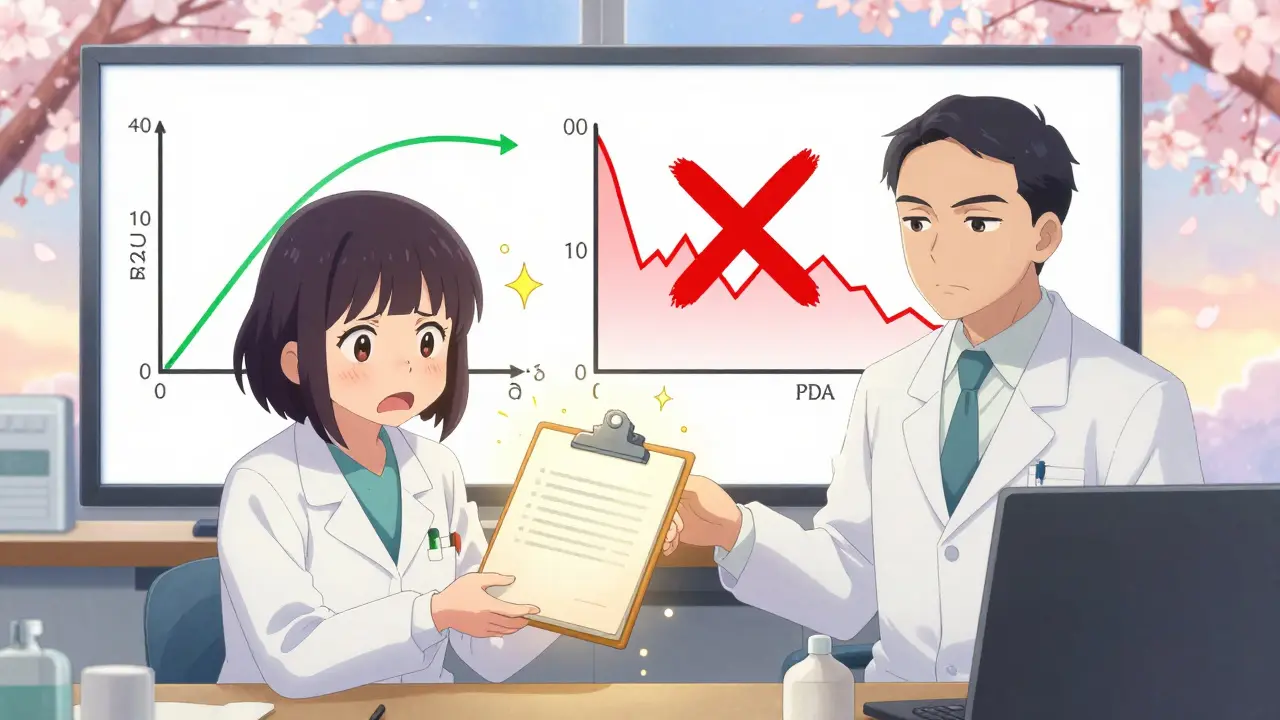
Partial AUC, or pAUC, measures drug exposure only during a specific window of time-not the whole curve. Think of it like zooming in on a graph. Instead of looking at the entire area under the curve from hour 0 to 72, you focus on, say, hours 0 to 4, where absorption happens. The FDA says this window should be tied to something clinically meaningful. For example:- The time when drug levels first exceed 50% of the peak concentration (Cmax)
- The time around when the reference drug hits its peak (Tmax)
- A fixed interval like 0-2 hours for drugs needing rapid onset
How Is Partial AUC Calculated?
It’s not just cutting the curve. The math has to be precise. The FDA recommends using the natural logarithm of the partial AUC values, then comparing them using ANOVA-same as with Cmax and total AUC. The bioequivalence range is still 80-125%, but now it applies only to that narrow time window. There are three common ways to define the time interval:- Concentration-based: Include all data points where concentration is above a threshold (like 50% of Cmax).
- Tmax-based: Use the average time to peak from the reference product as the cutoff.
- Fixed time: Use a standard window like 0-1 hour or 0-3 hours, especially for abuse-deterrent formulations.

Why This Matters for Generic Drug Developers
Implementing pAUC isn’t just a regulatory checkbox. It’s a game-changer for R&D costs and timelines. A senior biostatistician at Teva reported that switching to pAUC for an extended-release opioid generic increased their study size from 36 to 50 subjects. That added $350,000 to development costs. But it also prevented a clinical failure-something that could’ve led to recalls or lawsuits later. The problem? pAUC is more variable. Because you’re zooming in on a smaller part of the curve, noise matters more. That means you need bigger studies, better sampling, and more sophisticated modeling tools like Phoenix WinNonlin or NONMEM. A 2022 survey found 63% of companies needed extra statistical help for pAUC-compared to just 22% for traditional metrics. And it’s not just the math. The FDA’s product-specific guidances vary wildly. Only 42% clearly define how to pick the time window. One company might use 0-2 hours; another, 0-Tmax. That inconsistency has caused 17 rejections in FDA inspections in 2022 alone-8.5% of all bioequivalence deficiencies that year.Where Is Partial AUC Used Today?
Not every drug needs it. But for certain categories, it’s become standard:- Central nervous system drugs: 68% of new submissions use pAUC (antidepressants, antiepileptics, ADHD meds)
- Pain management: 62% (especially opioids with abuse-deterrent features)
- Cardiovascular agents: 45% (beta-blockers, extended-release nitrates)
Expert Opinions: Science vs. Reality
Dr. Bingming Wang, head of the FDA’s Division of Bioequivalence, says: “For some products, Cmax and AUC just don’t tell the whole story.” He points to abuse-deterrent opioids-where early exposure must match the brand to prevent crushing or snorting. pAUC is the only metric that can catch a generic that releases too quickly in the first hour. But it’s not all praise. Dr. Donald Mager from the University at Buffalo warns that pAUC’s variability can force sample sizes up by 25-40%. That’s expensive, especially for small companies. And with inconsistent guidelines across regions (FDA vs. EMA vs. Health Canada), global development timelines can stretch by 12-18 months. Still, the consensus is clear: when the drug’s absorption pattern matters to safety or effectiveness, partial AUC isn’t a luxury-it’s a necessity.What You Need to Get Started
If you’re working in generic drug development or regulatory affairs, here’s how to approach pAUC:- Check the product-specific guidance. Every drug with a pAUC requirement has a published FDA document. Don’t guess-follow the exact time window.
- Use pilot data. Run small studies to find the reference product’s average Tmax. Use that to define your window.
- Partner with a biostatistician. pAUC analysis isn’t something you can do in Excel. You need software trained in pharmacokinetic modeling.
- Plan for bigger studies. Assume you’ll need 20-40% more subjects than you’d need for standard bioequivalence.
- Document everything. The FDA is watching. If your time window isn’t justified by clinical relevance, your submission will be rejected.
The Future of Bioequivalence
The FDA is now testing machine learning tools to automatically pick the best pAUC window based on reference drug data. That could reduce ambiguity and speed up approvals. Meanwhile, the International Consortium for Innovation and Quality is pushing for global harmonization-so one pAUC window isn’t accepted in the U.S. but rejected in Europe. The bottom line? Bioequivalence is no longer just about total exposure. It’s about timing. And partial AUC is the tool that finally lets regulators see the full picture.What is partial AUC in bioequivalence studies?
Partial AUC (pAUC) measures drug exposure only during a specific, clinically relevant time window-like the first 2 hours after dosing-rather than the entire concentration-time curve. It’s used when the rate of drug absorption matters more than total exposure, especially for extended-release or abuse-deterrent formulations.
Why is partial AUC better than total AUC for some drugs?
Total AUC tells you how much drug entered the bloodstream over time, but not when. For drugs like extended-release opioids or ADHD medications, early absorption affects safety and effectiveness. pAUC focuses on that critical window, catching differences in absorption rate that total AUC misses.
How do regulators decide the time window for partial AUC?
The FDA and EMA require the time window to be tied to a clinically relevant pharmacodynamic effect-like the time when pain relief starts or when abuse potential peaks. Common methods include using the reference product’s Tmax, a fixed interval (e.g., 0-2 hours), or a concentration threshold (e.g., above 50% of Cmax).
Do all generic drugs need partial AUC testing?
No. Only specific drugs with complex release profiles require it-currently over 127 products listed in FDA product-specific guidances. These include extended-release opioids, CNS drugs, and cardiovascular agents. Most immediate-release generics still use standard Cmax and AUC.
Why is partial AUC more expensive to test?
pAUC is more variable because it focuses on a smaller part of the curve. To get reliable results, studies often need 20-40% more participants. This increases costs and requires advanced statistical tools and expertise, which many smaller companies outsource.
What software is used to calculate partial AUC?
Industry-standard tools include Phoenix WinNonlin, NONMEM, and R packages like PKPDsim. These handle nonlinear mixed-effects modeling and can log-transform data, calculate confidence intervals, and apply the Bailer-Satterthwaite-Fieller method for statistical analysis.
Can partial AUC prevent unsafe generics from reaching the market?
Yes. A 2021 AAPS case study showed pAUC detected a 22% difference in early exposure between a test and reference product-something traditional metrics missed. That difference could have led to underdosing or overdose risks. pAUC acted as a safety net, blocking a potentially unsafe generic from approval.
Is partial AUC used outside the U.S.?
Yes. The European Medicines Agency (EMA) began recommending pAUC in 2013 and now applies it to 27 specific product categories, especially modified-release formulations. Health Canada and other agencies are also adopting it, though guidelines vary, creating challenges for global drug development.
Diana Dougan
January 31, 2026 AT 08:46so like... we're spending $350k more per drug just to make sure some generic doesn't release too fast? lol. next they'll be measuring the exact shade of blue in the pill. i mean, if it works, why care if it's slow or fast? people aren't robots. also, typo: 'abuse-deterrent' is spelled wrong in the post. again.
Holly Robin
February 2, 2026 AT 06:52THIS IS A BIG PHARMA CONSPIRACY. THEY WANT YOU TO THINK THE GENERIC IS 'SAFE' BUT THEY'RE HIDING THE FACT THAT pAUC IS JUST ANOTHER WAY TO MAKE SMALL COMPANIES GO BANKRUPT SO ONLY BIG PHARMA CAN PLAY. 63% OF COMPANIES NEED STATISTICAL HELP? THAT'S BECAUSE THEY MADE THE RULES TOO COMPLEX ON PURPOSE. THEY WANT YOU TO PAY MORE. AND DON'T TELL ME IT'S FOR 'SAFETY' - if it was really about safety, why did the FDA approve 127 drugs without it for 20 years? Coincidence? I think not.
KATHRYN JOHNSON
February 2, 2026 AT 08:49The regulatory framework must be standardized. Inconsistent application across jurisdictions undermines public trust. The FDA’s lack of clear guidelines for time window selection is unacceptable. This is not innovation - it is regulatory negligence.
Sazzy De
February 3, 2026 AT 01:37interesting read. i never thought about how timing matters more than total amount. kinda makes sense though - like how a slow drip of coffee is better than chugging it all at once. still, seems like a lot of work for pills. but hey, if it keeps people safe, cool.
Beth Beltway
February 4, 2026 AT 03:18Let’s be real. This isn’t about safety. It’s about control. The FDA doesn’t want generics to be too easy to approve. They want to protect Big Pharma’s profits under the guise of 'clinical relevance.' You think they care about patients? No. They care about liability. And now they’re forcing small labs to hire expensive statisticians just to play their game. This is regulatory capture in action.
Marc Bains
February 5, 2026 AT 20:30As someone who’s worked in generics in India and the US, I’ve seen this shift up close. The pAUC thing? It’s not perfect, but it’s necessary. In India, we used to skip the early window because ‘it’s close enough.’ Then patients started having breakthrough pain or seizures. Now we test it right. It’s expensive, yeah. But saving one person from an overdose? Worth every dollar. Also - global harmonization is long overdue. Why does Europe use 0-3h and the US uses 0-Tmax? It’s madness.
Adarsh Uttral
February 7, 2026 AT 11:49bro this is wild. i read this and thought 'wait, so the pill's timing matters more than how much is in the blood?' like, imagine if your wifi speed was fine but the first packet took 10 mins to load. you'd be mad right? same thing. also, i think they should just use AI to pick the window. why make humans do math?
April Allen
February 7, 2026 AT 13:32Partial AUC is fundamentally a pharmacodynamic bridge - it operationalizes the temporal dimension of exposure-response relationships that total AUC obscures. The 80–125% CI applied to a clinically anchored interval (e.g., 0–Tmax) reduces Type II error in detecting bioinequivalence for modified-release formulations. The increased variability stems from reduced degrees of freedom in the exposure window, necessitating larger N to maintain power. This isn't regulatory overreach - it's precision medicine applied to generic development.
Shawn Peck
February 9, 2026 AT 09:29So you're telling me we need a whole new test just to make sure a pill doesn't explode in your stomach? That's ridiculous. Just make the damn thing work. If it's cheaper and does the job, let people buy it. Stop overcomplicating everything.