

When a panic attack hits, you don’t need to wait for it to pass - you can act.
It starts with a racing heart, tight chest, or sudden dizziness. Your mind screams that something’s wrong, maybe even that you’re dying. But here’s the truth: you’re having a panic attack, not a heart attack. And it will end. In fact, with the right tools, you can shorten it, reduce its power, and even prevent the next one.
Most people think panic attacks come out of nowhere. But they don’t. They’re the body’s alarm system going off for no real danger. The good news? You can retrain that alarm. A solid panic attack action plan combines three proven strategies: breathing to calm your body, grounding to pull your mind back to reality, and medication - when needed - to give you breathing room to heal.
How breathing stops the panic spiral
When panic hits, your breathing gets shallow and fast. That’s not just a symptom - it’s the fuel. Hyperventilating drops carbon dioxide in your blood, which tricks your brain into thinking you’re suffocating. That makes your heart race harder, your fingers tingle, and your chest tighten even more. It’s a loop.
Breaking that loop starts with slowing your breath. Not just a few deep breaths - you need rhythm. The 2-2-6 method works because it’s simple and precise: inhale through your nose for 2 seconds, hold for 2 seconds, then exhale slowly through your nose for 6 seconds. Pause for a second, then repeat. No need to force it. Just let the exhale be longer than the inhale.
Why does this matter? A 2021 study in the Journal of Anxiety Disorders found that people who practiced this daily for eight weeks cut their panic attacks by nearly half. It’s not magic. It’s biology. Your nervous system responds to breath. Slow breaths tell your body: “We’re safe.”
Try this: Set a daily alarm for 5 minutes, twice a day. Even if you’re not panicking. Practice the 2-2-6 rhythm. Do it while brushing your teeth, waiting for coffee, or sitting in traffic. When panic strikes, you won’t have to think - your body will remember.
Grounding: Bringing yourself back to the room
During a panic attack, your mind gets stuck in a loop of worst-case scenarios. “I’m going to faint.” “I’m losing control.” “Something terrible is happening.” These thoughts aren’t facts - they’re panic’s lies. Grounding techniques help you break free by anchoring your attention to the real world.
One of the most effective methods is the 5-4-3-2-1 technique. It’s not complicated: Name 5 things you can see, 4 things you can touch, 3 things you can hear, 2 things you can smell, and 1 thing you can taste. If you’re in a quiet room, focus on the texture of your shirt, the hum of the fridge, the taste of toothpaste still in your mouth. It doesn’t matter what you pick - the point is to shift focus from inside your head to outside your body.
Another powerful tool? Repeating a simple, true phrase. “I’m safe.” “This will pass.” “I’ve felt this before and I’m okay.” Write it on a card. Save it in your phone. Say it out loud. A 2022 survey by Mental Health America found that people who used personalized grounding statements saw their panic attacks shrink from an average of 22 minutes to just 14.
And here’s a quiet trick: Close your eyes. Sounds counterintuitive, right? But reducing visual input cuts sensory overload. Research from the Anxiety and Depression Association of America shows this alone can reduce symptoms by 32% within 90 seconds.

Medication: A tool, not a crutch
Medication isn’t for everyone - but for some, it’s the bridge that makes recovery possible.
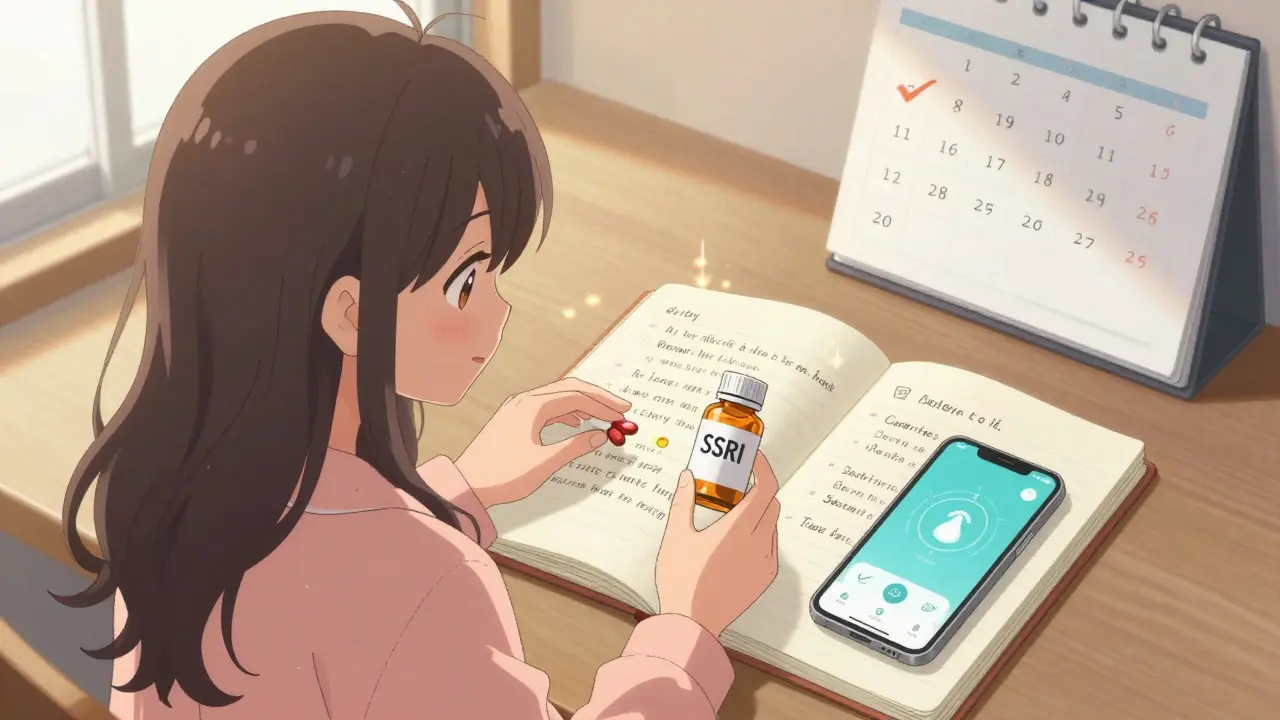
First-line options are SSRIs like sertraline (Zoloft) or paroxetine (Paxil). These aren’t fast-acting. They take 8 to 12 weeks to build up in your system. But when they do, they reduce panic frequency by 60-70%. They work by balancing serotonin, the brain chemical tied to mood and fear responses.
Then there are benzodiazepines - like alprazolam (Xanax) or clonazepam (Klonopin). These work fast: 15 to 30 minutes to calm a full-blown attack. But they come with serious risks. The FDA reports that 23% of daily users develop tolerance within 4-6 weeks. Dependence is real. That’s why doctors recommend them only for emergencies - never as your daily go-to.
Here’s what the data says: People who combine medication with breathing and grounding techniques have a 68% chance of long-term remission. Those who rely on medication alone? Only 42%. Medication helps you survive the storm. Breathing and grounding help you learn how to stop the storm from coming.
If you’re considering medication, talk to your doctor about your attack frequency. If you’re having more than two panic attacks a week, daily medication might be worth exploring. If they’re rare, focus on behavioral tools first. The American Psychiatric Association now recommends breathing-focused CBT before medication for uncomplicated cases.
Why practice matters - even when you’re fine
Most people only try breathing or grounding when they’re in the middle of a panic attack. That’s like trying to learn to swim while drowning.
Neuroscience shows that skills need rehearsal. Every time you practice slow breathing while calm, you strengthen the neural pathways your brain uses during panic. It’s like building a highway. The more you drive it, the faster your brain can take that route when things get scary.
Harvard Health found that 89% of patients who practiced 5 minutes of daily breathing for four weeks - then increased to 15 - saw clear improvement. Those who skipped practice? No change.
Start small. Five minutes a day. Use a free app like the one from UC San Francisco called “Panic Relief.” It has guided breathing and grounding prompts. Or just set a timer. Do it in the morning. Do it before bed. Make it as routine as brushing your teeth.
What doesn’t work - and what to avoid
Some techniques you hear about sound helpful but aren’t backed by science. Holding your breath to “control” panic? That can make hyperventilation worse. Drinking caffeine to “shake off” anxiety? It’s fuel for the fire. Trying to fight the panic with logic - “I know this isn’t real” - often backfires because panic doesn’t care about facts.
Also, don’t wait until you’re overwhelmed to build your plan. Create it now. Write down your breathing method. Save your grounding phrases. List your doctor’s contact info. Keep it on your phone. Put a copy in your wallet. Some people tie a rubber band around their wrist and snap it gently when panic starts - it’s a physical cue to stop the spiral and start breathing.
And don’t shame yourself if you need medication. There’s no weakness in using tools. It’s like wearing glasses for blurry vision. You’re not broken - you’re adapting.
Real people, real results
On Reddit’s r/anxiety, 78% of over 1,200 respondents said daily breathing practice was the most helpful thing they did - even if they only did it for five minutes. The 4-7-8 method (inhale 4, hold 7, exhale 8) is popular there, even though it’s not in clinical guidelines. If it works for you, use it.
One woman in Perth told her therapist she’d been having panic attacks every few days. She started the 2-2-6 breathing every morning while sitting on her balcony with her coffee. After three weeks, they dropped to once a week. After two months? None. She still does the breathing - not because she’s scared, but because it feels like self-care.
Your action plan - start today
Here’s what to do right now:
- Choose one breathing method: 2-2-6 or 4-7-8. Practice it for 5 minutes today.
- Write down three grounding phrases that feel true to you. Save them on your phone.
- If you’ve had more than two panic attacks a week in the past month, schedule a talk with your doctor about medication options.
- Download a free guided breathing app. Use it once a day for the next week.
You don’t need to fix everything at once. Just start with one step. Do it tomorrow. Then the next day. Progress isn’t about perfection - it’s about consistency.
When to get help
If panic attacks are stopping you from leaving the house, going to work, or being around people, you’re not alone - and you’re not weak. Panic disorder is treatable. The American Psychological Association gives CBT-based action plans the highest recommendation possible. And 70-80% of people who stick with it see major improvement.
Reach out to your GP, a psychologist, or a service like Beyond Blue (Australia) or the Anxiety and Depression Association of America. You don’t have to do this alone. Support exists. Help is waiting.
Can you stop a panic attack in 10 seconds?
You can’t always stop a panic attack in 10 seconds - but you can significantly reduce its intensity. Using a grounding technique like 5-4-3-2-1 or slowing your breath with the 2-2-6 method can cut symptoms by 30-50% within a minute. The goal isn’t instant silence - it’s regaining control. With practice, attacks become shorter and less frightening.
Do breathing techniques really work for panic attacks?
Yes - and the science backs it. A 2021 study showed that daily practice of slow breathing for eight weeks reduced panic attack frequency by 47%. These techniques work by reversing hyperventilation, which triggers many panic symptoms. They’re not a quick fix, but they’re one of the most reliable tools you have.
Is medication necessary for panic attacks?
Not always. For mild or infrequent attacks, breathing and grounding alone can be enough. But if you’re having more than two attacks a week, or if panic is stopping you from living your life, medication can be a crucial part of recovery. SSRIs are often recommended first. Benzodiazepines are for emergencies only due to dependency risks.
Can you use grounding techniques if you’re in public?
Absolutely. Grounding doesn’t require privacy. You can name objects you see, feel the texture of your phone or jacket, listen to background sounds, or silently recite a grounding phrase. No one will notice. These techniques are designed to be discreet and effective anywhere - on a bus, in a meeting, at a grocery store.
How long does it take to see results from a panic attack action plan?
Most people notice small improvements within 2-3 weeks of daily practice - like shorter attacks or feeling less scared between episodes. But full control usually takes 8-12 weeks. The key is consistency. Think of it like learning to ride a bike. You don’t master it in one try - you get better with each attempt.