
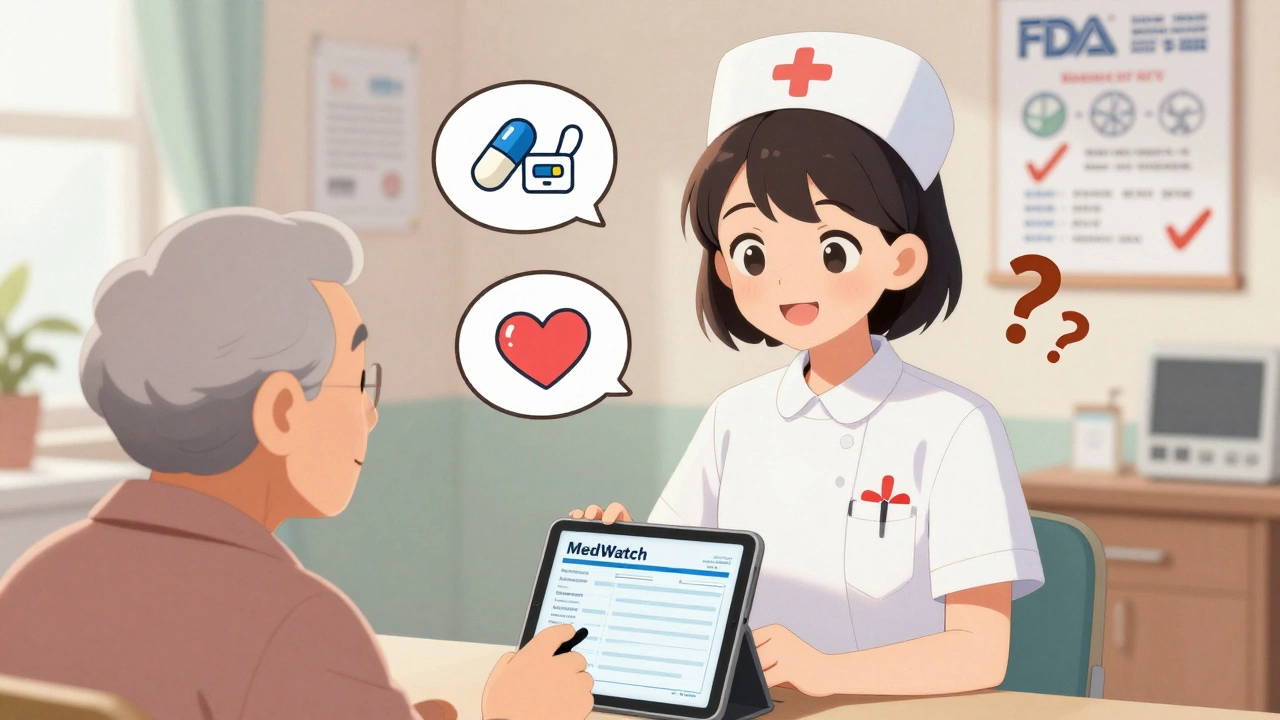
The U.S. Food and Drug Administration doesn’t just approve drugs and medical devices - it keeps watching them after they’re on the market. That’s where MedWatch comes in. It’s not a flashy program, but it’s one of the most important safety nets in American healthcare. Every year, over a million reports of problems with medicines, vaccines, implants, and even cosmetics flow into MedWatch. Some of these reports lead to label changes, recalls, or even product withdrawals. Others fade into the database, unnoticed. But without this system, we’d be flying blind when things go wrong.
What Exactly Is MedWatch?
MedWatch, officially called the FDA Safety Information and Adverse Event Reporting Program, started in 1993. It’s not a single tool - it’s a whole system built to catch problems that clinical trials miss. Trials involve thousands of people over months or a few years. Real life? Millions of people use the same drug for decades. Different ages, other medications, underlying conditions - all of that can trigger side effects no one saw coming. The FDA uses MedWatch to collect reports of anything bad that happens after a product is sold. That includes serious side effects like liver failure from a painkiller, a pacemaker malfunction, a skin rash from a new cream, or even a nurse giving the wrong dose because the label was unclear. It doesn’t matter if the problem seems rare or if it’s unclear whether the product caused it. If it’s serious, it goes in. MedWatch isn’t just a trash can for complaints. It’s a signal detector. The FDA uses software to scan millions of reports looking for patterns - like if five different people report sudden heart rhythm issues after taking the same new diabetes drug. That’s a red flag. That’s when the FDA digs deeper, contacts manufacturers, reviews clinical data, and sometimes issues a warning to doctors and patients.Who Reports to MedWatch?
There are two types of reporters: those who have to, and those who can. Manufacturers, importers, and hospitals that use medical devices are legally required to report serious problems. If a patient dies or is seriously injured because of a device like a hip implant or insulin pump, the company has 30 days to file a report. If it’s a life-threatening situation, they have just five workdays. These mandatory reports go into a separate database called MAUDE, but they feed into the same overall safety picture. The other half? Anyone. Doctors, nurses, pharmacists, patients, and family members can all file a report using Form FDA 3500. In fact, nearly half of all reports in 2022 came from regular people - not professionals. That’s huge. It means the public isn’t just passive users of medicine; they’re active watchdogs. One nurse in Texas reported a pattern of severe dizziness in elderly patients after switching to a new blood pressure pill. The FDA reviewed 17 similar reports and updated the warning label within six months. That’s MedWatch working as it should.How Do You File a Report?
Filing a report is free and open to everyone. You can do it online at www.fda.gov/medwatch, by fax, mail, or phone. The online form is the easiest. It walks you through a few simple steps:- What product was involved? (Name, brand, NDC code for drugs, model number for devices)
- What happened? Describe the problem clearly - not just "felt sick," but "severe vomiting started 2 hours after taking pill, lasted 18 hours, required ER visit."
- When did it start? Be specific: "Day 3 of taking medication."
- What happened after? Did the person recover? Was treatment needed? Did they stop the product?
- Any other meds they were taking? Drug interactions are a big part of safety.
- Patient’s age, sex, and relevant medical history (if known).
What Happens After You Submit?
Your report doesn’t disappear. It goes into the FDA Adverse Event Reporting System (FAERS), which holds over 28 million reports. The system uses algorithms to spot unusual clusters. One common tool looks for the Proportional Reporting Ratio - basically, if a side effect shows up way more often with Drug A than with other similar drugs, it gets flagged. A team of about 120 FDA scientists and analysts reviews these signals. They don’t act on every one. Most turn out to be random noise. But when a pattern holds up - like a spike in liver damage linked to a specific cholesterol drug - the FDA investigates further. They might request new studies from the manufacturer, re-analyze existing data, or consult outside experts. If they confirm a risk, they act. That could mean:- Adding a black box warning to the label
- Restricting who can use the drug
- Requiring a Risk Evaluation and Mitigation Strategy (REMS)
- Issuing a public safety alert
- Or, in rare cases, pulling the product off the market

Why Isn’t MedWatch Perfect?
Let’s be honest: MedWatch is underpowered. Studies estimate that only 1% to 10% of actual adverse events are ever reported. Most people don’t know about MedWatch. Others think their symptom is too minor. Some doctors don’t have time. A 2021 study found that filling out a report takes an average of 15 to 20 minutes - and most clinicians are already swamped. Even worse, many reports are incomplete. A ProPublica investigation found that 17% of submitted reports lacked basic info needed to evaluate them. No age? No timeline? No outcome? That’s not useful. It’s like sending a police report that says "something bad happened." And while the system is great at catching dramatic, sudden dangers, it struggles with slow-burn problems - like weight gain from a psychiatric drug or chronic fatigue from a supplement. Those don’t make headlines. They don’t trigger alarms. But they affect millions. The FDA admits it’s overwhelmed. With 1.2 million reports a year and only 120 analysts, they can’t dig into every lead. That’s why new tools are coming. In 2023, they launched MedWatch Direct - a way for electronic health records (like Epic and Cerner) to automatically send reports. By 2024, they plan to use AI to pull safety info directly from doctors’ notes. That could double the number of useful reports.How Does MedWatch Compare to Other Countries?
The U.S. isn’t alone. Europe has EudraVigilance. Canada has Canada Vigilance. The UK has the Yellow Card system. All serve the same purpose: post-market safety tracking. But MedWatch is unique in two ways. First, it’s open to the public. In most other countries, only healthcare professionals can report. Second, it’s also a communication tool. The FDA doesn’t just collect data - it actively pushes out safety alerts via email, social media, and its website. That’s rare. Still, MedWatch gets more reports than most. Why? Because the U.S. has the biggest pharmaceutical market and the most diverse patient population. More users = more chances to spot rare side effects.What Should You Do?
If you’re a patient and something feels off after starting a new medicine or using a device - don’t ignore it. Talk to your doctor. And then, consider filing a report. You don’t need permission. You don’t need to prove causality. Just report what happened. If you’re a healthcare provider, make reporting part of your routine. Don’t wait for a big incident. Report even small, unusual events. That’s how patterns are found. The FDA can’t protect you if they don’t know what’s happening. MedWatch is the eyes and ears of the system. And right now, it’s mostly powered by regular people who care enough to speak up.
Future of MedWatch
The future is digital. By 2025, the FDA plans to use blockchain to verify report authenticity and AI to cut analysis time from weeks to hours. They’re also pushing for better data standards - so reports from hospitals, pharmacies, and patients all talk the same language. Funding increased to $47.8 million in 2024, up 12% from the year before. That’s a good sign. But experts warn: technology won’t fix underreporting. Only culture will. The goal isn’t to collect more reports - it’s to collect better ones. And that means making it easier, faster, and less intimidating for everyone to participate.Key Takeaways
- MedWatch is the FDA’s main system for tracking side effects and safety problems with drugs, devices, and other products after they’re on the market.
- Anyone - patients, doctors, pharmacists - can report problems for free through the MedWatch website.
- Manufacturers and hospitals must report serious events by law; the public reports voluntarily.
- Over 1.2 million reports are filed each year, with 78% involving drugs and 15% involving devices.
- Only 1-10% of actual adverse events are reported, making underreporting the system’s biggest weakness.
- Reports with clear details (what happened, when, outcome) are most useful. Vague reports are ignored.
- MedWatch has led to label changes, warnings, and recalls - including high-profile cases like breast implants and blood thinners.
- New tools like AI and EHR integration aim to boost reporting rates and speed up analysis.
Is MedWatch only for prescription drugs?
No. MedWatch accepts reports for prescription drugs, over-the-counter medicines, vaccines, biologics, medical devices (like pacemakers or insulin pumps), cosmetics, dietary supplements, and even cannabinoid products. If it’s regulated by the FDA and something went wrong, it can be reported.
Do I need to prove the product caused the problem to report it?
No. You only need to report a serious problem that occurred after using the product. The FDA’s job is to figure out if there’s a link. Your report helps them see patterns - even if you’re not sure what caused it.
How long does it take for a MedWatch report to lead to action?
It varies. For urgent, life-threatening issues - like a sudden spike in heart attacks linked to a new drug - the FDA can act within weeks. For slower, less obvious patterns, it can take months or even years. Most reports don’t lead to immediate action, but they build the evidence base over time.
Can I report a problem with a medical device I bought online?
Yes. Whether you bought a device from a hospital, pharmacy, or Amazon, if it’s regulated by the FDA and caused a serious problem, you can and should report it. The source doesn’t matter - only the product and the outcome.
Are MedWatch reports anonymous?
You can choose to remain anonymous when filing a report. The FDA does not require your name, but providing contact info can help them follow up for more details if needed. Your information is protected under privacy laws and not shared publicly.
What if I don’t know the exact name of the drug or device?
If you don’t know the exact name, provide as much detail as possible: color, shape, markings on the pill, brand name, packaging, or where you bought it. Even a photo can help. The FDA has databases to match descriptions to products. Don’t let uncertainty stop you from reporting.
Is MedWatch the same as the MAUDE database?
No. MAUDE (Manufacturer and User Facility Device Experience) is a public database that contains only mandatory reports about medical devices - mostly from manufacturers and hospitals. MedWatch is the broader program that includes voluntary reports from the public and covers all FDA-regulated products, not just devices. MAUDE is one part of the MedWatch system.
Genesis Rubi
December 2, 2025 AT 14:35Doug Hawk
December 3, 2025 AT 13:46John Morrow
December 4, 2025 AT 10:24Kristen Yates
December 5, 2025 AT 19:14Saurabh Tiwari
December 6, 2025 AT 06:06Michael Campbell
December 6, 2025 AT 13:02Victoria Graci
December 7, 2025 AT 05:23Saravanan Sathyanandha
December 8, 2025 AT 17:35alaa ismail
December 8, 2025 AT 23:47Chelsea Moore
December 10, 2025 AT 22:04John Biesecker
December 12, 2025 AT 11:23ruiqing Jane
December 12, 2025 AT 22:29