

When you're breastfeeding, every pill, drop, or injection feels like a decision that could affect your baby. You want to feel better - whether it's from a headache, an infection, or postpartum anxiety - but you also don't want to risk your baby's health. The truth? Most medications are safe to take while breastfeeding. Yet, many mothers stop nursing because they're told to avoid something that’s actually low-risk. This isn’t about fear. It’s about knowing what’s backed by real data.
Most Medications Pass Into Breast Milk - But That Doesn’t Mean They’re Harmful
It’s true: almost all medications enter breast milk to some degree. But the amount your baby gets is usually tiny. The key metric doctors use is the Relative Infant Dose (RID) - how much of the drug your baby absorbs compared to your dose. If the RID is under 10%, it’s generally considered safe. Most common drugs fall well below that. For example, when you take 500 mg of acetaminophen, your baby gets about 0.1 to 0.2 mg through breast milk. That’s less than what you’d give a newborn as a fever reducer. Ibuprofen? Same story. Both are first-line choices because they’re not just safe - they’re already used directly in infants. The real danger isn’t the medication itself. It’s the myth that you must choose between your health and your baby’s. The CDC estimates that 10-15% of mothers stop breastfeeding unnecessarily because they were given outdated or incorrect advice. You don’t need to suffer in silence. You just need the right information.Pain Relief: What’s Safe and What to Avoid
Headaches, sore muscles, or recovery from delivery - pain is common after birth. Here’s what works:- Acetaminophen (Tylenol): RID of 0.04-0.23%. No known side effects in infants. Safe for daily use.
- Ibuprofen (Advil, Motrin): RID of 0.38-1.85%. Also safe for babies. Preferred over acetaminophen if you have inflammation.
- Naproxen (Aleve): Avoid long-term use. Its half-life is 12-17 hours, and there are rare reports of infant bleeding or anemia.
- Opioids: Codeine is risky - some mothers metabolize it too quickly, turning it into dangerous levels of morphine. Morphine and hydromorphone are safer if used for short periods at the lowest dose. Always watch your baby for unusual sleepiness or trouble feeding.
Antibiotics: Clear Choices for Infections
If you have a breast infection, UTI, or wound infection, you need antibiotics. But not all are equal.- Safest: Penicillins (amoxicillin), cephalosporins, vancomycin. All have RID under 2%, with zero documented harm in babies.
- Safe: Macrolides like azithromycin (RID 0.05-0.1%) and fluoroquinolones like ciprofloxacin (RID 0.5-1.0%). Even though animal studies raised concerns about cartilage, no cases of harm have been seen in breastfed infants.
- Use with caution: Doxycycline is okay for up to 21 days. Tetracycline can stain developing teeth - but only with long-term use. No cases have been reported in breastfed babies, but it’s still best to limit it.
- Watch out: Clindamycin can cause diarrhea in babies. If your infant develops loose, green stools, talk to your pediatrician.

Antidepressants and Anxiety Meds: You’re Not Alone
Postpartum depression and anxiety affect 1 in 7 new mothers. Medication can be life-changing - and safe.- Sertraline (Zoloft): The most studied SSRI. RID of 1.7-7.0%. Infant blood levels are often undetectable. First choice for most clinicians.
- Paroxetine (Paxil): RID 1.2-10.0%. Also well-studied. May be better for sleep issues.
- Fluoxetine (Prozac): Avoid if possible. Half-life is 4-6 days. Can build up in baby’s system. Linked to irritability and poor feeding in 2% of cases.
- Lorazepam (Ativan): Best benzodiazepine for breastfeeding. Short half-life (10-20 hours). Low RID. Use only as needed.
- Clonazepam (Klonopin): Avoid long-term. Half-life 30-40 hours. Can cause drowsiness or poor weight gain in babies.
- Quetiapine (Seroquel): Used for bipolar or severe anxiety. Milk levels are under 1% of maternal dose. Long-term studies show normal infant development.
Allergy and Cold Medicines: Don’t Let Sinuses Kill Your Supply
Allergies and colds are common. But some “safe” meds can wreck your milk supply.- Best choices: Nasal sprays like fluticasone (Flonase) and budesonide (Rhinocort). Less than 1% absorbed into blood. No trace in milk.
- Second-gen antihistamines: Loratadine (Claritin), cetirizine (Zyrtec), fexofenadine (Allegra). All have RID under 0.5%. No drowsiness in babies.
- Avoid: Diphenhydramine (Benadryl). RID 1-2%. Causes drowsiness in babies. Also reduces milk supply.
- Big red flag: Pseudoephedrine (Sudafed). Reduces milk supply by 24% on average. One study found 10-15% of mothers lost enough milk to stop breastfeeding. Use saline sprays instead.
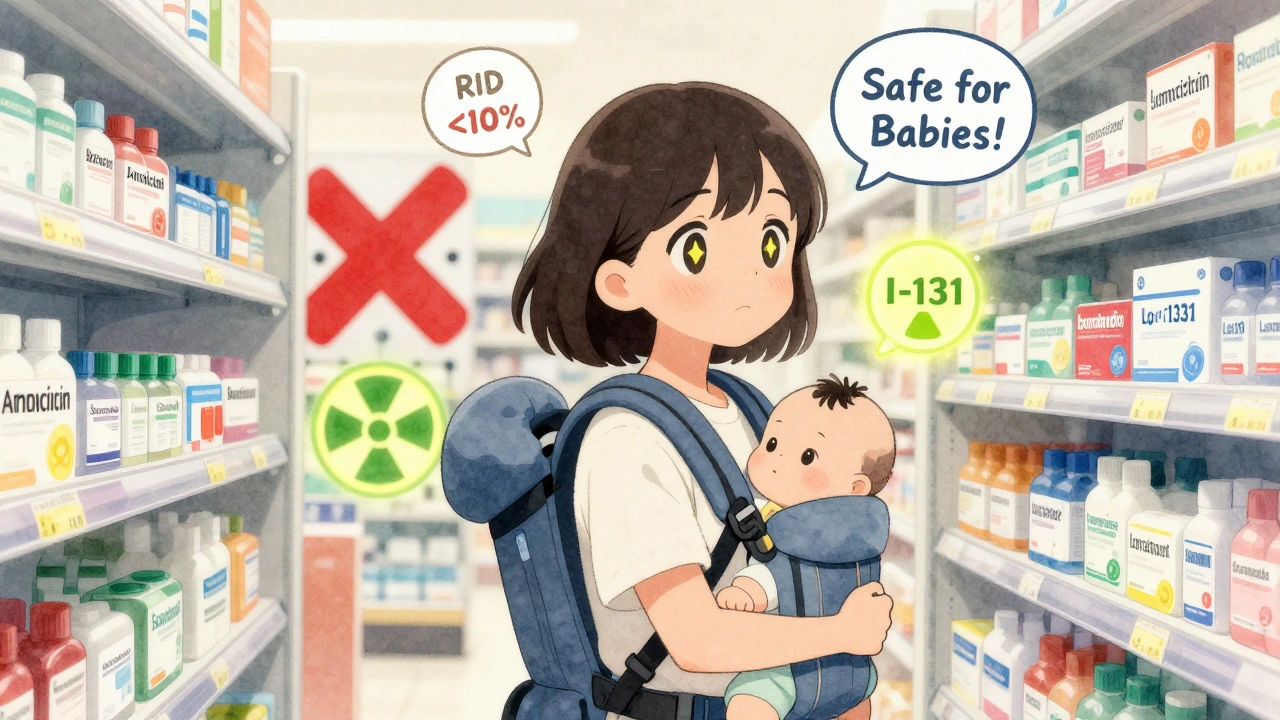
When Medications Are Not Safe - And What to Do
There are exceptions. Some drugs are truly dangerous during breastfeeding.- Radioactive iodine (I-131): Used for thyroid cancer or hyperthyroidism. Must stop breastfeeding for 3-6 weeks. Milk becomes radioactive.
- Chemotherapy drugs: Most are unsafe. Work with your oncologist to plan breaks or pump-and-dump schedules.
- Lithium: Used for bipolar disorder. Infants absorb 30-50% of maternal levels. Requires weekly blood tests. Only used if benefits outweigh risks.
What You Need to Know Before Taking Anything
You don’t need to guess. There are trusted, free, evidence-based tools:- LactMed: Run by the U.S. National Library of Medicine. Covers 1,000+ drugs with RID, milk levels, and infant effects. Updated quarterly.
- InfantRisk Center: Staffed by pharmacists and doctors. Offers free consultations by phone or text. Handles over 15,000 inquiries a year.
- MotherToBaby: Provides personalized risk assessments based on your specific meds and baby’s age.
Final Thought: Your Health Matters Too
Breastfeeding is a gift - but it shouldn’t come at the cost of your mental or physical health. Taking a safe medication doesn’t make you a bad mom. It makes you a smart one. The evidence is clear: most drugs are compatible with breastfeeding. The real risk isn’t the pill you take - it’s the fear that stops you from taking it. Use LactMed. Talk to your pharmacist. Ask your doctor for the RID. You’ve got this.Can I take ibuprofen while breastfeeding?
Yes, ibuprofen is one of the safest pain relievers for breastfeeding mothers. It transfers in very low amounts (RID 0.38-1.85%) and is already approved for use in infants. It’s preferred over naproxen or opioids for short-term pain or inflammation.
Is Zoloft safe while breastfeeding?
Yes, sertraline (Zoloft) is the most recommended SSRI for breastfeeding mothers. It has low transfer into breast milk (RID 1.7-7.0%), and infant blood levels are often undetectable. Studies show no negative effects on infant development, sleep, or feeding.
Does Sudafed reduce milk supply?
Yes, pseudoephedrine (Sudafed) can reduce milk supply by an average of 24%. Some mothers experience a significant drop, enough to stop breastfeeding. It’s best avoided. Use saline nasal sprays, steam, or antihistamines like loratadine instead.
Can I breastfeed after radioactive iodine treatment?
No. Radioactive iodine (I-131) enters breast milk and can damage your baby’s thyroid. You must stop breastfeeding for 3-6 weeks after treatment. Your medical team will guide you on pumping and discarding milk during this time to maintain supply, if desired.
What’s the safest antibiotic for a breastfeeding mom?
Amoxicillin is the safest and most commonly used antibiotic. It has low transfer into breast milk (RID 0.3-1.5%), no documented side effects in infants, and is approved for use in newborns. Cephalosporins and vancomycin are also excellent choices.
Should I pump and dump after taking medication?
Almost never. Pumping and dumping doesn’t speed up the elimination of most drugs from your milk. It only wastes milk and can hurt your supply. Unless you’re on a truly dangerous drug like radioactive iodine, continue breastfeeding normally. The amount your baby gets is usually too small to matter.
Lynette Myles
December 4, 2025 AT 23:07Acetaminophen is safe. Ibuprofen is safe. Zoloft is safe. Sudafed is not. LactMed exists. Stop guessing. This post is correct.
Annie Grajewski
December 6, 2025 AT 19:58okay but like… if you’re on lithium or chemo or radioactive iodine… are you *really* gonna be chilling with your baby like everything’s fine? 😅 like… i get the data but also… sometimes the data doesn’t care how scared you are. i took sertraline and my kid slept 18 hours straight for a week. data says ‘normal’… my heart says ‘what the actual f’.
luke newton
December 8, 2025 AT 16:24You people are so naive. The FDA doesn’t care about your baby. They care about profits. That ‘RID under 10%’? That’s not safety-that’s corporate math. They tested on rats, not human infants. And now you’re just handing your child poison because some ‘expert’ said it’s fine? Wake up. The system is rigged. You think they’d let you know if it was truly dangerous? Of course not.
James Moore
December 9, 2025 AT 20:02Let me be clear-this post is not just informative, it’s a moral imperative. In a nation where 1 in 7 mothers suffer postpartum depression, and where 15% abandon breastfeeding due to misinformation, this is not merely medical advice-it’s a civil rights issue. The right to mental health is not conditional upon lactation. To suggest otherwise is to weaponize maternal guilt. The science is unequivocal: the Relative Infant Dose is the only metric that matters. Anything else is pseudoscience dressed in virtue signaling. And yes, I’ve read LactMed. All 1,000+ entries. You haven’t.
Kylee Gregory
December 11, 2025 AT 16:08I appreciate how grounded this is. So many of us are terrified we’re failing our babies by taking anything, but the truth is… we’re failing them more by not taking care of ourselves. I took ibuprofen for a week after my c-section and still nursed my twins. They’re both thriving at 2. No side effects. Just a mom who didn’t let fear steal her healing.
Laura Saye
December 13, 2025 AT 06:06There’s a quiet violence in the assumption that breastfeeding must be perfect, pure, untainted by pharmaceuticals. But motherhood isn’t purity-it’s presence. The medication doesn’t dilute your love; it enables it. When your anxiety lifts, when your pain recedes, when you can hold your baby without trembling… that’s the real gift. The milk is just the vessel. The connection? That’s the medicine.
Philip Kristy Wijaya
December 15, 2025 AT 03:34People need to stop being so damn dramatic about medications. If you’re worried about your baby getting trace amounts of ibuprofen, you’re probably the same person who washes the baby’s pacifier with antibacterial soap after every drop. I’ve seen mothers refuse antibiotics because they’re ‘toxic’ and then show up at the ER with sepsis. Your baby doesn’t need a martyr. They need a mom who’s alive.
Jennifer Patrician
December 15, 2025 AT 11:09They’re lying. All of them. The CDC? LactMed? Fake. The real reason they say it’s safe is because Big Pharma owns the FDA. I know a mom who took Zoloft and her baby had seizures. They buried it. The hospital covered it up. Google ‘Zoloft infant seizures’ and you’ll see. They deleted the forums. They silenced the moms. You think you’re safe? You’re just the next victim waiting to be sanitized by the system.
Manish Shankar
December 16, 2025 AT 12:54This is a well-researched and commendable summary. The emphasis on Relative Infant Dose is scientifically sound. In clinical practice, I have observed that mothers who are provided with evidence-based guidance experience significantly reduced anxiety and improved breastfeeding continuation rates. The resources cited-LactMed, InfantRisk Center, and MotherToBaby-are invaluable and should be promoted universally. Thank you for this contribution to maternal health literacy.
Jimmy Jude
December 18, 2025 AT 06:07Let me tell you something. I was the mom who cried in the pharmacy aisle because I didn’t know if I could take a Tylenol. I thought I was a monster for even considering it. But then I read this. And I took the pill. And I held my baby. And I didn’t die. And neither did she. And now? I’m the one telling other moms: stop listening to the fear. Start listening to the science. You’re not broken. You’re just tired. And that’s okay.
Rupa DasGupta
December 18, 2025 AT 12:10ok but like… i took benadryl bc i was sneezing and my baby turned into a zombie for 3 days 😭 i thought it was just me… but now i know it’s the drug 😭😭😭 i’m never doing that again… also i cried reading this bc i felt so alone
Marvin Gordon
December 20, 2025 AT 11:59This is the kind of post that should be mandatory reading for every OB, pediatrician, and lactation consultant. Too many of them still say ‘avoid everything’ out of habit, not science. You didn’t just give info-you gave permission. And that’s worth more than any pill.
ashlie perry
December 21, 2025 AT 18:08They said ibuprofen was fine. My baby got a rash. Then they said it was coincidence. Then they said I was paranoid. Now I don’t trust any of it. Maybe I should’ve just stopped.
Stephanie Fiero
December 23, 2025 AT 07:22you’re not alone. i took sertraline for 6 months. my kid was fine. i was finally myself again. if you’re reading this and scared? take the pill. call LactMed. talk to a pharmacist. you’re not failing. you’re fighting. and you’re doing it right.