
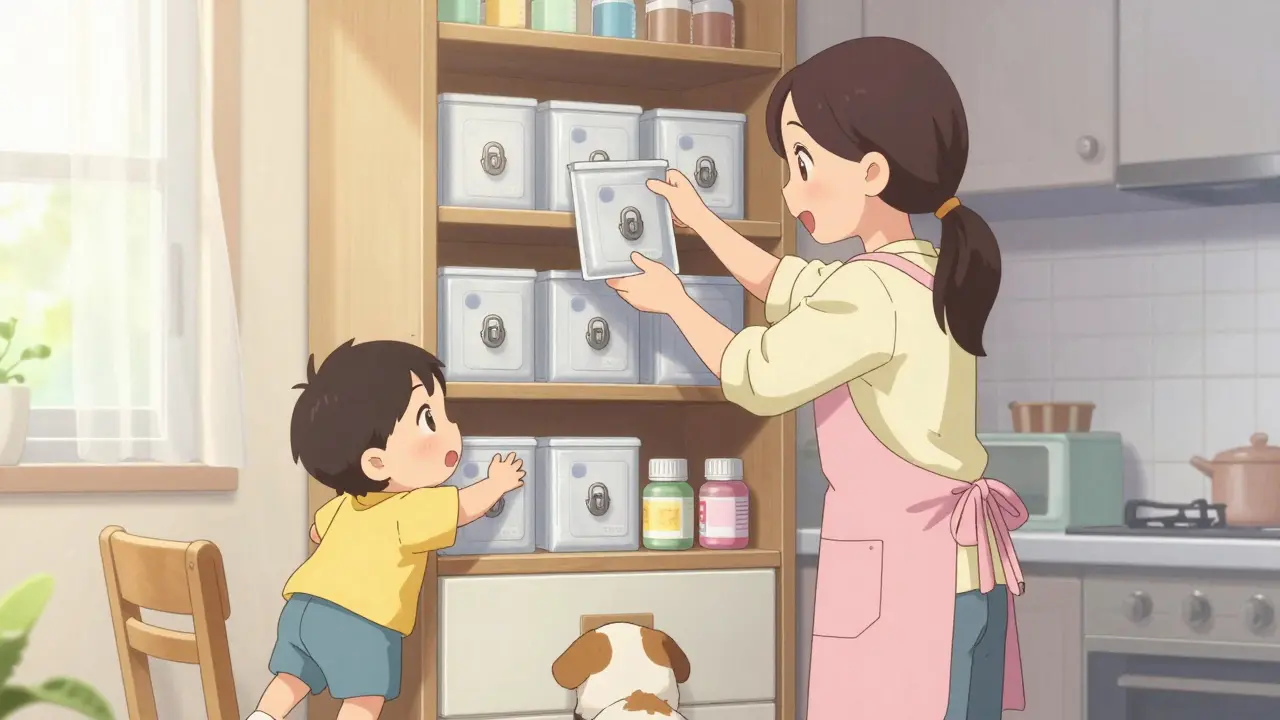
Every year, medication accidents send tens of thousands of children and pets to emergency rooms. It’s not because parents are careless - it’s because storing medicine safely isn’t always obvious. You might think a closed cabinet is enough, or that child-resistant caps will stop a curious toddler. But the truth is, most accidents happen right in the home, often within seconds of a caregiver turning their back. If you’ve ever left a pill bottle on the counter while helping a child take their medicine, or tucked a pet’s medication into a kitchen drawer because it was convenient, you’re not alone. But you’re also putting your family at risk.
Why Your Bathroom Cabinet Is the Worst Place for Medicine
It’s the most common mistake: storing medicine in the bathroom. Why? Because it’s near the sink, easy to access, and feels clean. But bathrooms are humid. The average humidity level hovers between 60% and 80%, especially after showers. That moisture doesn’t just make your mirror fog up - it breaks down pills and liquid medications. A 2023 study by VCA Animal Hospitals found that aspirin, antibiotics, and even insulin lose potency faster in humid environments. And if you think your child can’t reach the top shelf? Kids as young as two can climb on chairs, pull down towels, and jump to grab things. Research from the CDC’s Up & Away campaign shows that most children can reach objects up to four feet high. That’s eye level for a 3-year-old. A locked cabinet at five feet or higher is the minimum standard.Lock It. Not Just Close It.
Child-resistant caps aren’t locks. They’re delays. Studies show that 15% of toddlers can open them within five minutes. And pets? Dogs have noses 10,000 times more sensitive than humans. A flavored pill - whether it’s for ADHD, high blood pressure, or even a dog’s joint supplement - can smell like a treat. The FDA reports that 25% of pet medication incidents happen because owners accidentally take their pet’s medicine, thinking it’s their own. That’s why separate storage isn’t optional. Human medications and pet medications should never share a space. A single ibuprofen tablet can cause kidney failure in cats. A heart medication meant for a human can trigger seizures in dogs. Keep them in different rooms. Keep them in different containers.The Three-Zone System That Works
Veterinary and pediatric experts agree: the safest system is a three-zone approach. Zone 1 is for immediate use. Only keep the single dose you’re about to give on a flat, clear surface - like a kitchen table. Never leave it on a counter, bedside table, or coffee table. Zone 2 is short-term storage. This is where you keep the rest of the current prescription. Use a locked container, at least five feet high. A VADIC Safe Storage Bag with a combination lock (11" x 6") is one simple, affordable option. It’s small enough to fit on a high closet shelf, but strong enough to stop a determined child or pet. Zone 3 is for long-term storage. Unused or expired meds go here - in a separate, labeled box. Keep human meds in one box, dog meds in another, cat meds in a third. Cats are sneaky. They’ll jump onto a dresser, then onto a shelf. Dogs will sniff under couches. Don’t give them a chance.
Gummy Vitamins Are Not Candy. But Your Kids Think They Are.
Gummy supplements are the silent threat. They look like fruit snacks. They taste like candy. And according to CDC data, they account for 30% of all childhood supplement ingestions - even though they make up only 15% of the market. Parents assume gummies are safe because they’re labeled as “vitamins.” But too much iron or vitamin D can be deadly. Store gummy vitamins the same way you store prescription pills. Locked. High. Out of sight. And if you use a weekly pill organizer with gummies in it? Make sure it has a lock. The ones without locks are just fancy candy dishes.Disposal Isn’t Optional - It’s a Safety Step
Don’t flush pills. Don’t throw them in the trash loose. Don’t pour liquid meds down the sink. The EPA tested over 1,200 disposal methods and found one simple method that works: mix the medication with an unpalatable substance - like used coffee grounds or cat litter - at a 1:1 ratio. Seal it in a plastic bag. Then toss it in the trash. This makes the meds unappealing and unusable. A 2023 study from Child Care Aware showed this method prevents reuse in 92% of cases. If your town has a drug take-back program, use it. But if not, the coffee grounds trick is your best backup. And don’t forget expired pet meds. A dog’s arthritis pill might be fine for your dog - but dangerous if your toddler finds it.What About Bluetooth Safes and Smart Locks?
Yes, they exist. Bluetooth-enabled medication safes can send alerts to your phone when opened. Some even have timers that lock after a dose. They’re not necessary - but they’re helpful if you have a particularly curious child, multiple medications, or a history of near-misses. One parent on Reddit shared that after their 3-year-old opened a “childproof” cabinet, they bought a biometric safe. “It adds 10 seconds to my routine,” they wrote. “But I sleep better.” For most households, a simple combination lock box costs less than $20. That’s cheaper than an ER visit.
Two-Minute Rule: Secure It Before You Walk Away
The biggest cause of accidental ingestions? Temporary placement. You give your child their medicine. You set the bottle down to get a glass of water. You answer the door. You pick up the dog’s leash. And in those two minutes - that’s all it takes - a child grabs it. Or a pet knocks it over. Children’s Mercy Hospital found that 52% of childhood poisonings happen during these short, distracted moments. So make a habit: after every single dose, put the medicine away. Immediately. No exceptions. Even if you’re giving the next dose in two hours. Put it up. Lock it. Walk away. Make it automatic.Why This Matters More Than You Think
In 2023, poison control centers handled over 2.1 million human exposure cases. Nearly half involved children under six. Medications were the leading cause. For pets, accidental ingestion makes up 12% of all emergency vet visits. Dogs account for 78% of those cases. These aren’t rare events. They’re predictable - and preventable. The National Safety Council estimates that if every household used layered protection - locked storage, elevated placement, and separation by species - we could reduce pediatric poisoning by 89% and pet incidents by 76%. That’s not a guess. That’s data. And it means your actions today can save a life tomorrow.Start Today: Your 10-Minute Safety Checklist
- Walk through your home. Find every place medicine is stored - cabinets, drawers, purses, nightstands. Mark them.
- Move all meds to a locked container at least five feet high. No exceptions.
- Separate human and pet meds into different containers. Label them clearly.
- Check expiration dates. Discard old meds using the coffee grounds method.
- Put gummy vitamins and supplements in the same locked box as prescription pills.
- Teach every caregiver - grandparents, babysitters, partners - the two-minute rule.
- Keep the poison control number (1-800-222-1222 in the U.S.) saved in your phone.
It doesn’t take a lot of time. But it takes consistency. One locked box. One rule. One habit. That’s all it takes to turn a dangerous situation into a safe one.
Can I store medicine in the kitchen cabinet?
Yes - but only if it’s a high cabinet with a lock. Kitchens are actually better than bathrooms because humidity is lower (30-50%). But if your pet can jump onto counters or your child can pull open drawers, it’s not safe. Lock it, and keep it above five feet.
What if my child opens a child-resistant cap?
Child-resistant caps are designed to slow down kids - not stop them. About 15% of toddlers can open them in under five minutes. That’s why experts say they’re not a substitute for locked storage. Always use a locked box, even if the bottle has a child-resistant cap.
Can pets get sick from human medicine?
Absolutely. A single ibuprofen tablet can cause stomach ulcers or kidney failure in dogs. Acetaminophen (Tylenol) is deadly to cats - even a tiny amount. Heart medications, ADHD pills, and antidepressants can be fatal to pets. Never assume a medicine is safe just because it’s meant for humans.
Is it safe to flush old medicine down the toilet?
No. Flushing contaminates water systems. The EPA recommends mixing expired meds with coffee grounds or cat litter, sealing them in a plastic bag, and throwing them in the trash. This method prevents reuse and is 92% effective at stopping accidental ingestion.
How do I store medicine if I have both kids and pets?
Use three zones: Zone 1 - one dose on a flat surface during use; Zone 2 - locked box at 5+ feet for current meds; Zone 3 - separate labeled containers for human meds, dog meds, and cat meds. Never mix them. Pets and children have very different risks - so your storage must be too.
Are gummy vitamins safer than pills?
No. Gummy vitamins are one of the top causes of childhood ingestions because they look and taste like candy. The CDC says they account for 30% of supplement poisonings. Store them the same way you store pills - locked, high, and out of reach.
Alexander Erb
March 9, 2026 AT 13:22Y'all need to see this. I used to leave my kid's vitamins on the counter 'cause it was 'convenient.' Then my dog got into them. Turns out, gummy vitamins are basically candy to pets. 😅 Now everything's locked in a high cabinet. Best $20 I ever spent. My pup's alive, and I sleep better. 🙌
Donnie DeMarco
March 10, 2026 AT 12:34lock it up like ur weed bro. i had a lil guy once tryna snack on my dad's blood pressure pills. he thought they were skittles. i swear i nearly had a heart attack. now? locked box. no questions. no exceptions. even the damn fish meds are in there. 🤡
Tom Bolt
March 12, 2026 AT 05:11Let me be clear: storing medication in a bathroom cabinet is not merely negligent-it is a public health failure. Humidity degrades pharmaceutical integrity, and child-resistant caps are psychological illusions. The CDC data is not anecdotal; it is a forensic indictment of domestic complacency. If you do not secure your medications with a five-foot locked container, you are not a parent-you are a liability.
Bridgette Pulliam
March 12, 2026 AT 20:11I love how this breaks it down into zones. I never thought about separating human and pet meds like that. My cat jumped on the dresser last week and knocked over a bottle of my blood pressure pills. I didn’t even realize it was gone until I went to take my dose. Now everything’s in a locked box on the top shelf. So simple. So necessary. 💕
Mike Winter
March 13, 2026 AT 04:44It’s interesting how we treat medicine like it’s just… stuff. But it’s not. It’s a chemical agent with precise dosing, and we treat it like a spare key. I’ve been thinking about this lately-how our homes are designed for convenience, not safety. Maybe we need to reframe storage not as a chore, but as an act of care. A quiet ritual. A daily promise.
Randall Walker
March 13, 2026 AT 05:12So… you’re telling me I need to lock up my Adderall… and my dog’s heart medication… and my kid’s gummy vitamins… all in one box? Like… a tiny prison? 🤨 I mean, I get it. But also… I just want to nap. Can’t we just… not have kids or pets? Just saying.
Miranda Varn-Harper
March 15, 2026 AT 02:39While I appreciate the intention behind this article, I must point out that the emphasis on locked containers is alarmist. Medication safety should be taught through education, not fear-based containment. Children are naturally curious. Locking everything away teaches them that medicine is forbidden, not respected. Perhaps we should focus on raising children who understand dosage, not those who break into cabinets.
Shourya Tanay
March 16, 2026 AT 05:15The three-zone system aligns with operational risk mitigation frameworks in clinical environments. Zone 1: point-of-care access. Zone 2: controlled-access storage with physical and temporal constraints. Zone 3: irreversible disposal protocol. The coffee grounds method is a form of denaturing-akin to chemical deactivation in pharmaceutical waste streams. This is not anecdotal-it is a validated containment protocol.
LiV Beau
March 17, 2026 AT 02:45OMG I JUST REALIZED I’ve been keeping my gummy vitamins in my purse. 😱 My toddler’s been digging in there since she was 1. I’m literally running to lock everything up right now. Thank you. Thank you. Thank you. 🙏💕 This changed my life. Also, I’m telling my mom. And my sister. And my neighbor. Everyone. This is too important.
Adam Kleinberg
March 18, 2026 AT 12:55Of course they want you to lock your meds. They want you dependent. They want you afraid. The real danger isn’t your child-it’s the system that makes you think you need a $20 box to keep your own medicine safe. What’s next? Locked toothpaste? Locked water? Wake up. This is manufactured fear.
Denise Jordan
March 19, 2026 AT 19:40So… I’m supposed to lock up my pills… and my dog’s pills… and my kid’s vitamins… and I can’t leave them on the counter? What am I, a prison warden? This feels like overkill. I’ve been doing this for 12 years. Nobody’s died. Chill.
Gene Forte
March 21, 2026 AT 16:38Every small action creates a ripple. Locking your medicine isn’t about control-it’s about love. It’s about choosing safety over convenience. It’s about saying, ‘I care enough to do the right thing, even when it’s not easy.’ Start today. One box. One habit. One life saved.
Kenneth Zieden-Weber
March 22, 2026 AT 23:47Wait-you mean I can’t just leave my dog’s joint pills next to my coffee maker because ‘it’s convenient’? 🤔 I thought I was being efficient. Turns out I was being a walking hazard. I just moved everything to the top shelf. Took two minutes. I feel like a superhero now. Also, I told my roommate. He’s changing his habits too. Small wins, people.
Chris Bird
March 24, 2026 AT 13:00Why not just put all meds in the fridge? It’s cold. It’s locked. It’s clean. Why overcomplicate? You want three zones? I say one. One box. One rule. One fridge. Done.