
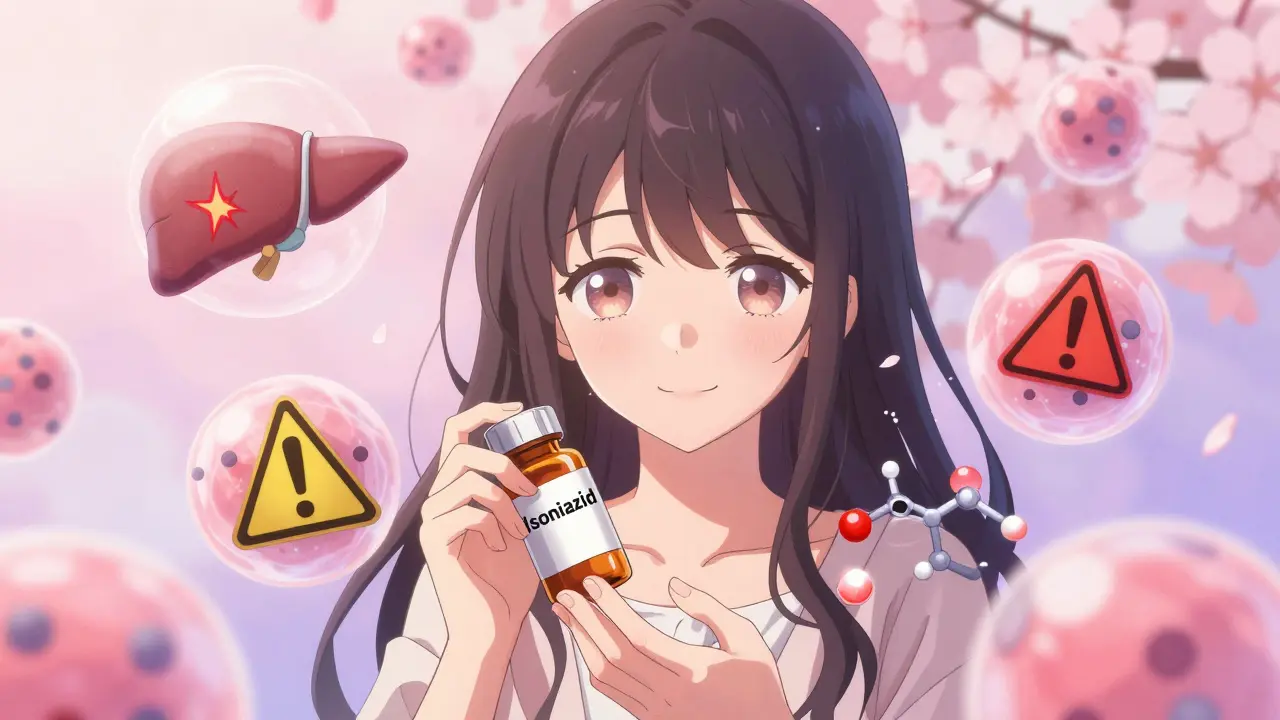
Isoniazid Hepatotoxicity Risk Calculator
Patient Risk Assessment
This calculator estimates your risk of liver injury from isoniazid based on key clinical factors. Always consult clinical guidelines before making treatment decisions.
Risk Assessment Results
When you’re treating tuberculosis, isoniazid is one of the most powerful tools you have. It’s been around since the 1950s, it’s cheap, and it works - especially when combined with other drugs like rifampin and pyrazinamide. But here’s the catch: for about one in five people taking it, that same drug can start attacking the liver. And it’s not just about the dose. It’s about your genes, what else you’re taking, and how your body handles toxins.
Why Isoniazid Hits the Liver Hard
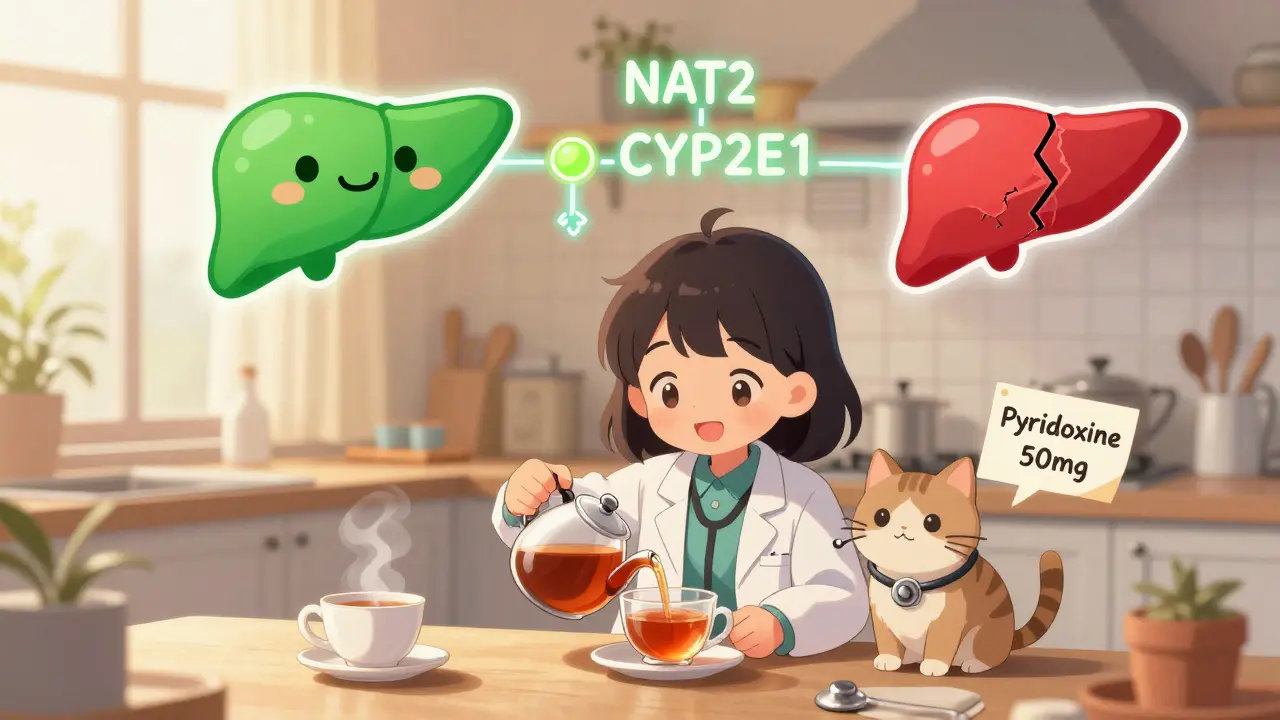
Isoniazid doesn’t hurt the liver directly. It’s what your body turns it into that causes the damage. Once you swallow a 300 mg tablet, your liver starts breaking it down using an enzyme called NAT2. But not everyone has the same version of this enzyme. Some people are fast acetylators - they process isoniazid quickly. Others are slow acetylators - and that’s where the trouble begins. Studies show that up to 87% of people who develop serious liver injury from isoniazid are slow acetylators. In these patients, the drug lingers longer in the bloodstream. That gives more time for it to break down into toxic byproducts like acetylhydrazine. These molecules trigger oxidative stress, damage mitochondria, and cause liver cells to die. The result? Elevated liver enzymes, nausea, fatigue, and sometimes jaundice. A 2016 study of 85 TB patients found that slow acetylators had nearly four times the risk of liver damage compared to fast acetylators. Their average drug exposure (measured as AUC) was over 40% higher. That’s not a small difference - it’s the difference between a safe treatment and a life-threatening reaction.The Perfect Storm: Isoniazid + Rifampin
You rarely give isoniazid alone. The standard TB treatment is a combo of four drugs: isoniazid, rifampin, pyrazinamide, and ethambutol. That’s called HRZE. And here’s the problem: rifampin makes isoniazid’s liver toxicity worse. Rifampin doesn’t just sit there. It turns on genes in your liver that produce more of the enzymes that break down isoniazid - especially CYP2E1 and CYP3A4. More enzymes mean more toxic metabolites are made faster. At the same time, isoniazid itself blocks other liver enzymes, which can cause other drugs - like phenytoin or carbamazepine - to build up in your blood. That’s why patients on seizure meds need extra monitoring if they’re also on TB treatment. The numbers tell the story. When isoniazid is used alone for latent TB, about 2-5% of people get liver enzyme elevations. But when it’s paired with rifampin and pyrazinamide, that number jumps to 10-20%. The CDC says the 2-month HRZE regimen carries nearly double the risk of liver injury compared to a 4-month HR regimen (without pyrazinamide). Some studies even show conflicting results - one paper found rifampin worsens isoniazid damage, while another claimed isoniazid actually lowered rifampin’s liver impact. But the consensus? Don’t assume safety just because the drugs are standard. The combo is a metabolic minefield.Who’s Most at Risk?
It’s not just slow acetylators. Certain groups face much higher danger:- People over 35 - risk increases with age
- Women - especially postpartum
- People with alcohol use disorder - more than 7 drinks a week for women, 14 for men
- Those with existing liver disease - ALT over 3 times the upper limit means avoid isoniazid
- Malnourished patients or those with HIV, diabetes, or kidney failure
What Happens When the Liver Gets Hurt?
Most cases are mild. About 70% of people who develop elevated liver enzymes don’t even feel sick. Their ALT levels rise, but they’re otherwise fine. Often, the liver adapts. The enzymes go back down on their own, even if they keep taking the drug. But in 30% of cases, things get serious. Symptoms show up: nausea, vomiting, belly pain, fever, dark urine, or yellow eyes. That’s not just a bad day - it’s a red flag. In the 2016 study, 95% of liver injuries were mild to moderate. Only one person out of 85 had a severe case (ALT over 20 times normal). But that one case almost killed them. The good news? Recovery is almost guaranteed. Stop the drug, and 95% of people bounce back fully within 4 to 8 weeks. The liver is resilient - if you catch it early.How to Monitor and Stay Safe
There’s no magic test to predict who will get hurt. But there are clear steps to reduce risk:- Get baseline liver tests before starting isoniazid - ALT, AST, bilirubin
- Check again every month if you’re asymptomatic
- Stop immediately if ALT is over 5x normal with symptoms, or 8x normal without symptoms
- Give everyone pyridoxine (vitamin B6) - 25-50 mg daily - to prevent nerve damage
- Ask about alcohol use, HIV, diabetes, or prior liver disease

New Treatments Are Changing the Game
Isoniazid isn’t going away anytime soon - it’s too cheap and too effective. But the future is shifting. In 2023, the TB Alliance introduced the BPaLM regimen: bedaquiline, pretomanid, linezolid, and moxifloxacin. It’s a 6-month cure for drug-resistant TB - and it doesn’t include isoniazid at all. For drug-susceptible TB, the WHO now recommends a 4-month regimen using rifapentine and moxifloxacin. That cuts isoniazid exposure from 6-9 months to just 4. Early data suggests this reduces liver injury risk by 30-40%. Even more promising? Research into silymarin (milk thistle extract). A 2021 trial in China showed it cut isoniazid-related liver damage by 27%. It’s not standard yet, but it’s a sign that we’re moving beyond just monitoring - we’re starting to protect.What You Need to Know Now
Isoniazid is a lifesaver. But it’s not harmless. The risk of liver damage isn’t rare. It’s predictable. It’s tied to your genes, your age, your habits, and the drugs you’re taking. You can’t ignore it. If you’re on TB treatment and feel off - even just a little - get your liver checked. Don’t wait for jaundice. Don’t assume it’s just a virus. The liver doesn’t scream until it’s too late. For doctors: test for NAT2 if you can. Consider alternatives for high-risk patients. Use shorter regimens when possible. And never forget: pyridoxine isn’t optional. It’s essential. For patients: know your risk. Tell your doctor about alcohol, other meds, or past liver problems. Take your vitamins. Report symptoms early. Your liver is working hard to keep you alive - give it a fighting chance.Can isoniazid cause permanent liver damage?
Permanent liver damage from isoniazid is rare. In most cases, liver injury is reversible if the drug is stopped early. Studies show that 95% of patients recover fully within 4 to 8 weeks after discontinuation. However, if treatment continues despite severe symptoms - like jaundice, confusion, or bleeding - the risk of acute liver failure increases. That’s why monitoring and early action are critical.
Is genetic testing for NAT2 recommended before starting isoniazid?
The European Medicines Agency (EMA) recommends NAT2 genetic testing in high-risk populations, but it’s not standard practice in most countries, including the U.S. and Australia. The main barrier is cost and access. However, for patients with a history of liver disease, alcohol use, or those from populations with high slow-acetylator rates (like South Africa), testing can guide safer dosing. If available, it’s a powerful tool to personalize treatment and avoid toxicity.
Can I take acetaminophen (Tylenol) while on isoniazid?
Use acetaminophen with caution. Both isoniazid and acetaminophen are processed by the same liver enzymes, especially CYP2E1. Taking them together increases the chance of toxic metabolites building up. The risk is low with occasional use (e.g., one 500 mg tablet for a headache), but avoid daily use or doses over 3,000 mg per day. If you need regular pain relief, talk to your doctor about alternatives like ibuprofen - but only if your kidneys are healthy.
Why is pyridoxine (vitamin B6) given with isoniazid?
Isoniazid interferes with vitamin B6 metabolism, which can lead to peripheral neuropathy - numbness, tingling, or pain in hands and feet. This affects 10-20% of patients, and up to 50% in slow acetylators or those with diabetes or malnutrition. Giving 25-50 mg of pyridoxine daily prevents this side effect. It’s not optional. It’s part of standard care, and skipping it puts patients at unnecessary risk.
Are there safer alternatives to isoniazid for latent TB?
Yes. For latent TB infection, two alternatives are now preferred in many guidelines. The 3HP regimen - 3 months of weekly isoniazid and rifapentine - reduces treatment time and lowers liver risk compared to 9 months of isoniazid alone. Another option is a 4-month course of rifampin alone. Both avoid the toxic metabolites of isoniazid. For patients at high risk of liver injury, these are often the first choice - especially if they’re over 35, drink alcohol, or have liver disease.
How common is isoniazid resistance, and does it affect treatment choices?
Isoniazid resistance is rising. In 2021, 7.4% of new TB cases worldwide were resistant to isoniazid, and 0.3% were multidrug-resistant (resistant to both isoniazid and rifampin). In regions with high resistance, like parts of Eastern Europe and Southeast Asia, doctors avoid isoniazid-containing regimens altogether. Newer drugs like bedaquiline and pretomanid are now used in first-line regimens for resistant cases. Resistance doesn’t just make treatment harder - it forces a complete shift away from isoniazid, increasing reliance on newer, more expensive drugs.
Rachel Liew
January 31, 2026 AT 02:38i just started tb treatment last month and was super scared about the liver stuff. my doc gave me b6 and said to watch for nausea but honestly i didn’t think it’d be this complicated. thanks for breaking it down so simply. i feel less alone now.
Angel Fitzpatrick
January 31, 2026 AT 04:09they’re hiding the truth. isoniazid was never meant for humans. it was a failed pesticide repackaged by pharma to keep people dependent. the real cause of liver damage? glyphosate buildup from your cereal. NAT2? a distraction. the government knows. ask yourself why pyridoxine is mandatory but not detox protocols. wake up.
Lilliana Lowe
February 1, 2026 AT 09:11While the post presents a clinically sound overview of isoniazid hepatotoxicity, it regrettably lacks a rigorous citation of pharmacokinetic modeling data from the 2018 Journal of Clinical Pharmacology meta-analysis, which quantifies the CYP2E1 induction variance across ethnic cohorts. Furthermore, the assertion that silymarin reduces toxicity by 27% is misleading-it was a single-center, non-blinded pilot with n=47. One must question the epistemic humility of clinical recommendations based on such fragile evidence.
Naresh L
February 2, 2026 AT 21:24It’s strange how we treat the body like a machine that breaks when you push too hard. But maybe the liver isn’t failing-it’s screaming. It’s saying, ‘I’ve been holding your toxins, your stress, your sleepless nights, your coffee, your wine.’ Isoniazid just gave it one too many things to carry. Maybe the real question isn’t how to monitor liver enzymes-but how to listen to what the body’s been trying to tell us all along.
franklin hillary
February 3, 2026 AT 22:42Y’all need to hear this: liver damage from isoniazid is NOT a lottery. It’s a countdown. If you’re over 35, drink, or have diabetes-stop waiting for jaundice. Get your ALT checked before day one. Take your B6 like it’s oxygen. And if your doc doesn’t mention 3HP or rifampin-only regimens? Find a new doc. This isn’t 1950 anymore. We have better tools. Use them. Your liver will thank you. #TBWarrior
Aditya Gupta
February 5, 2026 AT 15:40my cousin in delhi got liver issues on isoniazid. doc said he’s slow acetylator. gave him b6 and switched to rifampin only. 4 months later he’s fine. no hospital. no drama. just listen to your body and ask for alternatives. simple.
Nancy Nino
February 6, 2026 AT 11:28How adorable. A 2016 study with n=85 is now gospel? How quaint. The CDC’s guidelines are based on population averages, not individual biology. If you’re a woman over 35 with a glass of wine every night and you’re taking isoniazid, you’re not ‘at risk’-you’re playing Russian roulette with your hepatocytes. And yet, here we are, pretending this is ‘standard care.’
June Richards
February 8, 2026 AT 09:54why is everyone acting like this is new info?? i read this in med school 10 years ago. also why is everyone so dramatic about liver enzymes?? i had mine spike once and i just drank more water. chill. 🤷♀️
Jaden Green
February 8, 2026 AT 18:45Let’s be honest-the entire TB treatment paradigm is a relic of colonial-era medicine. We’re still using 70-year-old drugs because they’re cheap, not because they’re optimal. And now we’re pretending that monitoring ALT levels is ‘preventative care’ when what we really need is systemic investment in novel regimens, not Band-Aids on a leaking ship. The fact that we’re still debating pyridoxine dosing while bedaquiline sits underused in warehouses is the real tragedy. We don’t need better monitoring-we need better morality.
Lu Gao
February 9, 2026 AT 11:02wait… so milk thistle works? 😍 i’ve been taking it for my ‘liver cleanse’ since 2020. guess i was accidentally doing medicine? 🌿✨ also-why is no one talking about how the WHO changed guidelines without telling anyone? i found out via a tweet. #medicaltransparency
Nidhi Rajpara
February 9, 2026 AT 19:33As a nurse in Mumbai, I have seen many patients develop hepatotoxicity. The problem is not only genetic but also nutritional. Many patients skip meals to save money. Their livers are already weak. I always advise: eat protein, take B6, avoid alcohol. But doctors rarely ask about diet. This is the real gap.