
Most people assume that when they take a pill, the only thing that matters is the active ingredient-the drug itself. But what if the rest of the pill, the stuff that’s not supposed to do anything, actually can? That’s the question scientists and regulators are starting to ask about excipients, the so-called "inactive" ingredients in medications.
What Are Excipients, Really?
Excipients are the non-active parts of a drug: fillers, binders, coatings, flavorings, preservatives. They make pills hold together, dissolve properly, taste less awful, or last longer on the shelf. In a typical tablet, excipients make up 60% to 99% of the total weight. That’s right-most of what you swallow isn’t the medicine. It’s the support crew. For decades, regulators like the FDA treated these ingredients as harmless bystanders. The term "inactive" stuck because, by design, they weren’t meant to interact with your body the way the active drug does. But that assumption is crumbling. A 2020 study in Science found that 38 out of 314 tested excipients showed biological activity. Some, like propylene glycol and sodium benzoate, were interacting with human enzymes at concentrations you actually reach when taking the medicine.When "Inactive" Isn’t Inert
Take aspartame. It’s in some chewable tablets and orally disintegrating pills. We know it as an artificial sweetener, but it’s also an inhibitor of the glucagon receptor-something involved in blood sugar control. At 8.5 μM, it’s active in lab tests. And guess what? That’s the same concentration you can get in your blood after swallowing a pill with enough of it. Sodium benzoate, used as a preservative, blocks monoamine oxidase B, an enzyme linked to brain chemistry. Propylene glycol, common in liquid meds and inhalers, hits monoamine oxidase A. These aren’t random chemicals. They’re in your medicine because they’re cheap, stable, and easy to use. But now we’re seeing they might be doing more than just holding the pill together. This isn’t theoretical. In 2018, 14 generic versions of valsartan were recalled because a new solvent used in manufacturing created a cancer-causing contaminant. That solvent wasn’t the active ingredient. It was an excipient-related impurity. And it slipped through because regulators didn’t fully account for how changing one excipient could create a cascade of unintended chemical reactions.Regulation: One Rule for Pills, Another for Shots
Here’s where it gets messy. The FDA treats different types of drugs differently. If you’re making a generic version of a pill you can swallow, you can swap out excipients as long as you prove the medicine still works the same way. But if you’re making an injection, eye drop, or ear drop? You have to match the original excipients exactly. Why? Because those routes bypass your body’s natural filters. A tiny change in an IV solution can cause a severe reaction. The European Medicines Agency (EMA) is similar but stricter about documentation. Generic manufacturers have to justify every excipient change in a detailed Quality Overall Summary. In the U.S., the FDA’s Inactive Ingredient Database (IID) lists around 1,500 approved excipients and their safe limits by route of administration. For example, polysorbate 80 is safe up to 5% in pills, but only 0.05% in IV fluids. But here’s the problem: 17% of generic drug applications get rejected-not because the active ingredient is wrong, but because the excipients weren’t justified well enough. The most common reason? Not enough proof that the new excipient won’t change how the drug is absorbed or cause an allergic reaction.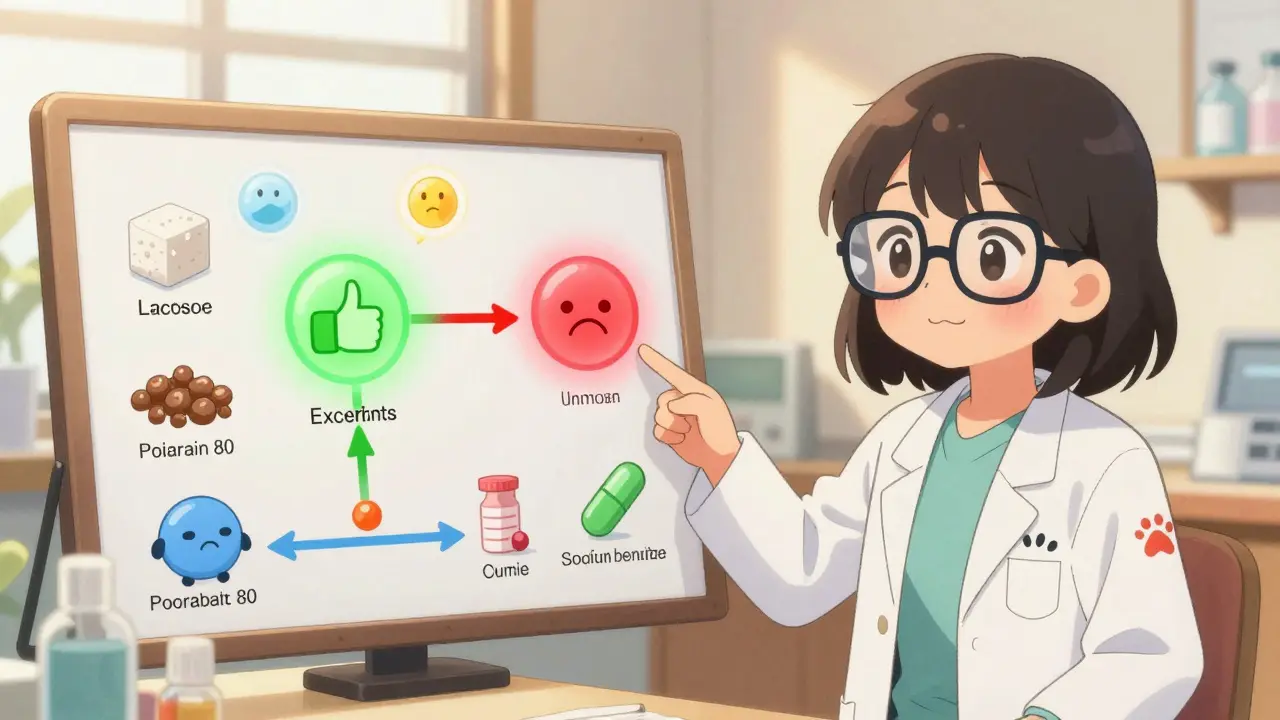
Real-World Failures and Successes
In 2020, Aurobindo tried to replace magnesium stearate with sodium stearyl fumarate in a generic version of Entresto. The FDA rejected it. Why? In vitro tests showed the new excipient changed the drug’s release rate by 15% at stomach pH levels. That’s enough to make the medicine less effective-or worse, cause side effects. On the flip side, Teva’s generic version of Jardiance succeeded because they swapped one disintegrant (sodium starch glycolate) for another (croscarmellose sodium) and proved through bioequivalence studies that blood levels of the active drug were nearly identical. Cmax: 374 vs. 368 ng/mL. AUC: 4,215 vs. 4,187 ng·h/mL. The numbers were close enough. The FDA approved it. The difference? Data. One company did the work. The other didn’t.Why This Matters for You
If you’ve ever had an unexplained reaction to a generic drug-rash, nausea, dizziness, or even a change in how well it worked-you’re not imagining it. It might not be the active ingredient. It could be the excipient. People with allergies to lactose, gluten, or certain dyes (like tartrazine) already know this. But what about people who react to propylene glycol, polysorbate 80, or aspartame? Those aren’t always labeled clearly. And if you’re on multiple meds, the cumulative effect of excipients could add up. There’s no database that tracks your total daily exposure to these substances across all your prescriptions. The FDA’s 2023 pilot program is a step forward. They’re now requiring extra safety data for 12 high-risk excipients in orally disintegrating tablets, including aspartame and saccharin, after reports of rare hypersensitivity reactions. That’s the first time regulators have acknowledged that "inactive" doesn’t mean "safe for everyone."
What’s Next?
The pharmaceutical industry is changing. More than 87% of new drugs now use novel excipients to improve delivery-think slow-release pills, targeted gut absorption, or taste-masked liquids. But the rules haven’t caught up. The FDA is working on a computational model to predict which excipients might interact with human proteins. They’re also considering requiring all new excipients to be screened against 50 high-risk biological targets before approval. If that happens, it could add $500,000 to $1 million to the cost of developing each new generic drug. That might sound like a lot, but it’s cheaper than a recall. Or worse-a patient getting sick because a "harmless" filler turned out to be anything but. The bottom line? Excipients aren’t just filler. They’re part of the medicine. And for some people, they might be the reason a drug works-or doesn’t.What You Can Do
You don’t need to be a scientist to protect yourself. Here’s what works:- If you notice a change in how a generic drug works after switching brands, talk to your pharmacist. Ask if the excipients changed.
- If you have known allergies (lactose, sulfites, dyes), check the drug’s package insert or ask for the full ingredient list. Not all pharmacies keep this on hand, but manufacturers must provide it.
- Don’t assume all generics are the same. If one version makes you feel off, try another. Sometimes, the difference is in the excipients.
- Report unusual side effects to the FDA’s MedWatch program. Even if it seems minor, it helps build the evidence.
The science is clear: excipients are not all harmless. The system is catching up-but slowly. Until then, your awareness might be the best safeguard you have.
Gregory Parschauer
January 13, 2026 AT 18:35Let me just say this: the FDA is still operating like it’s 1985. They treat excipients like they’re harmless filler, but we’ve got peer-reviewed studies showing propylene glycol and sodium benzoate are bioactive at therapeutic doses. This isn’t conspiracy-it’s pharmacology. And yet, generics get approved with excipient swaps that could literally alter drug absorption kinetics. We’re putting people at risk because regulatory agencies are too lazy to update their frameworks. It’s not negligence-it’s institutional arrogance.
And don’t even get me started on how they treat oral vs. IV formulations. Why should a pill get a free pass while an injection gets scrutinized? The body doesn’t care about the route-it cares about exposure. This is a systemic failure dressed up as science.
Someone needs to sue the FDA for malpractice by omission. And until then, every time you swallow a generic, you’re playing Russian roulette with your biochemistry.
lucy cooke
January 14, 2026 AT 19:25Oh, darling, isn’t it just *so* poetic? The pharmaceutical industry-our modern-day alchemists-swearing up and down that their little chalky pills are pure, while the real magic (or menace) lies in the unspoken, the unlisted, the invisible scaffolding of chemical silence. Excipients: the unsung villains of modern medicine, the silent orchestra tuning your neurons to a frequency you never asked for.
Aspartame in a tablet? A sweet betrayal. Propylene glycol? A velvet glove over a steel fist. We’ve been conditioned to trust the label, but the label is a fairy tale written by lawyers and chemists who don’t believe in souls-only solubility.
It’s not a drug. It’s a performance. And we’re all just audience members who forgot to bring our own scripts.
Trevor Davis
January 15, 2026 AT 22:42Hey, I just want to say-this is actually super important. I had this weird nausea for weeks after switching to a generic version of my blood pressure med. My pharmacist pulled up the ingredient list and we found out the new version used magnesium stearate instead of sodium stearyl fumarate. Same active ingredient, different filler. Totally changed how it hit me.
Turns out, I’m sensitive to magnesium stearate. I didn’t even know that was a thing. Now I always ask for the full list. It’s not hard. Just say, ‘Can I see the excipients?’ Most pharmacists are happy to help.
Thanks for sharing this. I wish more people knew this stuff.
Lethabo Phalafala
January 17, 2026 AT 09:45I used to think excipients were just… filler. Like the cotton in a pill bottle. But after my cousin had a seizure on a generic version of her seizure med-same active ingredient, different coating-everything changed.
Turns out, the new coating dissolved too fast in her stomach. The drug hit her system like a sledgehammer instead of a whisper. She was fine after switching back, but the hospital didn’t even consider the excipient. They blamed her ‘noncompliance.’
This isn’t just science. It’s survival. People are getting sick because no one’s asking the right questions. And if you’re allergic to lactose or dyes? You’re already on the front lines. But what about the rest of us? The ones who don’t even know what we’re reacting to?
We need a database. A public one. Like a nutrition label for pills. I’m not asking for a PhD-I’m asking to not die because a chemist picked the cheaper option.
John Pope
January 18, 2026 AT 01:19Let’s be real: the entire pharmaceutical regulatory model is a Rube Goldberg machine built on wishful thinking. Excipients are treated like background noise, but we’re living in a world where a single molecule can hijack your enzyme pathways. Sodium benzoate blocking MAO-B? That’s not an accident-it’s a pharmacological feature. And we’re just now noticing because we stopped assuming ‘inactive’ means ‘innocent.’
And let’s talk about the economic absurdity: we spend billions on active ingredient patents, but the real innovation-and the real danger-is in the excipient cocktail. Companies don’t patent excipients because they’re ‘off-patent.’ But guess what? They’re the reason generics work-or don’t.
It’s like saying the engine matters but the fuel doesn’t. Except the fuel is laced with neuroactive compounds and you didn’t sign a waiver.
Clay .Haeber
January 18, 2026 AT 23:48So let me get this straight: the FDA lets you swap out the ‘filler’ in a pill like you’re changing the wallpaper in your bathroom, but if you try to tweak the IV solution? You need a PhD, a notarized letter from your grandmother, and a blood sacrifice to Apollo.
Meanwhile, aspartame’s in chewable tablets and nobody blinks. But put it in soda and suddenly we’re having national debates about cancer and autism? Oh, the hypocrisy is delicious.
Next up: ‘inactive’ ingredients in your shampoo causing migraines. Oh wait-that’s already happening. And you know what? You’re probably drinking it through your scalp right now. Congrats, you’re a biochemistry experiment with socks.
Adam Vella
January 19, 2026 AT 07:51It is imperative to recognize that the pharmacokinetic variability introduced by excipient substitution is not merely theoretical but empirically demonstrable. Bioequivalence studies, as defined by the FDA’s guidance for industry, require demonstration of comparable Cmax and AUC parameters across formulations. The case of Aurobindo’s Entresto generic illustrates a clear deviation in dissolution kinetics attributable to excipient alteration, resulting in non-equivalence.
Moreover, the Inactive Ingredient Database (IID) is not a permissive catalog but a risk-assessed repository of safety thresholds by route of administration. Polysorbate 80, for instance, exhibits dose-dependent hemolytic potential in intravenous contexts, necessitating strict concentration limits.
Regulatory divergence between oral and parenteral formulations is not arbitrary but physiologically grounded. The gastrointestinal tract provides metabolic and absorptive buffering mechanisms absent in direct vascular or mucosal delivery systems.
Thus, the current framework, while imperfect, remains scientifically defensible-provided manufacturers adhere to rigorous characterization and testing protocols. The issue is not regulatory stagnation, but noncompliance by certain industry actors.
Nelly Oruko
January 19, 2026 AT 16:05excipents arent inert. and we shouldnt act like they are.
if you feel weird after a generic switch? its not you. its the filler.
ask for the list. report it. you’re not crazy.
we need a pill label like food labels.
that’s it.
vishnu priyanka
January 20, 2026 AT 20:25Back home in India, we call these ‘fillers’ the ‘silent partners’-they don’t get the credit, but they make the whole thing work. Or break it. I once saw a man collapse after switching to a cheap generic of his epilepsy med. Turned out the new version used a dye he was allergic to. No one checked the label. The pharmacy didn’t even know it was there.
Here’s the thing: in rich countries, we have databases and pharmacists. In mine? People swallow whatever’s cheapest. And if they get sick? Well, that’s just life.
Maybe this isn’t just a science problem. Maybe it’s a justice problem. Everyone deserves to know what’s in their pill-even if it’s just ‘inactive’ stuff.