
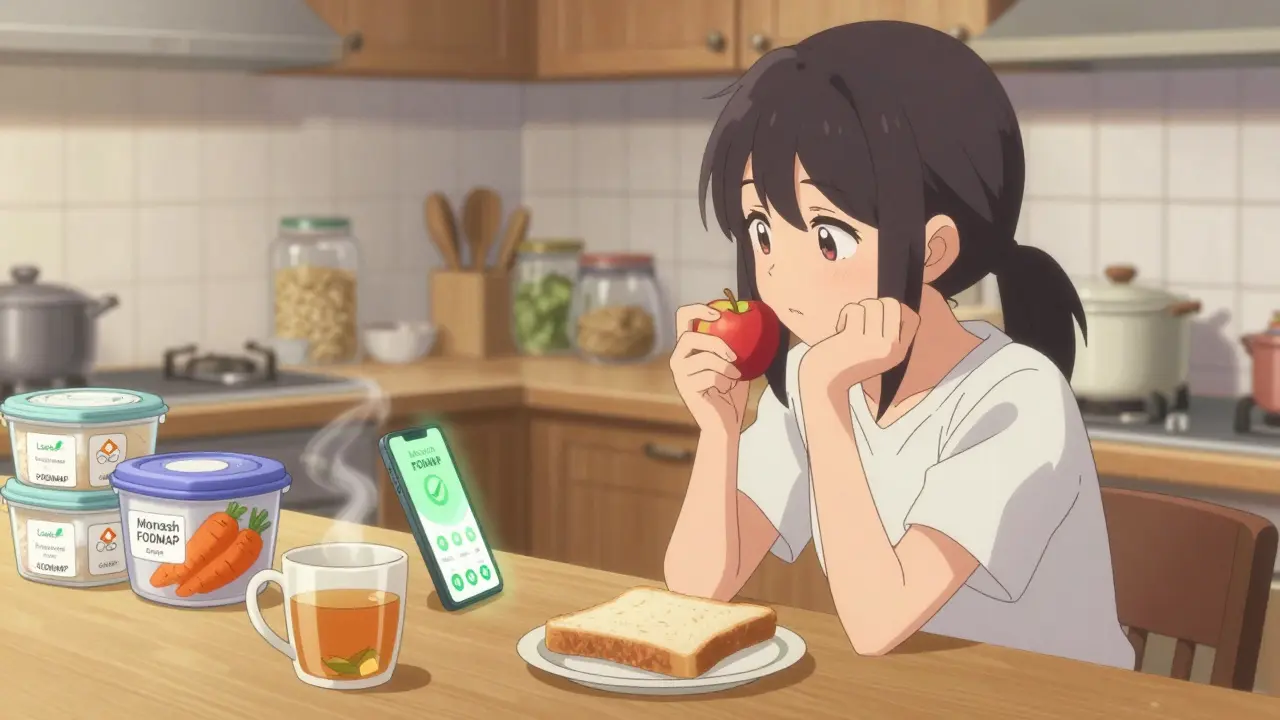
Living with irritable bowel syndrome (IBS) means constant guesswork: What did I eat? Why am I bloated? Why did my stomach crash after salad? For millions, the answer isn’t medication-it’s food. But not all diets work the same. Three main approaches-low-FODMAP, low-residue, and general elimination-offer different paths to relief. Only one has solid science backing it. The others? They might help short-term, but they can make things worse long-term.
What Is the Low-FODMAP Diet?
The low-FODMAP diet isn’t just another “cut out carbs” trend. It was developed by researchers at Monash University in Australia after years of clinical trials. FODMAP stands for fermentable oligosaccharides, disaccharides, monosaccharides, and polyols. These are types of carbohydrates that some people’s guts can’t absorb well. Instead, they get fermented by gut bacteria, which causes gas, bloating, pain, and changes in bowel habits.
This diet has three phases. Phase 1 is strict: you avoid all high-FODMAP foods for 2 to 6 weeks. That means no garlic, onions, wheat, apples, milk, honey, or artificial sweeteners like sorbitol. You eat only foods with less than 0.5g of FODMAPs per serving. Portion size matters-eating 2 apples might be fine, but 3 could trigger symptoms. The Monash FODMAP app, which tests foods in a lab, helps you track this. Over 75% of people see major improvement in pain and bloating during this phase.
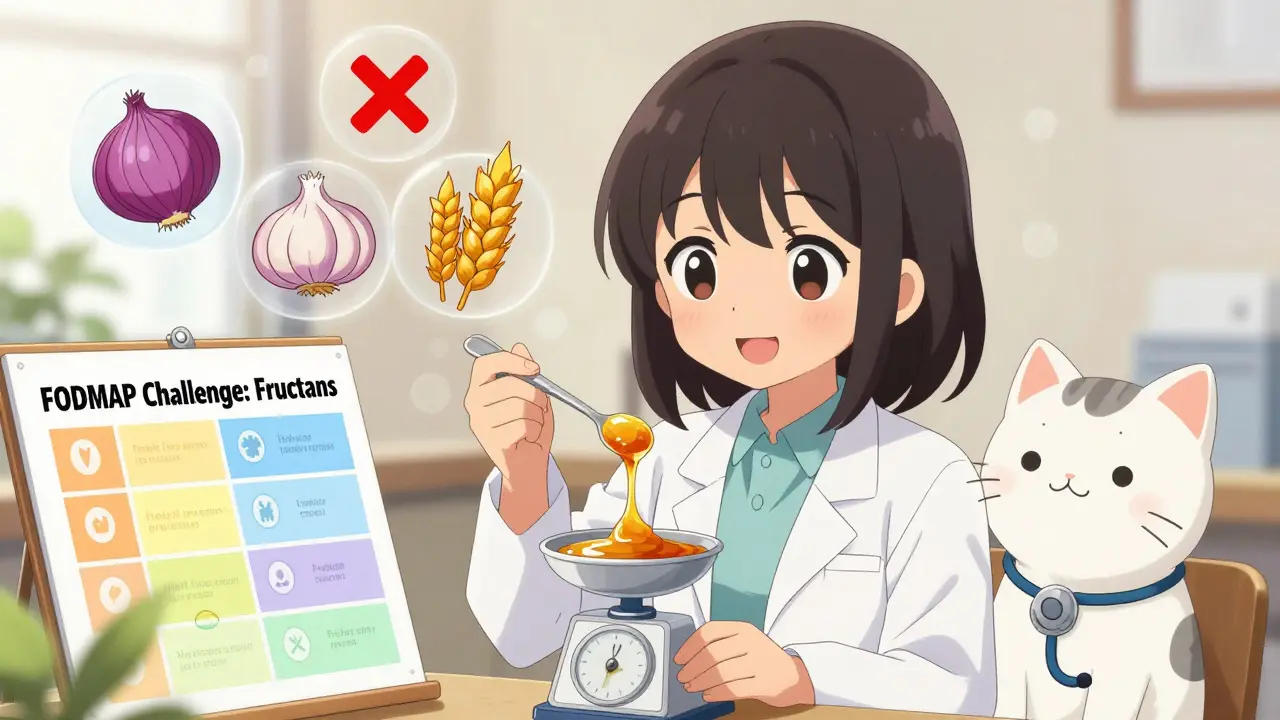
Phase 2 is where the real work happens. You slowly reintroduce each FODMAP group one at a time. Start with fructans (found in wheat and onions). Eat 3g of it-about 1 slice of bread-and watch for symptoms over the next 24 hours. Then move to galacto-oligosaccharides (in beans), lactose (in dairy), excess fructose (in apples and mangoes), and polyols (in mushrooms and sugar-free gum). Each challenge uses a standardized dose. This step tells you exactly which foods you can tolerate and which you can’t.
Phase 3 is personalization. Most people end up eating 50-80% of the foods they eliminated. You don’t have to be perfect. You just need to know your limits. Someone might handle a little onion but not garlic. Another person might eat yogurt daily but avoid apples. That’s the goal: freedom, not restriction.
What Is a Low-Residue Diet?
Low-residue diets have been around since the 1940s, but they were never meant for IBS. They were designed for people with Crohn’s disease, ulcerative colitis, or before bowel surgery. The idea is simple: reduce the amount of undigested food passing through the gut. That means cutting fiber to 10-15g per day (compared to the recommended 25-38g), avoiding raw fruits and veggies, nuts, seeds, whole grains, and legumes. Dairy is limited to lactose-free options.
For someone with diarrhea-predominant IBS, this might help in the short term. Less bulk = fewer bowel movements. But here’s the problem: 60-70% of IBS patients don’t need this level of restriction. And cutting fiber long-term causes real harm. Folate drops by 35%. Calcium intake falls 25%. Constipation gets worse. Your gut microbiome loses diversity. You’re not fixing the problem-you’re masking it with starvation.
Unlike the low-FODMAP diet, there’s no reintroduction phase. You just stay on it. That’s why gastroenterologists only recommend it for temporary use, like during a flare-up. It’s not a solution for IBS. It’s a Band-Aid that can damage your gut over time.
General Elimination Diets: Do They Work?
General elimination diets are what most people try first. Cut out gluten, dairy, caffeine, spicy foods, and alcohol for 2-4 weeks. Then add them back one by one. Sounds logical, right? But without structure, it’s a mess.
Most people eliminate too many foods at once. They cut out dairy, gluten, eggs, soy, and sugar. Then they reintroduce them all at once. How do you know which one caused the flare? You don’t. Studies show only 30% of people correctly identify their trigger without professional help. And many eliminate foods they don’t even need to. A 2023 study found that 45% of people on general elimination diets were unnecessarily avoiding dairy-despite not being lactose intolerant.
The low-FODMAP diet beats this because it’s targeted. It doesn’t cut out everything. It cuts out specific carbs that are proven to trigger IBS. It uses lab-tested foods. It has clear dosing. It’s not guesswork. It’s science.
Which Diet Is Best for You?
Let’s compare them side by side.
| Feature | Low-FODMAP Diet | Low-Residue Diet | General Elimination Diet |
|---|---|---|---|
| Primary Goal | Identify specific carbohydrate triggers | Reduce stool volume | Find food sensitivities |
| Duration | 3-6 months (with phases) | Short-term only | 2-4 weeks |
| Effectiveness for Pain/Bloating | 75-80% | 45% | 40-50% |
| Effectiveness for Diarrhea | 75% | 60% | 50% |
| Effectiveness for Constipation | 40-50% | Worsens symptoms | Variable |
| Long-Term Sustainability | High (personalized) | Low (nutrient deficiencies) | Low (unstructured) |
| Requires Professional Guidance? | Strongly recommended | Yes | Helpful, but not required |
Bottom line: If you have IBS, the low-FODMAP diet is the only one with proven, lasting results. Low-residue diets are outdated for IBS. General elimination diets are too vague to be reliable.
What You Need to Get Started
Trying the low-FODMAP diet on your own is risky. A 2022 study found that only 45% of people without a dietitian could follow the reintroduction phase correctly. Most skip it entirely. That’s why 35% of non-responders say they didn’t get better-they never got to phase 3.
Here’s what you need:
- The Monash FODMAP app ($9.99/month or $49.99/year). It tells you which foods are safe and in what portion. It even scans barcodes.
- A digital kitchen scale. You need to measure food to the gram. A tablespoon of honey isn’t safe. A teaspoon might be.
- A symptom journal. Track what you eat, when you eat it, and how you feel. Look for patterns over 24-48 hours.
- A registered dietitian trained in FODMAPs. They’ll guide you through reintroduction. Find one through the Monash University directory-they’re certified in 37 countries.
Don’t rely on blogs or Pinterest lists. They’re full of mistakes. For example, many say “all gluten-free foods are low-FODMAP.” False. Many gluten-free breads have inulin or agave syrup-both high-FODMAP.

What to Expect
Phase 1 can be tough. You’ll miss onions. You’ll crave bread. You might feel worse at first-your gut is adjusting. But within 10 days, most people report 70-80% less bloating. One Reddit user wrote: “After 15 years of daily diarrhea, I went 3 days without a bathroom trip. I cried.”
Reintroduction is harder. You’ll have flare-ups. That’s normal. It means you’re learning. u/IBSWarrior2020 said: “I thought I was sensitive to everything. Turns out, I only react to fructans and polyols. Now I eat onions, apples, and beans-just not together.”
But not everyone succeeds. About 25% of people don’t improve. That’s not the diet’s fault. It’s because their IBS isn’t food-driven. Stress, motility issues, or small intestinal bacterial overgrowth (SIBO) might be the real culprits. That’s why you need a doctor too.
Common Mistakes and How to Avoid Them
- Mistake: Cutting out too many foods at once. Solution: Stick to the official low-FODMAP list. Don’t add your own restrictions.
- Mistake: Skipping reintroduction. Solution: Reintroduction isn’t optional. It’s the whole point.
- Mistake: Eating “healthy” packaged foods. Solution: Check labels for inulin, fructans, honey, agave, and sorbitol. They’re in protein bars, granola, and even “gut health” snacks.
- Mistake: Trying it without support. Solution: Find a dietitian. Even one 30-minute session can save you months of confusion.
Final Thoughts
IBS isn’t caused by one food. It’s caused by how your gut reacts to specific carbs. The low-FODMAP diet gives you the tools to find out which ones. Low-residue diets starve your gut. General elimination diets are blindfolded. Only FODMAP gives you sight.
You don’t have to live with pain. You don’t have to avoid social meals forever. You just need to know your triggers. And with the right approach, you’ll find them.
Can I do the low-FODMAP diet without a dietitian?
Yes, but it’s risky. Without guidance, you’re likely to misinterpret the reintroduction phase, cut out foods unnecessarily, or miss hidden FODMAPs in processed foods. Studies show only 45% of people succeed without professional help. A dietitian can prevent mistakes that lead to long-term nutritional gaps or unnecessary restrictions.
Is the low-FODMAP diet a lifelong plan?
No. It’s designed as a temporary tool to identify triggers. Most people end up eating 50-80% of the foods they eliminated. The goal isn’t permanent restriction-it’s personalization. You’ll find your own safe thresholds and build a sustainable diet around them.
Does the low-FODMAP diet help with constipation?
It helps less than it helps with diarrhea or bloating. Studies show only 40-50% of constipation-predominant IBS patients improve. That’s because fiber restriction can worsen constipation. Some people need to reintroduce certain low-FODMAP fibers like oats or kiwi. A dietitian can tailor this.
Are low-FODMAP products worth buying?
They can be helpful, but they’re not necessary. The Monash-certified label means the product has been lab-tested for FODMAP content. But many regular foods are safe in small amounts. For example, a slice of regular white bread (not whole grain) is low-FODMAP. Don’t overpay for specialty items unless you need them for convenience.
Can stress make the low-FODMAP diet less effective?
Yes. Stress affects gut motility and sensitivity. Even if you follow the diet perfectly, high stress can trigger symptoms. That’s why many experts recommend combining the diet with mindfulness, therapy, or gut-directed hypnotherapy. Food isn’t the only trigger.
What if I don’t feel better after 6 weeks?
Talk to your doctor. You might have another condition like SIBO, celiac disease, or a motility disorder. Or you might have followed the diet incorrectly. A gastroenterologist can order tests to rule out other causes. Don’t assume the diet failed-assume you need more help.
Melissa Stansbury
March 16, 2026 AT 18:39Okay but like… I tried the low-FODMAP diet and it made me obsessed with food. I started weighing my spinach. I cried when I accidentally ate a garlic-infused olive oil. I’m not even mad. I just miss onions. Like, deeply. My partner had to start calling me ‘the FODMAP widow.’
Kyle Young
March 17, 2026 AT 13:24It’s fascinating how we’ve reduced complex physiological conditions to dietary checklists. The low-FODMAP diet’s success isn’t just about carbohydrate malabsorption-it’s about creating a structured framework for self-observation. In a world of noise, structure becomes therapy. But we must ask: are we treating the gut, or are we treating our anxiety about the gut?
Aileen Nasywa Shabira
March 19, 2026 AT 00:22Oh wow, another ‘science says’ post. Next you’ll tell me the moon is made of cheese and the low-FODMAP diet was approved by NASA. I tried it. Lost 12 pounds. Got depression. My therapist said I had ‘food OCD.’ Then I ate a slice of garlic bread and my stomach didn’t explode. Coincidence? I think not.
Kendrick Heyward
March 20, 2026 AT 05:12People who say 'just avoid onions' are the same ones who think kale fixes everything. You don't need a $50 app to know that if it makes you gassy, don't eat it. This whole thing is a scam. Big Food is just selling you a $49.99 subscription to feel better about your life. 🤦♂️
lawanna major
March 22, 2026 AT 04:33The beauty of the low-FODMAP diet lies not in its restrictions, but in its rigor. It transforms guesswork into data. Each reintroduced food becomes a hypothesis tested against your body’s response. That’s not dieting-that’s self-education. For those who dismiss it as faddish, I’d ask: have you ever measured your portion sizes? Have you tracked symptoms for 48 hours? Or did you just cut out gluten because a blog said so? The difference between trial and science is the difference between wandering and walking.
Ryan Voeltner
March 22, 2026 AT 12:40Linda Olsson
March 24, 2026 AT 02:33Let’s be real-this is all just Big Pharma and diet gurus teaming up to sell you a $200/month subscription to feel special. The real cause of IBS? Glyphosate. Gluten is a distraction. Your microbiome is being poisoned by corporate agriculture. You think onions are the problem? It’s the pesticides on them. The Monash app? Probably funded by Big FODMAP. Wake up.
Ayan Khan
March 25, 2026 AT 20:07In India, we have traditional ways of managing digestion-turmeric, ginger, fermented foods like idli and buttermilk. The low-FODMAP diet is useful, but we must not forget that healing is cultural too. I’ve seen people thrive by blending FODMAP principles with Ayurvedic practices. One size doesn’t fit all. Respect your roots while learning science.
Emily Hager
March 27, 2026 AT 14:34For someone who claims to be evidence-based, this post ignores the fact that 25% of people don’t respond to FODMAP at all. That’s a third of the population. You’re acting like this is the only path. It’s not. What about gut-brain axis interventions? Pelvic floor therapy? Neuroplasticity? You’re reducing a neurological condition to a grocery list. That’s not science. That’s reductionism.
Melissa Starks
March 28, 2026 AT 23:46I just wanna say-this post saved my life. I had diarrhea every day for 7 years. I thought I was broken. I tried everything. Paleo. Keto. Vegan. Nothing worked. Then I found the Monash app. Started phase one. Felt worse at first. Cried a lot. Ate plain rice and chicken for 3 weeks. Then I did the reintroductions. Turns out I’m fine with apples. Just not apples with honey. And onions? Yeah I can have 1/4 of one. I’m not perfect. But I’m free. I went to a concert last weekend. Ate a slice of pizza. Didn’t run to the bathroom. I’m not a hero. I just followed the steps. If you’re reading this and you’re still suffering-try it. Not because it’s trendy. Because it works. And you deserve to not feel like your body is a betrayal.
Lauren Volpi
March 29, 2026 AT 17:23Low-FODMAP? Sounds like a rich white lady diet. You need a scale? An app? A $100 dietitian? I just don’t eat stuff that makes me gassy. Done. Stop overcomplicating everything. This isn’t rocket science. It’s your gut. Listen to it. Not a spreadsheet.