
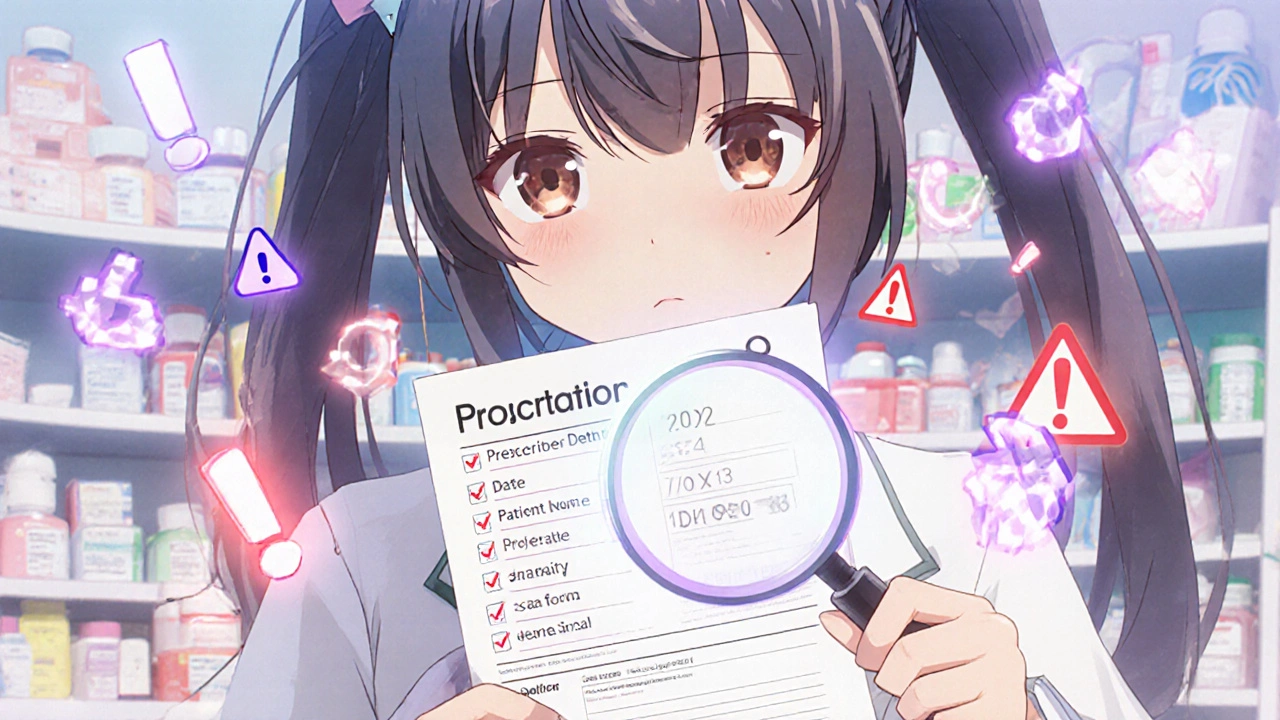
Getting the quantity and directions right on a controlled substance prescription isn’t just good practice-it’s the law. One wrong number, one unclear sig, and you could be looking at a DEA enforcement action, a license suspension, or worse-a patient harmed by a dosing error. In 2023, the DEA reported that 6,214 enforcement cases involved improper verification of controlled substances, and nearly 4 out of every 10 pharmacies failed inspections due to verification gaps. This isn’t about being extra careful. It’s about survival in a high-stakes system where mistakes cost lives and livelihoods.
What You Must Check Every Time
Every controlled substance prescription, whether it’s oxycodone, Adderall, or diazepam, must pass seven mandatory checks before you dispense it. These aren’t suggestions. They’re written into federal law under 21 CFR § 1306.05. Skip even one, and you’re liable.- Prescriber’s full name and address - No abbreviations. No initials. If it says "Dr. J. Smith" and the DEA number doesn’t match, stop. Call them.
- Date of issuance - Schedule II prescriptions must be dated the day they’re written. Schedules III-V can be up to six months old. If it’s dated last week but filled today, that’s fine. If it’s dated January 2024 and today is November 2025? Reject it.
- Patient’s full name and address - Same as the prescriber. No "John Smith" if the file says "John A. Smith." Mismatch? Verify.
- Drug name and strength - "Hydrocodone 5mg" isn’t the same as "Hydrocodone 7.5mg." And don’t assume. "Vicodin" is a brand name. The generic is hydrocodone/acetaminophen. Know the difference.
- Dosage form - Tablet? Capsule? Liquid? Extended-release? If the prescription says "tablet" but you’re handed a liquid, ask. Don’t guess.
- Quantity prescribed - This is where most errors happen. The number must match the written word. "30" and "thirty" must line up. If they don’t, you’re not allowed to dispense. CMS data shows 2% of Medicaid rejections in 2022 were due to this exact mismatch.
- Directions for use (sig) - "Take one by mouth every 6 hours as needed for pain" is clear. "1 q6h PRN pain" is acceptable. "1 tid"? Unclear. Call the prescriber. You’re legally required to clarify ambiguous directions.
DEA Number Validation: The Math That Saves You
You’ve seen DEA numbers a thousand times: AB1234567. But do you know how to check if it’s real? The DEA built a simple math formula into every number to catch fakes. Here’s how it works:- Look at the second letter. It must match the first letter of the prescriber’s last name. If the prescriber is Dr. Chen, the second letter must be "C." If it’s "A," it’s invalid.
- Add the 1st, 3rd, and 5th digits. For AB1234567: 1 + 3 + 5 = 9.
- Add the 2nd, 4th, and 6th digits, then multiply by 2: 2 + 4 + 6 = 12 → 12 × 2 = 24.
- Add the two totals: 9 + 24 = 33.
- The last digit of that sum (3) must match the 7th digit of the DEA number. In this case, the 7th digit is 5. 3 ≠ 5 → invalid DEA number.
This method catches 98.7% of fake DEA numbers, according to the DEA’s 2021 validation study. You don’t need a calculator. Do it in your head. If it doesn’t add up, don’t fill it. Call the prescriber. Document it. Protect yourself.
Quantity and Sig: The Most Common Mistakes
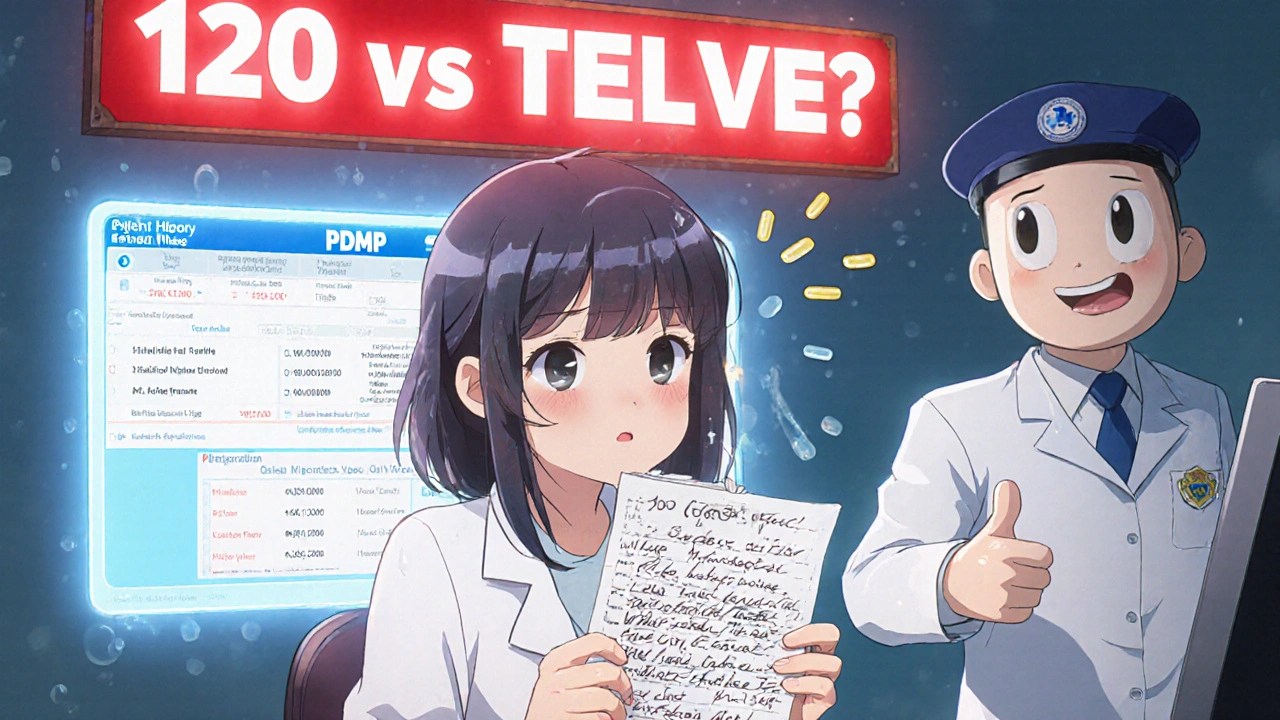
The biggest source of dispensing errors isn’t the DEA number. It’s the quantity and directions. In a 2022 University of Michigan study, pharmacists spent 42% of their total verification time just checking these two elements.Handwritten prescriptions are the worst. A 2023 Pharmacy Times survey found 68% of pharmacists struggle with illegible handwriting. One pharmacist in Texas told me: "I had a script for 120 hydrocodone tablets. The prescriber wrote '120' but the word said 'twelve.' I called. They meant 12. I saved a patient from an overdose."
With opioids, quantity isn’t just about the number-it’s about the total daily dose. The CDC’s 2022 opioid conversion guidelines say:
- Codeine: 0.15x morphine equivalent
- Fentanyl patch (25 mcg/hr): 2.4x morphine equivalent
- Hydrocodone: 1x
- Hydromorphone: 4x
- Methadone: 4x for under 20mg/day, up to 12x for over 80mg/day
If a patient is already on 60mg of hydrocodone daily (60 morphine equivalents) and you get a script for 30mg of methadone, you’re looking at 360 morphine equivalents. That’s six times the daily limit. That’s a red flag. You must cross-check this with the PDMP.
PDMP: Your Real-Time Safety Net
In 49 states, you’re legally required to check the Prescription Drug Monitoring Program (PDMP) before dispensing controlled substances. But not all PDMPs are created equal.Only 27 states require real-time data submission-meaning the prescription shows up in under five minutes. In 18 states, you’re waiting up to 24 hours. In four, it’s weekly. That’s a gap. In 2022, the DEA found 1,247 diversion cases where delayed PDMP data allowed someone to get multiple scripts from different doctors.
Use the NABP’s PMP InterConnect platform. It’s the only system that pulls data from multiple states in one search. Pharmacists who use it report a 37% reduction in verification time. In California, where CURES 2.0 is integrated with EHRs, verification takes 9 minutes on average. In Tennessee? 14 minutes. In New York? 7. But you don’t get to pick. You must check every time.
Electronic vs. Manual: What Works Best
You’ve got two choices: manual verification or electronic systems.Manual verification-hand-checking every field-is still used in 42% of independent pharmacies. But it’s error-prone. A 2014 University of Florida study found a 18.7% error rate with manual checks. That’s nearly 1 in 5 scripts with mistakes.
Electronic systems-used by 98% of chain pharmacies-are faster and more accurate. They auto-check DEA numbers, flag quantity mismatches, and pull PDMP data in seconds. But they cost $15,000 to $50,000 to install. And they must be DSCSA-compliant. As of November 27, 2023, the FDA requires every pharmacy to verify product identifiers on controlled substance packaging. If your system can’t read the 2D barcode or validate the serial number, you’re non-compliant.
DEA inspections in 2022 showed that pharmacies using DSCSA-compliant systems had only a 4% diversion rate. Non-compliant ones? 31%.

The Five-Point Verification Protocol
The American Society of Health-System Pharmacists (ASHP) recommends a 5-point checklist every pharmacist should follow:- DEA number validation - Use the math method. Don’t trust the screen.
- PDMP review - Check for multiple prescribers, early refills, high doses.
- Prescription integrity - Look for security paper, microprinting, tamper-evident boxes. If it looks like a photocopy, it probably is.
- Prescriber verification - Call the office. Say: "I’m verifying a controlled substance script for [patient]. Can you confirm the quantity and directions?"
- Clinical appropriateness - Does this make sense? Is the patient on other opioids? Are the doses within CDC guidelines? Is this a new patient with no history? If anything feels off, pause. Ask. Document.
This isn’t bureaucracy. It’s your shield. If something goes wrong, this checklist is your proof that you did your job.
What’s Coming Next
By 2026, every controlled substance prescription in the U.S. will need a QR code linked to a unique digital identifier. The DEA is rolling out this system to track every pill from manufacturer to patient. It’s part of the DSCSA package-level tracing mandate that took effect in November 2023.AI-assisted verification is already being piloted in 12 states. These systems flag patterns-like a patient getting scripts from three different doctors in one week-and alert pharmacists before they dispense. But the AMA is worried about privacy. The government says it’s about safety. You? You just need to know your tools are changing.
Final Word: Don’t Guess. Verify.
You’re not just filling a prescription. You’re the last line of defense. A single error can lead to addiction, overdose, or death. The DEA, FDA, and CDC have given you the tools. The law gives you the responsibility. The patients give you the reason.Don’t rely on memory. Don’t assume the prescriber knows what they wrote. Don’t skip the PDMP because you’re busy. Don’t think, "It’s probably fine."
Verify. Every time. Every field. Every script.
shawn monroe
November 27, 2025 AT 05:29DEA validation math? YES. I do this in my head while scanning scripts. 1st+3rd+5th = 9, 2nd+4th+6th x2 = 24, total 33 → last digit must be 3. If it's 5? RED FLAG. 98.7% of fakes caught. Don't trust the screen. Call the prescriber. Document. Repeat. This isn't optional-it's your armor. 🛡️
marie HUREL
November 29, 2025 AT 00:57I appreciate how thorough this is. I’ve had scripts where the sig said '1 q6h PRN' but the prescriber meant '1 q8h'-tiny difference, huge risk. I always call. It takes 90 seconds. Saves lives. And honestly? Most prescribers are grateful we double-check. We’re not hassling them-we’re protecting them too.
Asha Jijen
November 30, 2025 AT 11:19so like uhh check the numbers right? and call if its weird? yeah thats cool i guess
Edward Batchelder
December 1, 2025 AT 21:50reshmi mahi
December 2, 2025 AT 14:56laura lauraa
December 4, 2025 AT 14:44Kaleigh Scroger
December 5, 2025 AT 19:27The PDMP gap is the real crisis. 24-hour delays in 18 states? That’s not a system-that’s a liability waiting to happen. I work in a rural clinic. Last month, a guy got 3 scripts from 3 states in 72 hours. My PDMP hadn’t updated since yesterday. I called the DEA hotline. They said ‘we’re aware.’ That’s not good enough. We need real-time. Mandatory. Now. And if you’re not using PMP InterConnect, you’re playing Russian roulette with overdose deaths.
Elizabeth Choi
December 6, 2025 AT 16:25Let’s be honest-the 5-point protocol is performative. The DEA doesn’t care if you called the prescriber. They care if the DEA number math checks out. The PDMP? Only checked if there’s an audit. The rest? Paperwork to make you feel safe. Real compliance? It’s about avoiding the audit. Not saving lives. The system is designed to protect the system. Not the patient.