
When you hear the word biosimilars, it might sound like just another fancy drug term. But if you’re paying for biologic medications-like those used for rheumatoid arthritis, Crohn’s disease, or cancer-you need to know what they are and how they affect your wallet. Biosimilars aren’t generics. They’re not exact copies. But they’re close enough to work the same way, and they can cut your out-of-pocket costs by up to 30% or more. The big question isn’t whether they’re safe-it’s whether you’ll actually get to use them and save money.
What Exactly Are Biosimilars?
Biosimilars are versions of biologic drugs that have already been approved by the FDA. Biologics are complex medicines made from living cells-yeast, bacteria, or animal cells-not chemicals in a lab. Think of them like a handmade cake versus a boxed mix. You can replicate the cake, but you can’t copy the exact same ingredients or process every time. That’s why biosimilars aren’t identical to the original, but they’re highly similar in structure, function, and effect.
The FDA requires biosimilars to go through rigorous testing: comparing molecular structure, how the drug behaves in the body, and even clinical trials to prove it works just as well and is just as safe as the original. The first biosimilar approved in the U.S. was Zarxio in 2015, a copy of the cancer drug Neupogen. Since then, 45 biosimilars have been approved, targeting conditions like arthritis, inflammatory bowel disease, and multiple types of cancer.
Unlike generic pills-which are exact chemical duplicates of brand-name drugs-biosimilars can have minor differences in their manufacturing. These differences don’t affect safety or effectiveness, but they do mean you can’t just swap them in at the pharmacy like you would with a generic. Your doctor has to approve the switch.
Why Are Biosimilars Cheaper?
Biologics are expensive because they’re hard to make. Developing one can cost over $1 billion and take more than a decade. That’s why drugs like Humira cost around $7,000 a month. Biosimilars don’t need to repeat all those early-stage trials. They build on the original drug’s data, which cuts development time and cost. But they still need expensive labs, specialized equipment, and skilled scientists to produce them.
That’s why biosimilars don’t drop prices as much as generics do. While generics can be 80% cheaper, biosimilars typically launch at 15-30% less than the original. For example, when Humira biosimilars hit the market in 2023, their list price was about $5,000 per month-28% lower than Humira’s $7,000. That’s still a lot, but for patients on long-term treatment, it adds up. Over a year, that’s $24,000 saved.
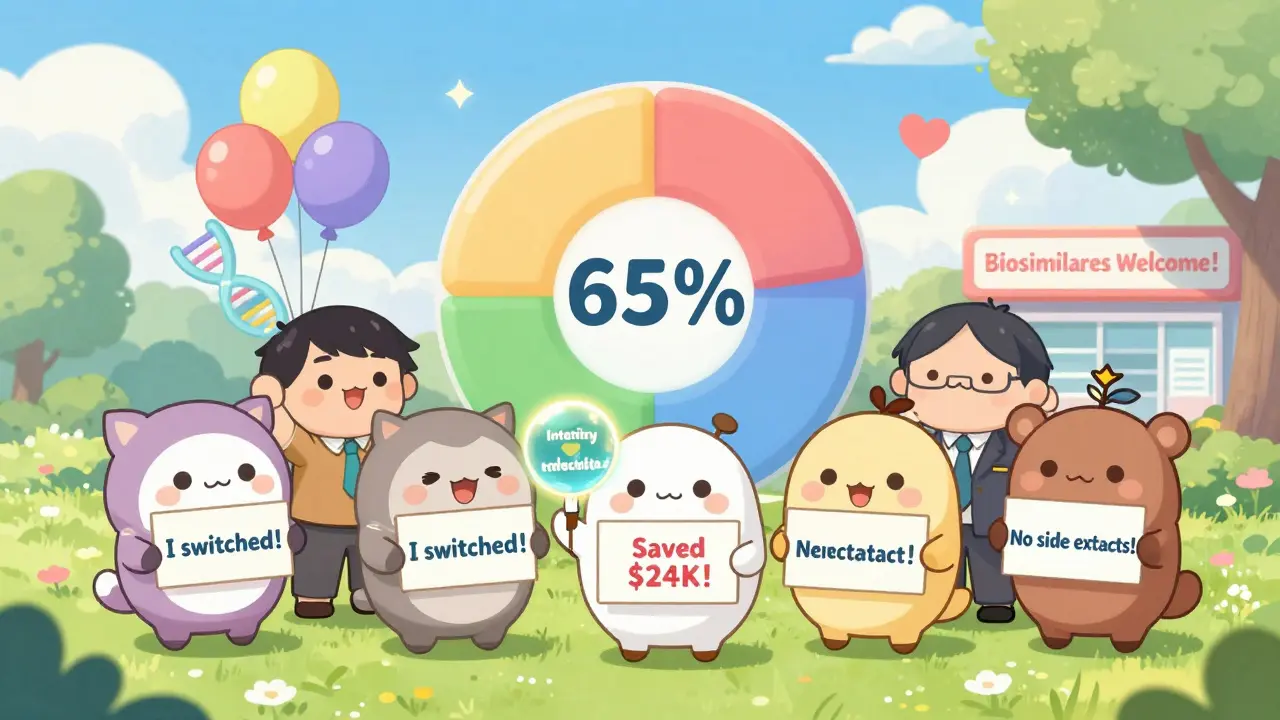
And prices keep falling. As more biosimilars enter the market, competition increases. In Europe, where biosimilars have been around longer, some drugs like filgrastim now have 84% market share for biosimilars. In the U.S., it’s lower-around 65% for some drugs-but growing fast. The Inflation Reduction Act of 2022 is helping too: starting in 2024, Medicare Part D patients will pay only 25% out-of-pocket for biosimilars, making them even more affordable.
Are Biosimilars Safe?
Yes. And this is the most common concern.
Many patients worry that if a drug isn’t identical, it might not work the same-or worse, cause side effects. But the science says otherwise. The NOR-SWITCH trial, a large study published in The Lancet, followed over 500 patients switching from the original biologic to a biosimilar. After 52 weeks, there was no increase in side effects or loss of effectiveness. The FDA, European Medicines Agency, and World Health Organization all agree: biosimilars are as safe and effective as the originals.
A 2022 survey by the Arthritis Foundation found that 87% of patients using biosimilars reported no difference in how well the drug worked compared to the brand-name version. And 72% said their out-of-pocket costs went down. Real people are using them-and thriving.
Some patients still feel uneasy. That’s normal. Switching from a drug you’ve been on for years can feel risky. But doctors who specialize in these treatments say the fear often comes from lack of information, not science. One rheumatologist on Reddit explained it this way: “I spend 10-15 minutes per patient explaining the evidence. Once they understand the data, most are happy to switch.”
Why Aren’t More People Using Them?
If biosimilars are safe and cheaper, why aren’t they everywhere?
One big reason: patent battles. Drug companies use legal tactics to delay biosimilar entry. They file lawsuits, extend patents on minor changes to the original drug, or bundle discounts with pharmacies to lock in customers. This is called “product hopping.” For example, while biosimilars took over 72% of the infliximab (Remicade) market within 18 months, they only captured 28% of the etanercept (Enbrel) market because of aggressive patent protection.
Another issue: insurance rules. Even if a biosimilar is cheaper, your plan might not cover it unless your doctor jumps through hoops. Some insurers require you to try the original drug first. Others won’t cover the biosimilar unless you’re switching from a specific brand. It’s confusing. A 2022 survey of oncologists found that 78% said navigating payer rules was their biggest challenge in prescribing biosimilars.
And then there’s the lack of awareness. Many patients don’t even know biosimilars exist. Or they think “biosimilar” means “lower quality.” That’s why education matters-not just for patients, but for doctors too. The American Society of Clinical Oncology found that most oncologists needed 1-2 hours of training before feeling confident prescribing them.
What’s the Future?
The next wave of biosimilars is coming fast. Seven are pending FDA approval for Stelara (ustekinumab), a top-selling drug for psoriasis and Crohn’s. Once they launch, savings could be huge-Stelara costs over $10,000 a year. And in July 2023, the FDA approved the first interchangeable biosimilar for Humira: Hyrimoz. Interchangeable means your pharmacist can swap it for the brand without asking your doctor-just like a generic.
By 2027, experts predict biosimilar use will rise from 25-30% to 50-60% for most biologics. The Congressional Budget Office estimates this could save the U.S. healthcare system $150 billion annually by 2030. But that only happens if barriers like patent thickets and insurance red tape are broken down.
Meanwhile, a new generation called “biobetters” is emerging. These are improved versions of biologics-longer-lasting, easier to inject, or with fewer side effects. They’re not biosimilars, but they’ll compete with them. That means even more options-and potentially more savings-for patients.
What Should You Do?
If you’re on a biologic drug and paying a lot for it:
- Ask your doctor: “Is there a biosimilar available for my medication?”
- Call your insurance company: “Do you cover biosimilars? What’s the process to switch?”
- Check the FDA’s Purple Book-it’s the official list of all approved biosimilars and their reference products.
- Don’t assume your insurance will automatically switch you. You may need to request it.
- If you’re nervous about switching, ask for data. Look up the clinical studies. Talk to other patients. You’re not alone.
Biosimilars aren’t magic. They won’t make every drug free. But they’re the most promising tool we have right now to bring down the cost of life-changing medicines. And they’re backed by science, real-world use, and growing evidence that they work.
Are biosimilars the same as generic drugs?
No. Generics are exact chemical copies of small-molecule drugs, like aspirin or metformin. Biosimilars are copies of complex biologic drugs made from living cells. They can’t be identical because the manufacturing process involves living organisms. Biosimilars are highly similar and work the same way, but they’re not exact duplicates.
Can I switch from a biologic to a biosimilar safely?
Yes, and many patients do. Studies like the NOR-SWITCH trial show no increase in side effects or loss of effectiveness when switching. The FDA and EMA both confirm biosimilars are as safe and effective as the original. However, your doctor should monitor you during the transition, especially if you’ve been on the original drug for years.
Why aren’t biosimilars cheaper than generics?
Because they’re harder and more expensive to make. Biologics require living cells, sterile environments, and complex testing. Biosimilars still need large-scale clinical trials to prove similarity. Generics just need to match a chemical formula. So while generics can be 80% cheaper, biosimilars typically start at 15-30% less, with potential for more savings as competition grows.
Can my pharmacist switch my drug to a biosimilar without asking my doctor?
Only if it’s labeled as “interchangeable” by the FDA-and only in states that allow it. As of 2023, only six biosimilars have that designation. Most require a doctor’s approval. Even if your state allows substitution, your insurance may still require prior authorization. Always check with your provider and pharmacy.
Do biosimilars have side effects?
They can, but not more than the original biologic. All biologics carry risks like infection, allergic reactions, or immune responses. Clinical trials and real-world data show biosimilars have the same safety profile. The FDA requires manufacturers to monitor for immunogenicity-how the body reacts to the drug-and report any issues. Post-marketing surveillance in Europe over 16 years has shown no unexpected safety concerns.
How do I find out if a biosimilar is available for my drug?
Check the FDA’s Purple Book, which lists all approved biosimilars and their reference products. You can also ask your doctor or pharmacist. Some patient advocacy groups, like the Biosimilars Council, offer free tools like “Biosimilars By Disease” to help you search by condition. Don’t rely on manufacturer websites alone-they may focus more on cost than clinical evidence.
Will my insurance cover a biosimilar?
Most do-but not always automatically. Many insurers require you to try the brand-name drug first (called step therapy). Some only cover biosimilars for new patients. Others have preferred lists. Call your insurer and ask: “Is there a biosimilar for [your drug name]? What’s the coverage process?” The Inflation Reduction Act now limits your out-of-pocket cost for biosimilars under Medicare Part D to 25% starting in 2024.
Final Thoughts
Biosimilars are not a gamble. They’re a proven, science-backed way to make expensive biologic drugs more affordable. The data is clear: they work. They’re safe. And they’re saving people money-right now. The biggest hurdle isn’t the science. It’s the system: insurance rules, patent delays, and misinformation.
If you’re paying hundreds or thousands a month for a biologic, don’t accept that as normal. Ask questions. Push for options. Use the tools available. You have the right to know what’s out there-and you deserve to pay less for the same treatment.
Fabian Riewe
December 29, 2025 AT 05:35Man, I was skeptical at first too-thought biosimilars were just cheap knockoffs. But after my doc switched me from Humira to one of the biosimilars, I’ve been fine for over a year. No flare-ups, no weird side effects. And yeah, my copay dropped from $400 to like $120. Seriously, if you’re paying a fortune for biologics, ask about this. It’s not magic, but it’s real.
Amy Cannon
December 30, 2025 AT 10:54While I appreciate the comprehensive overview provided in this post, I must express my profound concern regarding the systemic disincentives embedded within the current pharmaceutical regulatory and reimbursement architecture, which, despite the overwhelming clinical equivalency demonstrated by biosimilars, continue to perpetuate economic inequities for patients navigating chronic autoimmune conditions. The fact that insurers still mandate step therapy for drugs with over a decade of safety data is not merely bureaucratic-it is ethically indefensible.
Himanshu Singh
December 31, 2025 AT 00:18sooo i just found out my doc prescibed me a biosimilar last month and i had no idea! i thought i was still on the brand. but my bill was way lower and i felt the same. turns out i was switched without even being told. kinda scary but also kinda cool? glad it worked!
Greg Quinn
January 1, 2026 AT 00:58It’s fascinating how we treat molecules like they’re sacred objects-like if it’s not identical, it’s somehow less valid. But life doesn’t work that way. No two snowflakes are the same, no two handmade cakes taste exactly alike, and no two batches of biologics are chemically identical either. The body doesn’t care about the label on the vial. It cares about whether the signal gets through. And the data says it does. The real tragedy isn’t the science-it’s that we’ve turned healthcare into a market where fear sells better than evidence.
Lisa Dore
January 2, 2026 AT 15:58Hey everyone-just wanted to say if you’re nervous about switching, you’re not alone. I was terrified when I switched from Enbrel to a biosimilar. But I talked to my rheumatologist, read the Lancet study, and even joined a Reddit group for people on biosimilars. Everyone there had the same fears. Now I’m on it for 18 months and feel better than ever. And I saved $20k in 2 years. You got this. And if you need someone to talk to about it, DM me. I’m happy to help.
Sharleen Luciano
January 3, 2026 AT 23:27Look, if you’re okay with ‘close enough’ medicine, then sure, go ahead. But I’d rather pay $7,000 a month for the original than risk some lab’s inconsistent cell line producing a drug that might subtly degrade my immune response over time. Science is messy, and biosimilars are the pharmaceutical equivalent of a knockoff designer bag. It looks the same, but you know it’s not the same.
Jim Rice
January 5, 2026 AT 01:37Everyone’s acting like biosimilars are some miracle. Newsflash: they’re not. The FDA approves them based on ‘similarity,’ not ‘identical.’ That’s a loophole. And the real reason they’re cheaper? Because the original drug companies are paid to let them in-via patent settlements and pay-for-delay deals. This whole thing is rigged. You think you’re saving money? You’re just being funneled into a system designed to keep Big Pharma rich while pretending to care.
Henriette Barrows
January 6, 2026 AT 20:55My mom’s on a biosimilar for RA and she cried when she saw her copay. Not because she was sad-because she could finally afford to fill the prescription without skipping meals. I wish I’d known about this sooner. If you’re reading this and you’re scared to ask your doctor-just say ‘I want to explore biosimilars.’ That’s all it takes. No shame. No guilt. Just smart choices.
Alex Ronald
January 7, 2026 AT 10:13For anyone wondering about interchangeability: only 6 biosimilars have it right now, and even then, it depends on your state. But the Humira one-Hyrimoz-is a game-changer. Pharmacists can swap it without calling your doctor. That’s huge. It’s the first time a biosimilar has been treated like a true generic. Keep an eye on the Purple Book. And if your insurer pushes back, ask for the clinical trial IDs-they’re public. Knowledge is power.