
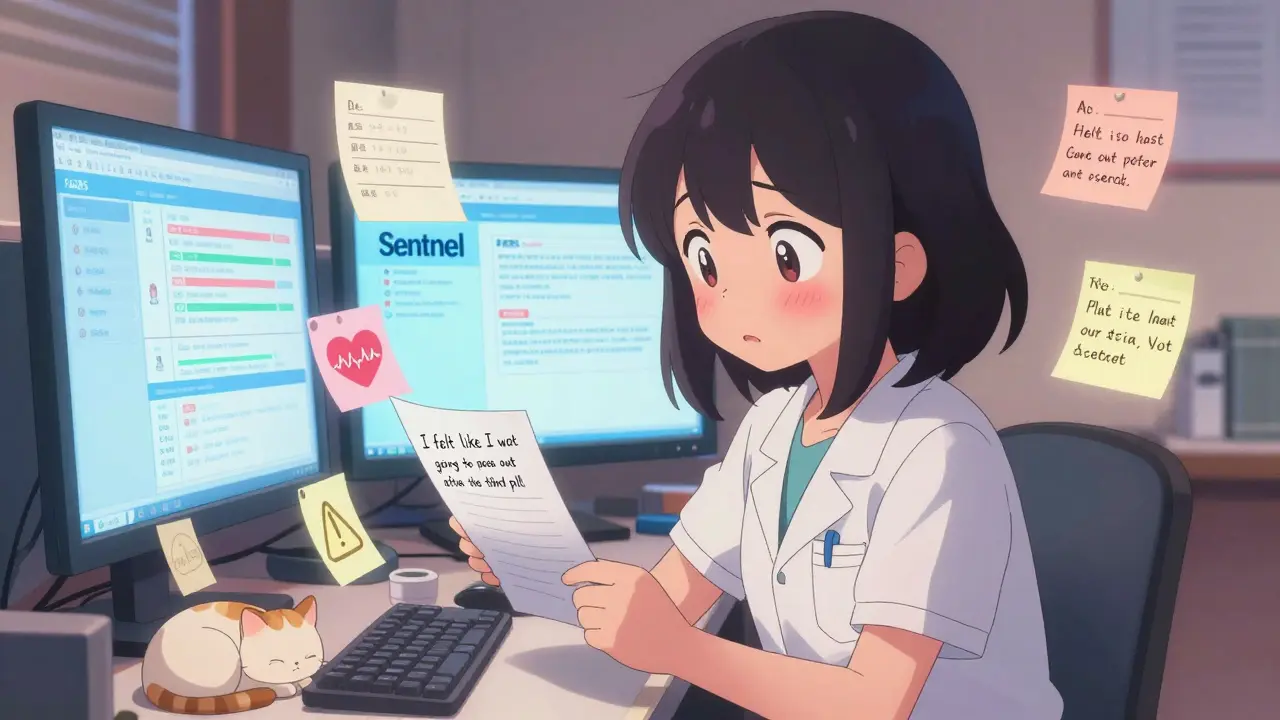
When a new drug hits the market, the work isn’t done. In fact, the real test of safety begins after approval. Pre-approval clinical trials involve a few thousand patients under tightly controlled conditions. They rarely include older adults, pregnant women, or people taking multiple medications. That’s where post-marketing surveillance comes in - the ongoing, real-world monitoring of how drugs behave once millions of people start using them.
Tracking these studies isn’t optional. It’s a legal requirement for drug manufacturers and a critical public health function. Missed signals can mean missed dangers. The FDA’s own data shows that 63% of safety actions - like updated warnings or restricted use - are triggered by reports from doctors, patients, and pharmacists after the drug is already out there. So if you’re responsible for managing drug safety, whether you work for a pharmaceutical company, a regulatory body, or a hospital pharmacy, knowing how to track these studies isn’t just helpful - it’s essential.
What Exactly Are Post-Marketing Studies?
Post-marketing studies, also called Phase IV studies, are not optional experiments. They’re mandated by regulators like the FDA and EMA when a drug’s initial data leaves gaps. These studies fall into three main types:
- Observational studies - tracking what happens in real life. For example, researchers might follow 10,000 patients on a new diabetes drug for five years to see if heart failure rates increase.
- Interventional studies - where patients are assigned to specific treatment arms, often to compare long-term outcomes against existing drugs.
- Database studies - analyzing existing electronic health records, insurance claims, or pharmacy databases to find patterns. These can reveal rare side effects that only show up in large populations.
Each study has a deadline. The FDA typically requires completion within three years. But according to the National Academies of Sciences, 72% of these studies run late - often by years. Why? Patient recruitment is slow. Data from different hospitals doesn’t talk to each other. And many companies don’t have the systems in place to track deadlines, milestones, or data quality.
The Core Systems Behind Drug Safety Tracking
Two major systems handle the bulk of safety data in the U.S.: FAERS and Sentinel.
FAERS (FDA Adverse Event Reporting System) is the oldest and most widely used tool. It’s a database with over 30 million reports from healthcare providers, patients, and drug companies. Anyone can submit a report - a nurse noticing unusual bleeding, a patient reporting dizziness, a pharmacist spotting a pattern. These reports are reviewed by teams of scientists who look for signals: unexpected side effects, clusters of reactions, or reactions that happen more often than expected.
But FAERS has limits. It’s passive. It relies on people reporting. Many events go unreported. And it doesn’t tell you if the reaction was caused by the drug or something else - like a patient’s other meds or underlying illness.
That’s where Sentinel comes in. This is an active surveillance system. It pulls data from insurance claims and electronic health records from over 300 million Americans. It can answer questions FAERS can’t: Did patients on this drug have more kidney injuries than those on a similar drug? Did they visit the ER more often? Were they hospitalized? Sentinel can even track lab values, vital signs, and diagnoses over time.
But even Sentinel has gaps. Dr. Janet Woodcock, former head of FDA’s drug division, pointed out that insurance claims often lack clinical details. If a patient has a seizure, did they have a brain tumor? Were they taking a new antibiotic? Without that context, signals can be misleading.

How to Set Up a Tracking System
Companies that manage multiple drugs need a centralized system. Here’s how to build one:
- Inventory all mandated studies - List every study required by regulators. Include the deadline, the sponsor, the study type, and the regulatory authority (FDA, EMA, etc.). Use a spreadsheet at first, then upgrade to a dedicated pharmacovigilance platform.
- Assign ownership - Every study needs a lead. That person tracks progress, flags delays, and communicates with investigators. Best practice: One pharmacovigilance specialist for every $500 million in annual sales of the product.
- Set automated alerts - Use software that sends reminders 90, 60, and 30 days before deadlines. Also set alerts for data milestones: 25% enrollment, 50% data cleaning, final analysis.
- Integrate data sources - Connect your tracking system to FAERS, Sentinel, and internal safety databases. If a new safety signal pops up in FAERS, your system should auto-flag related studies and pause enrollment if needed.
- Measure performance - Track the Post-Marketing Study Timeliness Index (PMSTI): the percentage of studies completed on time. Aim for above 85%. If you’re below 70%, you’re at risk of regulatory action.
One company reduced delays by 40% in two years just by implementing automated alerts and assigning clear ownership. They didn’t hire more staff. They just made the process visible.
Common Pitfalls and How to Avoid Them
Many teams fail not because they lack resources, but because they misunderstand the data.
- Mistake: Treating FAERS as a definitive source. Fix: Use FAERS to generate hypotheses, not conclusions. Always cross-check with Sentinel or published literature.
- Mistake: Waiting for regulators to ask for updates. Fix: Submit interim reports quarterly, even if not required. It builds trust and gives you early warning.
- Mistake: Ignoring international data. Fix: Monitor EudraVigilance (EU) and Canada Vigilance Program. A side effect seen in 100 patients in Canada might be invisible in the U.S. due to lower usage.
- Mistake: Assuming the study design is set in stone. Fix: Be ready to adapt. If new safety data emerges, you may need to change your inclusion criteria or add a new endpoint.
Also, don’t underestimate the power of plain text. Many safety signals come from patient reports written in their own words. A simple phrase like “I felt like I was going to pass out after the third pill” can be more telling than a coded lab result. Train your team to read these reports carefully - not just scan for keywords.
What’s Changing in 2025-2026
The field is moving fast. Here’s what’s next:
- Sentinel Common Data Model Plus (SCDM+) - Launching in 2024, this will add genomic data to the mix. If a patient has a rare genetic variant that increases drug toxicity, the system will flag it.
- EudraVigilance AI - The EU’s new system, launching in 2025, will use machine learning to detect signals 30% faster than current methods.
- LLMs in pharmacovigilance - Early pilots show AI can pull safety signals from unstructured EHR notes with 42% more accuracy. But false positives are still 23% higher than human review - so AI is a tool, not a replacement.
- Global data sharing - The WHO is building a network of 100 countries by 2027 to share adverse event data in real time. A reaction seen in Japan might be linked to one in Brazil within hours.
These tools will make tracking easier - but only if you’re ready to use them. Companies that integrate AI and global data into their workflows will get ahead. Those that stick to spreadsheets and manual checks will fall behind.
What You Can Do Today
You don’t need a $10 million system to start tracking effectively.
- Start with one drug. List all its post-marketing studies. Set up a simple calendar with deadlines.
- Sign up for FDA’s Drug Safety Communications. They’re free and updated weekly.
- Check FAERS data monthly. Look for spikes in reports related to your drug.
- Train your team to read narrative reports - not just coded fields.
- Connect with your regional pharmacovigilance center. Many offer free training and data-sharing tools.
Drug safety isn’t about perfection. It’s about awareness. The goal isn’t to catch every single side effect - it’s to catch the ones that could kill someone before it’s too late.
What’s the difference between FAERS and Sentinel?
FAERS is a passive database where anyone can submit reports of side effects - like a doctor writing in that a patient had a stroke after taking a drug. Sentinel is an active system that pulls data from electronic health records and insurance claims of over 300 million people. It can compare outcomes between drug users and non-users, track lab results, and identify patterns that FAERS can’t see. FAERS tells you what happened. Sentinel helps you figure out if the drug caused it.
Why do post-marketing studies often run late?
The biggest reasons are poor data access and patient recruitment. Hospitals don’t always share records. Patients drop out. Studies requiring long-term follow-up (5+ years) struggle to keep participants. Many companies also don’t have dedicated teams to manage timelines. The FDA found that 72% of mandated studies miss their three-year deadline, with an average delay of over two years.
Can AI replace human reviewers in drug safety monitoring?
No - not yet. AI tools like Large Language Models can scan thousands of patient notes and flag potential signals faster than humans. In FDA pilots, they improved detection accuracy by 42%. But they also generate 23% more false alarms. Human experts are still needed to interpret context: Was the patient taking another drug? Did they have a pre-existing condition? AI is a powerful filter, but not a decision-maker.
What’s the most common safety action taken after a post-marketing study?
Updating the drug’s label. Between 2018 and 2022, 87% of safety actions involved changing the prescribing information - adding new warnings, contraindications, or dosage limits. Other actions include sending letters to doctors (9%), tightening risk management plans (3%), and, rarely, removing the drug from the market (less than 1%).
How do I know if my drug has a safety signal?
Look for three things: 1) A sudden spike in reports to FAERS, especially from multiple sources; 2) A pattern in Sentinel data - like higher hospitalization rates among users; 3) Similar findings in international databases like EudraVigilance. If two or more systems show the same pattern, it’s likely a real signal, not random noise.
Tasha Lake
February 8, 2026 AT 14:14FAERS is basically a giant crowdsourced symptom log - it’s raw, messy, and full of noise, but it’s the first line of defense. The real gold is in the patterns: when you see 17 reports of angioedema in a 3-week window for a drug that’s been on the market for 18 months, that’s not coincidence. You gotta pair that with Sentinel’s granular data - lab trends, ER visits, concomitant meds - to triangulate causality. Otherwise, you’re chasing ghosts.
Sam Dickison
February 8, 2026 AT 15:3672% of Phase IV studies run late? Yeah, I’ve seen this first-hand. Sponsor teams treat deadlines like suggestions. The fix isn’t more staff - it’s automation. We built a Jira + Salesforce pipeline that auto-flags delays, pulls in site enrollment stats, and nudges PIs with calendar invites. No more ‘I thought the deadline was next quarter.’ Now we’re at 89% on-time completion. Simple. Clean. No drama.
Brett Pouser
February 9, 2026 AT 13:08Just wanted to say - this post nailed it. I work in a rural clinic where patients don’t even know what ‘adverse event’ means. But when they say, ‘Doc, I feel like my heart’s gonna jump outta my chest after this pill,’ you listen. Those unstructured narratives? They’re the heartbeat of safety. We started training our nurses to transcribe them verbatim into our system. Last month, we caught a rare bradycardia pattern just from three patient quotes. No coded fields. Just real talk.
Karianne Jackson
February 11, 2026 AT 04:14THIS IS WHY DRUGS KILL PEOPLE.
Chelsea Cook
February 12, 2026 AT 10:38Ohhh so you mean we’re supposed to *actually do our jobs*? Not just slap a ‘compliance’ sticker on a spreadsheet and call it a day? Wow. Mind blown. Next you’ll tell us to wash our hands before surgery. 🤯
John Sonnenberg
February 12, 2026 AT 10:54Let me get this straight: we’re trusting a database that gets reports from ‘anyone’ - including people who think their headache was caused by aspirin after they ate a burrito - to drive regulatory decisions? And you call this science? This isn’t pharmacovigilance. This is a reality TV show called ‘Who’s Got the Worst Side Effect?’
Jessica Klaar
February 12, 2026 AT 20:14I’ve been on both sides - pharma and hospital pharmacy - and I can tell you this: the real breakthrough isn’t AI or Sentinel. It’s communication. When our team started sharing FAERS signals with the EMA’s EudraVigilance team via a shared Slack channel (yes, really), we caught a cardiac arrhythmia pattern 4 months earlier. International data isn’t just nice to have - it’s a lifeline. We need more of this. Not more tech. More trust.
PAUL MCQUEEN
February 14, 2026 AT 07:37Why are we still using spreadsheets? It’s 2025. You don’t need a $10M system - you need a single person who actually knows what a ‘safety signal’ looks like. But no, instead we hire 12 interns to copy-paste from PDFs. And then we wonder why we miss things. The system isn’t broken. The people running it are.
glenn mendoza
February 15, 2026 AT 06:06While the technical frameworks outlined here are indeed commendable and reflect a robust commitment to public health stewardship, I would respectfully posit that the human element remains the most underleveraged asset in pharmacovigilance. The discipline is not merely one of data aggregation or algorithmic pattern recognition - it is fundamentally an act of ethical vigilance, rooted in the dignity of patient narratives and the moral imperative to protect the vulnerable. One must never mistake efficiency for efficacy.
Randy Harkins
February 16, 2026 AT 00:07AI is a game-changer - 42% more accurate? Yes please. But I’ve seen too many teams treat it like a magic wand. One of our LLMs flagged 147 ‘possible liver injuries’ in a week. Turned out 143 were patients on statins + alcohol. The AI didn’t know that. Human reviewers did. So we built a hybrid workflow: AI filters, humans validate. It cut false positives by 60%. AI isn’t replacing us - it’s making us better.
MANI V
February 16, 2026 AT 19:00Of course the studies run late. Everyone is too busy chasing profits. Pharma companies don’t care about safety - they care about quarterly earnings. Patients are just numbers on a balance sheet. This whole system is a joke. You think a few automated alerts will fix this? Wake up. The system is corrupt.
Simon Critchley
February 17, 2026 AT 08:46FAERS is the Wild West. Sentinel? Now we’re talking - it’s like having CCTV in every ER. But here’s the kicker: we’re still stuck in 2010 with our data pipelines. Why? Because no one wants to touch legacy EHRs. I’ve seen teams spend 18 months just getting a single hospital’s data to talk to their system. The real innovation isn’t AI - it’s data integration. That’s the ugly, boring, vital work. No one wants to do it. So we’re all stuck in the dark.
Tom Forwood
February 18, 2026 AT 04:51Biggest tip? Stop overthinking it. I manage 8 drugs. Every Monday I check FAERS for spikes, update my Notion tracker, and ping the team if anything looks weird. No fancy AI. No dashboards. Just a calendar and a habit. We caught a rare kidney issue last year because a patient wrote ‘I peed blood after the third dose’ - and our med rep actually read it. That’s it. Be present. Don’t just automate.
John McDonald
February 19, 2026 AT 09:05Love this breakdown. But let’s be real - most companies don’t even have a dedicated pharmacovigilance lead until they get slapped by the FDA. Why wait? If you’re managing a drug with $100M+ in sales, you need someone on it full-time. Period. It’s not a cost center - it’s your liability shield. Build it now, before the audit hits.
Andy Cortez
February 20, 2026 AT 15:41So you’re telling me we’re trusting a system built on ‘reports from patients’ to keep people alive? What if someone reports a side effect because they’re mad their ex left them? Or they think their dog’s barking is ‘drug-induced hallucination’? This is why we can’t have nice things. The FDA is running a fanfiction forum. Someone needs to shut this down.