

When you’re flying across multiple time zones, your body gets thrown off balance - sleep, hunger, even your medication schedule. For most people, forgetting a vitamin is a minor issue. But for travelers taking antimalarials or antiretroviral drugs for HIV, a missed or mistimed dose can mean serious consequences: drug resistance, treatment failure, or even life-threatening infection. The good news? With the right plan, you can stay on track no matter how many time zones you cross.
Why Timing Matters More Than You Think
It’s not just about remembering to take your pills. It’s about keeping drug levels steady in your bloodstream. If levels drop too low, the disease can come back - or worse, the pathogen learns to resist the drug. This is especially true for antimalarials like atovaquone-proguanil (Malarone) and antiretrovirals like dolutegravir or tenofovir.
For example, Malarone needs to be taken daily with food. If you skip a dose or take it on an empty stomach during a long flight, your body absorbs less than half the drug. A 2008 pharmacology study found that taking Malarone with fatty food boosts absorption by 300-400%. Miss that, and you’re unprotected.
Similarly, some HIV medications have a narrow window - just 4 to 6 hours - before their effectiveness drops. If you’re on a protease inhibitor like lopinavir, a 12-hour delay during a flight from New York to Tokyo could put you at risk of viral rebound. That’s why travelers with HIV are advised to plan ahead, not just pack pills.
Antimalarials: The Three Main Types and Their Rules
There are three main antimalarial drugs used for prevention, and each has different timing rules.
- Atovaquone-proguanil (Malarone): Start 1-2 days before entering a malaria zone. Take it daily, always with food or milk. Continue for 7 days after leaving. If you miss a dose, take it as soon as you remember - but if you’re in a high-risk area, you may need to extend protection for up to 4 weeks after resuming.
- Chloroquine: Taken weekly. Start 1-2 weeks before travel. Dose is based on weight: 10 mg per kg on days 1-2, then 5 mg per kg weekly. Easy to remember, but not effective in many regions due to resistance.
- Mefloquine: Taken once a week. Can be taken up to 10 days before travel. It’s flexible - you can stick to your home time zone schedule for weeks. But it comes with risks: 12.3% of users report anxiety, dizziness, or hallucinations, according to a 2017 NEJM study.
Artemether-lumefantrine is used for treatment, not prevention. It requires four tablets right away, then another four 8 hours later, followed by twice daily for two more days. And yes - each dose must be taken with fatty food. No food? No drug absorption. This makes it nearly impossible to use on long flights or in places where meals aren’t reliable.
Antiretrovirals: Forgiveness Windows and Flight Durations
Not all HIV meds are created equal. Some can handle a delay. Others can’t.
Here’s what the data shows:
| Drug Class | Example Drug | Maximum Safe Delay |
|---|---|---|
| Integrase Inhibitors | Dolutegravir | 12 hours |
| Integrase Inhibitors | Raltegravir | 8 hours |
| NRTIs | Tenofovir | 6 hours |
| NRTIs | Emtricitabine | 6 hours |
| Protease Inhibitors | Lopinavir | 4-6 hours |
That means if you’re on dolutegravir, you have more room to breathe. If you’re on lopinavir, you need to be precise. The longest commercial flight - Singapore Airlines SQ22 from Newark to Singapore - lasts 18 hours and 45 minutes. If you’re on a tight-window drug, you need a plan before you even board.

How to Adjust Your Schedule Before You Fly
You don’t have to jump straight into the new time zone. Gradual shifting works better.
For antiretrovirals crossing more than 8 time zones:
- Start adjusting your dosing time 72 hours before departure.
- Shift your dose by 1-2 hours per day toward your destination time.
- For example: If you take your pill at 8 p.m. New York time and are flying to Bangkok (11-hour difference), start taking it at 10 p.m. on Day 1, 12 a.m. on Day 2, and 2 a.m. on Day 3.
- On the flight, take your dose at the time you would have taken it at home - then switch to destination time once you land.
For antimalarials:
- Calculate your "dose zero" based on when you’ll arrive at your destination - not when you leave.
- If you’re flying out of Chicago at 1 p.m. and landing in Nairobi at 8 a.m. the next day (7-hour time difference), your first dose should be taken at 8 a.m. Nairobi time - even if that means taking it at 1 a.m. Chicago time on your departure day.
A 2021 study found that 41.7% of travelers got this wrong - and ended up unprotected.
Real Problems Travelers Face (And How to Solve Them)
Here’s what actually goes wrong on the ground:
- Sleeping through alarms: One traveler on Reddit missed doses on a 16-hour flight and had a viral load spike within weeks. Solution: Set multiple alarms. Use Medisafe or similar apps - they have 4.7-star ratings and 12,000+ reviews.
- Food not available: Malarone and artemether-lumefantrine need fat to work. On a long flight? Pack peanut butter packets, cheese sticks, or nuts. Don’t rely on in-flight meals.
- Language barriers: If you need to refill meds abroad, carry a doctor’s note in local language. Some pharmacies won’t fill prescriptions without it.
- Jet lag messing with routines: If you’re exhausted, you’ll forget. Try to sleep on the flight, then adapt to local time as soon as you land.
Pro tip: Print out your dosing schedule. Write the time in both your home zone and destination zone. Tape it to your phone case. Carry a backup pill in your wallet.
New Tools Making It Easier
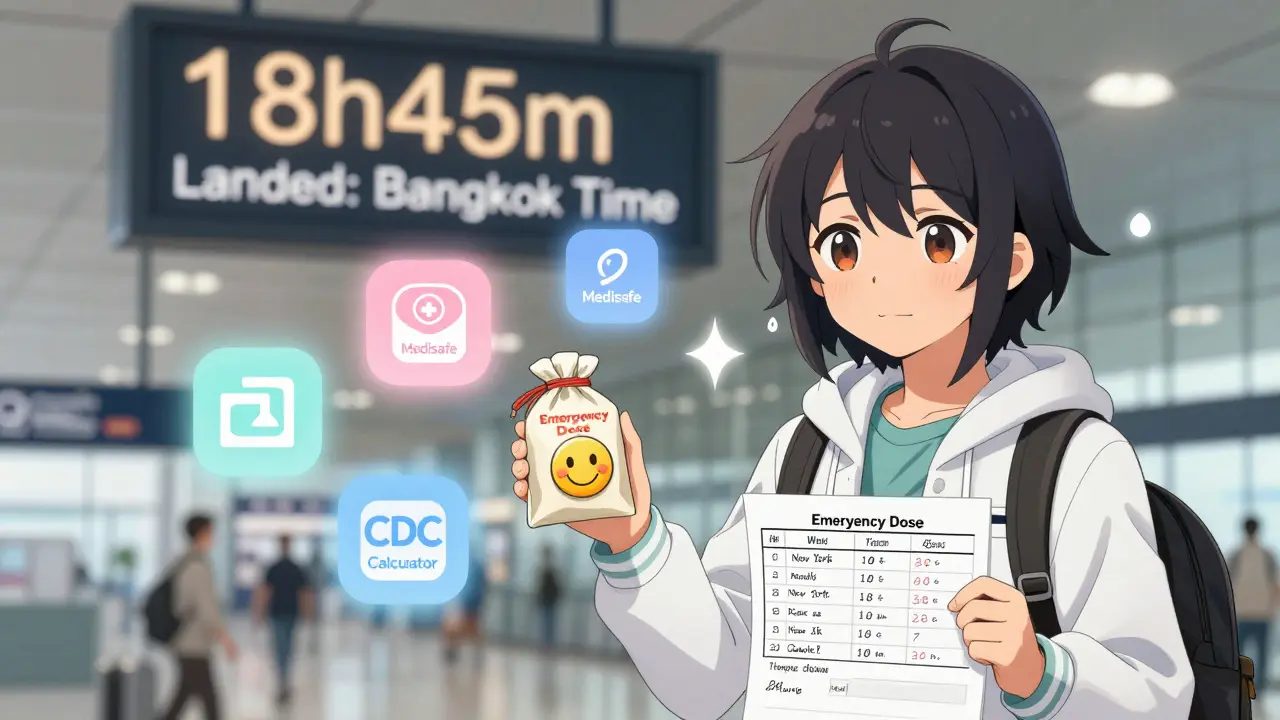
In February 2024, the CDC launched its Malaria Prophylaxis Timing Calculator. You input your flight details, destination, and medication - and it spits out a personalized schedule. A pilot study at Johns Hopkins showed it cut timing errors by 63%.
For HIV patients, long-acting injectables like cabotegravir/rilpivirine are now available in 17 countries. You get one shot every month - no daily pills. But access is still limited.
By late 2025, AI-powered apps are expected to launch that predict jet lag intensity and adjust dosing times automatically. Until then, stick with proven methods.
What You Should Do Before You Leave
Don’t wait until the airport. Here’s your checklist:
- See your doctor 4-6 weeks before travel. Discuss your medication and itinerary.
- Ask for a written dosing schedule with home and destination times.
- Get extra pills - at least 10% more than you think you’ll need.
- Download a medication app (Medisafe, MyTherapy, or Dosecast).
- Carry a doctor’s note explaining your meds - especially if you’re crossing borders.
- For antimalarials: Know your destination’s malaria risk level. Some areas need stronger protection.
And remember: if you miss a dose, don’t panic. But don’t ignore it either. For Malarone, if you miss a dose in a high-risk area, keep taking it for 4 full weeks after you resume. That’s not optional.
Final Thought: It’s Not Just About Pills - It’s About Routine
Traveling with medication isn’t about being perfect. It’s about being prepared. The body doesn’t care if you’re on a plane, in a hotel, or at a market. It responds to consistent drug levels. The same rules that apply at home apply abroad.
Use tools. Ask for help. Plan ahead. And don’t assume your usual routine will work on the other side of the world.
Can I take antimalarials without food?
No - not if you want protection. Drugs like Malarone and artemether-lumefantrine need fat to be absorbed properly. Taking them on an empty stomach can cut effectiveness by over half. Always take them with a meal, milk, or at least a handful of nuts or cheese.
What if I miss a dose of my HIV medication during a flight?
It depends on the drug. If you’re on dolutegravir, you can be up to 12 hours late without major risk. But if you’re on a protease inhibitor like lopinavir, even a 6-hour delay can increase resistance risk. Take the missed dose as soon as you remember - then stick to your new schedule. If you’re unsure, contact your doctor. Never double up unless instructed.
Do I need to adjust my antimalarial schedule if I’m only crossing 2 time zones?
Not necessarily. If you’re crossing fewer than 3 time zones, you can usually stick to your home time zone schedule. But if you’re in a high-risk area, it’s safer to switch to local time as soon as you land. Always check with your doctor - some regions have higher resistance rates.
Are there apps that help with timing meds across time zones?
Yes. Medisafe (iOS/Android) is rated 4.7/5 with over 12,000 reviews. It lets you set location-based alarms, syncs with your calendar, and sends reminders in multiple time zones. The CDC’s Malaria Prophylaxis Timing Calculator (launched in 2024) is also free and built for travelers.
Can I use mefloquine because it’s weekly and easier to manage?
It’s easier to schedule - yes. But it’s not safer. About 12.3% of users report serious side effects like anxiety, dizziness, or hallucinations. If you have a history of depression, seizures, or heart issues, avoid it. The CDC recommends it only if other options aren’t suitable.
Laura Gabel
March 16, 2026 AT 01:58Just took Malarone on an empty stomach in Bangkok and thought I was fine. Turned out I wasn't. Got malaria. Don't be me.
David Robinson
March 17, 2026 AT 03:37Everyone's acting like this is rocket science. It's not. Take your pills with food. Set alarms. Carry nuts. Done. Stop overcomplicating it. I've done 17 international trips with HIV meds and never missed one. No app needed. Just discipline.
Jeremy Van Veelen
March 18, 2026 AT 08:31Let me just say this: the CDC’s new calculator? It’s not a calculator. It’s a lifeline. I was on lopinavir, flying from NYC to Mumbai. 18-hour flight. I almost didn’t make it. I used the tool. It told me to take my dose at 3:47 AM EST. I did. I landed. I lived. This isn’t advice. This is survival.
jerome Reverdy
March 18, 2026 AT 19:45For those of you stressing about timing - chill. The body’s circadian rhythm isn’t some rigid clock. It’s a tide. You can shift it. If you’re on dolutegravir? You’ve got 12 hours of wiggle room. That’s like a whole nap. Even if you sleep through one alarm, you’re probably fine. But yeah - always pack peanut butter. I keep three single-serve packets in my pocket. I’ve saved more than one flight with that. Also - if you’re on mefloquine and have ever cried for no reason? Stop. It’s not stress. It’s the drug.
Andrew Mamone
March 19, 2026 AT 16:12App recommendation: Medisafe. 📱✅ I use it for my HIV cocktail. Location-based alerts. Time zone auto-adjust. Backup reminders. My phone buzzes even if I’m on silent. It saved me on my trip to Bali. 10/10. Also - always carry a printed schedule. Paper doesn’t die. Batteries do. 💾
MALYN RICABLANCA
March 21, 2026 AT 07:18Oh. My. GOD. I just realized I’ve been taking Malarone with black coffee for three years. THREE. YEARS. And now I’m reading that fat absorption boosts it by 400%?!?! I’m basically a walking Petri dish. I’ve been lucky. I’ve been a fool. I’m not just crying - I’m sobbing. I’m going to get malaria and die alone in a hostel in Laos. My cat will find my body. She’ll stare at my phone with the Medisafe app still blinking. I’m so sorry, Mom.
gemeika hernandez
March 22, 2026 AT 20:36Just take your pill. Eat something. Sleep. That’s it. No apps. No charts. No science. You’re overthinking. I went to Kenya. Took my pill. Ate a banana. Lived. Done.
Nicole Blain
March 23, 2026 AT 18:02Just did a 14-hour flight from LA to Sydney. Took my antimalarial with a cheese stick I packed. Napped. Woke up. Took another. Felt fine. 🧀😴
Kathy Underhill
March 25, 2026 AT 01:51The body doesn’t care about borders. It cares about consistency. Whether you’re in Chicago or Cusco, the drug needs to be there, at the right level, at the right time. The tools help. But the real discipline is in the quiet repetition - the habit, not the hack. A pill with food. Not a ritual. Not a performance. Just care.
Alexander Pitt
March 26, 2026 AT 18:12For anyone on dolutegravir: you’re in the lucky club. 12-hour window? That’s a luxury. I’ve had patients miss doses during layovers and not even blink. But if you’re on a protease inhibitor - especially lopinavir - treat it like a bomb timer. 6 hours is your limit. I’ve seen viral rebound from a missed flight meal. Don’t gamble. Plan. Always plan.
Manish Singh
March 27, 2026 AT 18:13I’m from Mumbai. We’ve been dealing with malaria for generations. No fancy apps. No calculators. We just knew: take it with food. Never skip. Always carry nuts. My uncle took chloroquine for 20 years. Never got sick. Simple rules. You don’t need tech. You need sense.
SNEHA GUPTA
March 28, 2026 AT 12:48It’s funny how we treat medicine like it’s a performance. We obsess over timing, apps, charts - but forget the simplest thing: consistency. You don’t need to be perfect. You just need to be present. Take the pill. Eat something. Breathe. That’s the whole protocol. Everything else is noise.
Gaurav Kumar
March 29, 2026 AT 05:55Why are Americans so obsessed with apps? In India, we’ve been managing antimalarials for decades without a single app. We use alarms on our phones. We eat with our meals. We don’t need a CDC calculator. We need discipline. And respect for the disease. This isn’t a game. It’s survival.
Ayan Khan
March 29, 2026 AT 09:02I traveled to rural Laos last year on antiretrovirals. No internet. No power. No alarms. I set a manual watch to my home time. Took my pills at 9 p.m. every night. Landed. Adjusted. No problem. The human body adapts. So do we. We don’t need tech to be responsible. We just need to remember: this isn’t about convenience. It’s about survival.
Kal Lambert
March 30, 2026 AT 19:03Biggest tip? Don’t wait until you’re on the plane. Talk to your doctor 4-6 weeks out. Get a written schedule. Print it. Tape it to your phone. Carry a backup pill. You’ll thank yourself when you’re exhausted, jet-lagged, and trying to figure out if it’s 3 a.m. or 3 p.m. in Bangkok. Simple. Practical. Effective.