
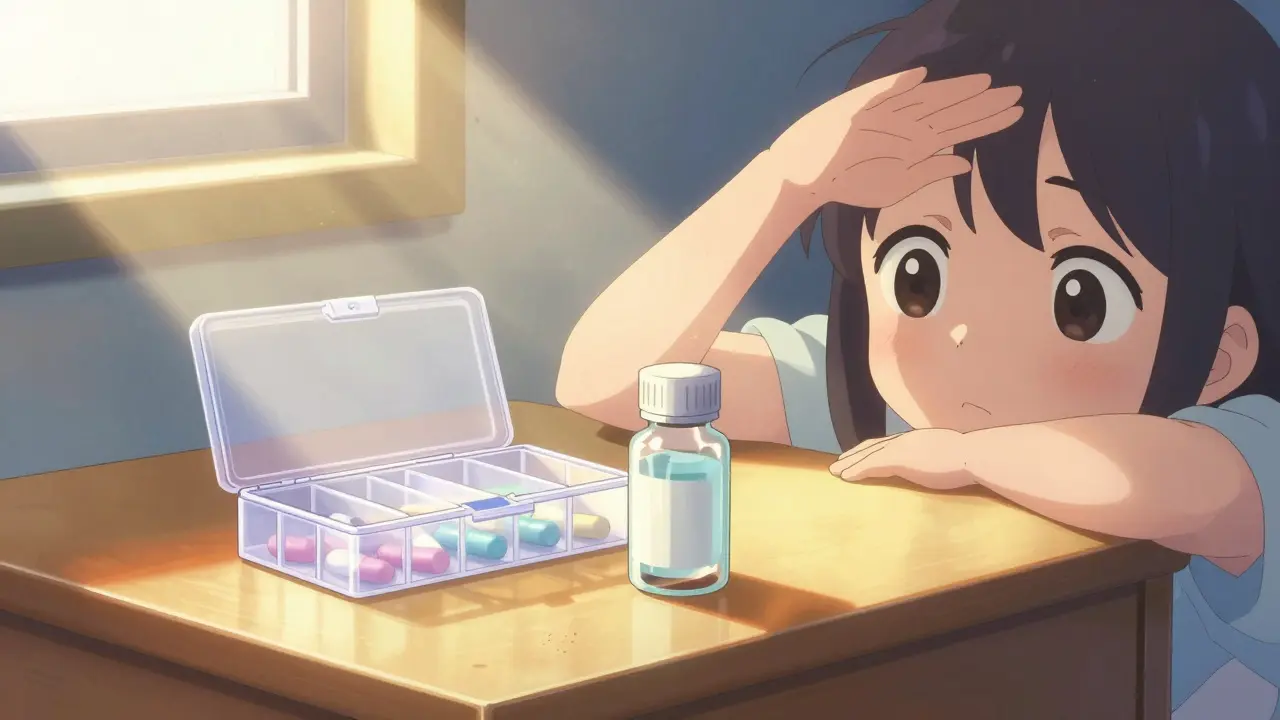
You might think your medicine cabinet is safe enough, but light can sneak in and ruin your prescriptions faster than you realize. If you have ever wondered why your eye drops stop working or if your pills look slightly different than when you bought them, the culprit might be something as simple as the sun shining through your window. We often focus on temperature, but light exposure is just as critical for many drugs. Improper storage doesn't just change the color; it reduces potency by up to 50%, which means you are paying for medicine that doesn't work.
This isn't just about keeping things cool anymore. With modern pharmaceuticals becoming more complex, especially biologic therapies and liquid ophthalmic solutions, protecting them from ultraviolet radiation has become a standard part of treatment plans. Whether you are dealing with chronic eye conditions or managing daily supplements, understanding how to store these sensitive items correctly ensures they do their job when you need them most.
The Science Behind Light Degradation
To understand why you need special storage, you need to know what happens to your medicine under the right conditions. Many active ingredients in medications react chemically when exposed to photons, specifically in the ultraviolet spectrum. This process, known as photodegradation, breaks down the chemical bonds that make the drug effective. When these bonds break, the medication loses its strength. In some cases, like with tetracycline antibiotics, the breakdown products can actually be harmful if ingested.
Think of light like a slow-acting eraser. It doesn't happen overnight, but over weeks of sitting on a sunny windowsill or near a bright fluorescent bulb, the damage accumulates. Research from the US Pharmacist analysis in 2022 highlighted that nearly half of parenteral drugs require some level of light protection during storage. That is a significant number considering these are drugs meant to save lives. For topical creams or eye drops, the risk is even higher because liquids absorb light more readily than solid tablets.
Photodegradation is a chemical reaction where compounds break down due to light energy absorption. This phenomenon affects light-sensitive medications significantly, reducing efficacy.If you notice your cream turning yellow or your clear eye drops becoming cloudy, those are visual cues of this reaction taking place. It is not just cosmetic; it indicates the drug molecule itself has changed structure.
Identifying Your Light-Sensitive Medicines
Not every pill needs a dark vault, but knowing which ones do is crucial. You should check the label of your prescription first. Look for phrases like "protect from light," "store in original container," or symbols indicating light sensitivity. However, relying solely on memory can be risky. Many patients move pills into weekly organizers for convenience, forgetting that these organizers are often translucent or clear.
Certain categories of drugs are almost always sensitive to light. Chemotherapy agents, hormonal treatments, and insulin are high-risk. For eye drops specifically, nearly all aqueous formulations degrade quickly without UV shielding. The American Academy of Ophthalmology recommends that multi-dose bottles remain in their original packaging because transferring them to smaller travel vials can expose the remaining solution to damaging wavelengths. Even if the travel vial is brown, repeated opening exposes the contents to ambient light.
Choosing the Right Storage Location
The bathroom might seem like the logical place for eye drops, especially if you apply them upon waking up. However, bathrooms are notorious for being the worst place to store medication. The combination of humidity from showers and fluctuating temperatures creates a perfect storm for instability. Heat alone can accelerate the effects of light exposure.
A dedicated cabinet in the bedroom or living room, away from direct sunlight, is usually best. A drawer is better than a shelf because closing the door blocks out the morning sun. If you live in a region with intense sun year-round, consider a closet that faces away from windows. Aim for an environment that stays between 59 and 77 degrees Fahrenheit. Anything hotter than 86 degrees risks breaking down proteins in biologics, which might already be compromised by UV rays.
Bathroom Medicine Cabinet is often cited by Pharmacists as an unsuitable location due to humidity and temperature fluctuations affecting light-sensitive medications.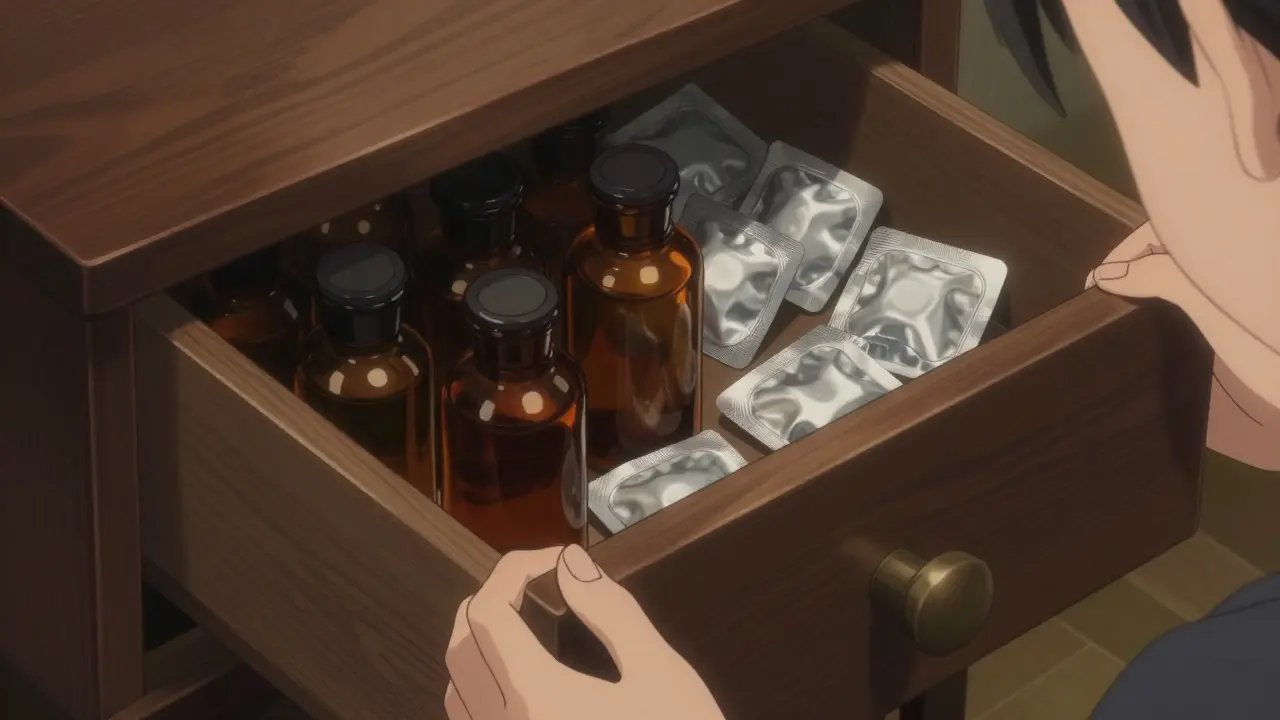
Container Types and Material Protection
The bottle the pharmacy gives you is likely designed specifically for that drug. Amber glass remains the gold standard for blocking ultraviolet light, offering roughly 98% protection against harmful rays. Plastic containers with similar tinting exist but typically block only about 85% of UV radiation. While glass is heavier and prone to shattering, its protective properties are superior for long-term stability.
Some medications come in opaque blister packs made of aluminum. These offer 100% light protection until you open them. However, once you pop the tablet out into a palm-sized organizer, you lose that shield. If you use a pillbox, choose one that is opaque black rather than clear plastic. If your doctor prescribes compounded creams that come in clear tubes, ask the pharmacist for a secondary amber tube or keep it inside a drawer immediately after dispensing.
| Container Type | UV Protection Level | Durability | Best Used For |
|---|---|---|---|
| Amber Glass Bottle | High (98%) | Fragile | Liquid solutions, long-term storage |
| Opaque Plastic Bottle | Moderate (85%) | Impact Resistant | Tablets, daily transport |
| Aluminum Foil Pouch | Maximum (100%) | Single-use only | Hospitals, short-term handling |
| Transparent Pill Organizer | Low (<50%) | Durable | Non-light-sensitive meds only |
Handling Eye Drops with Precision
Eye drops are uniquely vulnerable because the volume is small, meaning the entire contents can degrade quickly. Unlike a bottle of ibuprofen where you take one pill at a time, you are using a shared reservoir for every dose. Each time you unscrew the cap and hold the bottle toward the light to check the stream or aim for the eye, you risk exposing the remaining liquid.
A practical tip often overlooked is to wipe the outside of the bottle before storing it back in the cabinet. Residue left on the threads can catch bacteria, but also, if it's a colored cap, the dye can sometimes leach or degrade. More importantly, keep the bottle upright. Storing them sideways can cause the liquid to touch the rubber stopper, potentially introducing contaminants or absorbing chemicals from the dropper material. Always close the bottle tightly immediately after application.
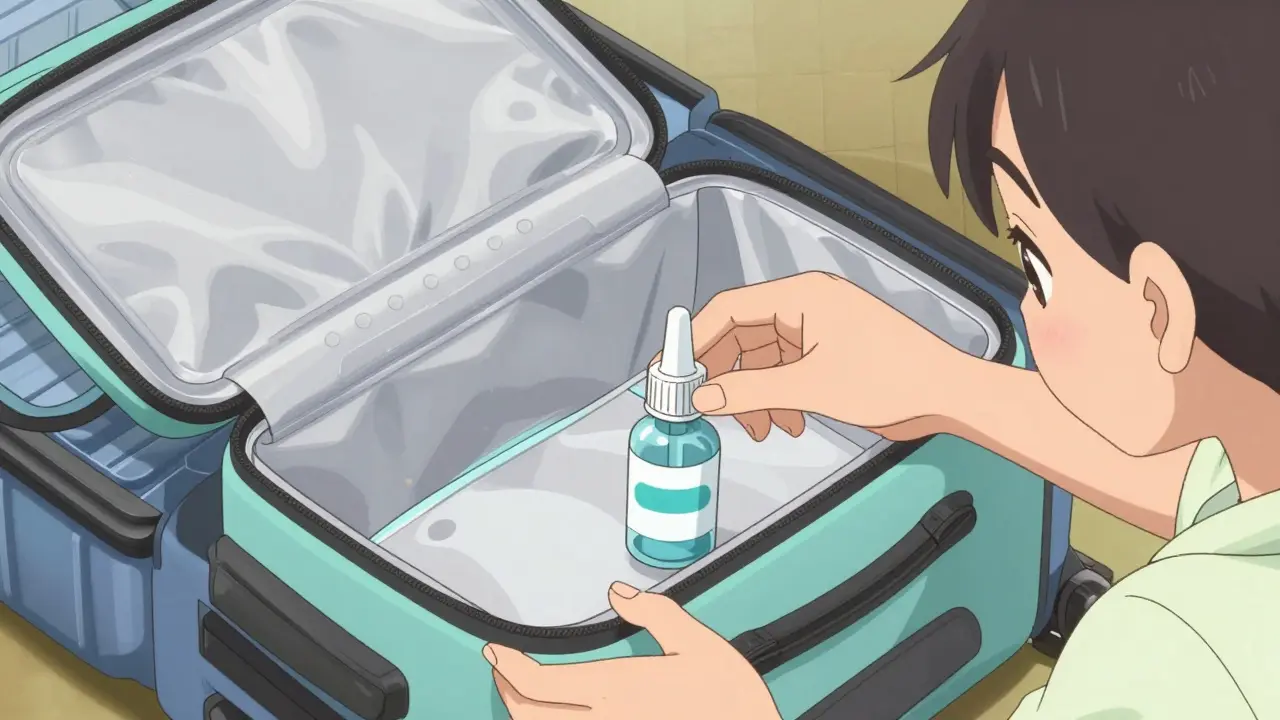
Traveling Safely with Sensitive Meds
When you pack for a trip, the stakes go up. Airport security requires inspection of liquids, and TSA agents might leave your eye drops out of the bag for a moment. During this transit, sunlight through the terminal windows or the hot car trunk can be disastrous.
Invest in a travel case specifically designed for UV protection. These insulated bags often have a UV-blocking lining that keeps both light and heat out. For short trips, simply keeping the original amber bottle inside a sealed bag works well. Do not transfer meds to decanted, non-protective bottles just to save space. If you are traveling to a destination with extreme heat, carry a small cooler bag. Remember that airplane cargo holds can freeze, so keep light-sensitive biologics in your carry-on luggage to maintain proper temperature ranges.
Recognizing Signs of Degradation
Your eyes are good detectors. Before discarding old meds, check them periodically. Tablets that are cracked, crumbled, or changed color are prime indicators of stress. Liquid medications like eye drops should be clear; any cloudiness or floating particles suggests contamination or breakdown. Some creams develop a distinct sour smell, unlike their fresh scent.
If a medication expires, do not rely on the date alone if it looked degraded earlier. Sometimes expiration dates assume ideal storage conditions. If you kept your nitroglycerin on a kitchen counter near the sink where steam rose from pots, it likely expired months before the label said so. When in doubt, throw it out. The cost of a refill is far less than the cost of ineffective treatment.
Safe Disposal Methods
Growing light-sensitive waste shouldn't be thrown directly into recycling bins or flushed unless explicitly instructed. Many disposal guidelines recommend mixing unused liquid medications with unpalatable substances like coffee grounds or cat litter before sealing them in a ziplock bag. This prevents recovery and protects children and pets.
For eye drops, check your community for drop-box programs at pharmacies or hospitals. They are equipped to handle hazardous pharmaceutical waste. If you have a specific concern about whether your medication was stored incorrectly during the month, consult your pharmacist. They have access to stability data sheets that can tell you exactly how long a specific batch remains viable under various conditions.
How do I know if my medication is light-sensitive?
Check the prescription label for warnings like "protect from light." Additionally, if the bottle is amber or brown plastic/glass, it is almost certainly light-sensitive.
Can I store eye drops in the bathroom medicine cabinet?
It is generally recommended to avoid bathrooms due to humidity and temperature swings. A bedroom drawer or cupboard away from sunlight is safer for preserving potency.
Does sunlight through a window affect medicine?
Yes, standard glass does not block UV rays effectively. Direct sunlight on a windowsill can degrade medicines within days depending on the formulation.
What happens if I accidentally expose my meds to light?
A brief accidental exposure usually won't ruin the drug, but consistent exposure over weeks significantly reduces effectiveness. If you notice color changes, dispose of the medication safely.
Do all clear plastic bottles fail to protect medicine?
Clear plastic offers almost no UV protection. Unless there is a specific UV-blocking coating (rare in standard bottles), the medication is exposed to ambient light levels.
Calvin H
March 31, 2026 AT 01:24The real problem isn't the light, it's that you buy cheap trash in the first place.
Victor Ortiz
March 31, 2026 AT 16:32You are missing the fundamental chemistry here. Most people ignore the spectral analysis required for UV degradation. It isn't just about dark storage. The photons break bonds regardless of temperature control. You think keeping it under a counter works when the door opens every morning? Light floods in during those ten seconds of retrieval. Your bottle design is usually flawed to begin with. Pharmacies prioritize cost over amber quality for plastic containers. Stop assuming clear organizers are safe. They act like lenses focusing the damage on your pills directly. It is basic physics that most consumers refuse to accept.
Amber Armstrong
April 2, 2026 AT 00:17I hear what you are saying about the physics, but it feels harsh to blame the users entirely. We try our best with what we get from the local shop downtown. Often the label just says store tightly closed without specifying light blocking. It creates anxiety when we see color changes happening despite our efforts. My mother had her eye drops turn cloudy even though she kept them in a drawer. She felt so guilty thinking she wasted the money she barely had saved. The pharmacy staff rarely warn us about the plastic versus glass difference explicitly. They just hand you the bottle and move to the next person in line quickly. It makes sense that transparency becomes a major issue for older folks with poor vision too. Reading warnings on tiny labels is already a struggle for many families. We should probably keep a dedicated box just for these sensitive items permanently. Maybe wrapping them in aluminum foil adds that extra layer of safety mentioned earlier. It is better than throwing away medication that could still help someone recover fully. I appreciate the science breakdown because ignorance really hurts patients who trust blindly. Understanding photodegradation helps explain why symptoms return after feeling cured initially. Hopefully manufacturers listen to feedback and improve packaging standards soon.
Carolyn Kask
April 3, 2026 AT 07:53Back home we know better than to let foreign regulations dictate proper storage protocols. Our FDA guidelines are strict enough without international interference suggesting improvements. People who complain about bathroom humidity should move to drier states immediately. We spend billions on healthcare infrastructure yet individuals cannot manage a drawer properly. It is frustrating to see global advice ignoring regional realities completely. The sun in the south destroys things faster anyway.
Brian Yap
April 4, 2026 AT 06:30Honestly down under we deal with UV levels that would fry these meds instantly outside. 🌟 Most Aussie pharmacies wrap everything in brown paper bags automatically. It might seem silly but it saves the integrity of the solution. 🐘 Living here means protecting your health from radiation is part of daily life. Just putting stuff in the shower cabinet is a recipe for disaster. 👹 Try moving it to a bedroom cupboard instead. Keeps it cool and dark which matters way more.
Katie Riston
April 5, 2026 AT 22:34Consider the nature of preservation itself when dealing with chemical compounds over time. We seek to arrest decay yet entropy always demands its due eventually. Light acts as an agent of change accelerating this inevitable process toward ruin. Perhaps the fault lies in expecting permanence from transient biological substances fundamentally. Our desire for stability conflicts with the reality of molecular fragility inherent in nature. Medicine represents a fight against time using knowledge rather than force alone.
Ruth Wambui
April 7, 2026 AT 18:38They tell us about light protection so we don't question the ingredients themselves. Why is stability such a massive issue if the drugs were truly safe to handle freely. Shadows hide secrets regarding shelf life manipulation by big pharma executives quietly. Cloudy liquids are just excuses to sell more refills sooner. They want your wallet drained through negligence disguised as chemistry lessons today.
emma ruth rodriguez
April 9, 2026 AT 01:54Please disregard unfounded speculation regarding corporate malfeasance in pharmaceutical distribution channels!!! It is a well-documented scientific phenomenon unrelated to profit margins exclusively. Photolysis occurs naturally under specific wavelengths of solar irradiation exposure. Regulatory bodies mandate opaque packaging precisely to mitigate these known risks effectively. Ignoring established guidelines leads to therapeutic failure and unnecessary harm subsequently. Proper storage ensures patient safety remains uncompromised throughout the duration of treatment. Trust the research conducted by accredited institutions globally!
Michael Kinkoph
April 10, 2026 AT 08:21One must understand that bourgeois misconceptions often plague the lower classes regarding hygiene maintenance..!! The sophistication required to maintain bio-stability eludes the masses unfortunately. True discernment involves acquiring amber vessels rather than settling for generic plastic fare. It separates the cultured from the careless. Such distinctions define proper societal standing ultimately. !??
Jonathan Sanders
April 11, 2026 AT 18:41You act like owning fancy glass bottles solves all your existential problems with the world. Nothing brings joy quite like lecturing others about pill storage habits deeply. We are all doomed regardless of how dark your drawer stays eventually. Save the energy for something that actually impacts your miserable existence slightly less. It is exhausting watching people obsess over container tint shades constantly.
Beccy Smart
April 13, 2026 AT 13:52Just put it in a bag or whatever people stop being lazy. 🤼 It is actually morally wrong to waste resources on bad meds because of sunlight. 💝f You should care more about preserving the investment properly. 🌠 Don't let the devil of UV rays win easily against you. 🔱⃐f
sanatan kaushik
April 14, 2026 AT 10:23Kids leave stuff in the car and wonder why it fails later. Sun kills the juice inside the drop right away honestly. Put it in the fridge or dark corner done. People argue too much about nothing useful here really. Just follow the warning signs on the box clearly.
Rick Jackson
April 15, 2026 AT 13:00Simplicity often holds the truth hidden in plain sight effectively. Harmony between storage and environment preserves function naturally. Aggression solves little regarding chemical stability issues peacefully. Focus on action over argument consistently.
Debbie Fradin
April 16, 2026 AT 12:42It is amazing how everyone suddenly forgot to read basic instructions decades ago now. Did the sun change intensity overnight or did education just vanish completely. Likely the latter since common sense disappeared years back already. Stop asking for handouts regarding chemical preservation basics immediately.