

Imagine taking 12 pills every day - some in the morning, some after lunch, others at night, and a few more before bed. Now imagine trying to remember which ones are for your blood pressure, which are for your diabetes, and which you’re supposed to skip if you feel dizzy. This isn’t rare. It’s the daily reality for millions of older adults and people managing multiple chronic conditions. The good news? You don’t have to live like this. Simplifying your medication regimen isn’t just about fewer pills - it’s about fewer daily doses, fewer mistakes, and more freedom.
Why Fewer Doses Mean Better Adherence
It’s simple: the more times you have to take medicine each day, the more likely you are to miss a dose. Studies show that people taking four or fewer doses per day are twice as likely to stick to their plan compared to those taking seven or more. That’s not just a preference - it’s a proven pattern. In fact, nearly 30% of patients take medications seven or more times a day, while only about 15% organize their schedule into four or fewer time blocks. That gap isn’t accidental. It’s the result of years of prescribing without considering how real life works. When doses pile up, people start skipping, doubling up, or just giving up. One study found that 41% of medication regimens in older adults living at home could be simplified without losing effectiveness. That means almost half of all complex regimens are unnecessarily hard to follow. And it’s not just about forgetting pills - it’s about confusion, anxiety, and the fear of making a mistake.Four Proven Ways to Cut Down Daily Doses
There are four main strategies that work. Each one tackles a different part of the problem. You don’t need to use all of them - just the ones that fit your situation.1. Fixed-Dose Combinations (FDCs)
This is when two or more medications are combined into a single pill. For example, instead of taking a blood pressure pill and a cholesterol pill separately, you might get one pill that does both. About one-third of all simplification efforts use this method. It’s especially common in HIV treatment, where once-daily FDCs cut pill burden by more than half. But it’s not magic. FDCs only work if the doses match up. You can’t combine two drugs if one needs to be taken with food and the other on an empty stomach. Your pharmacist or doctor will check this before switching you.2. Once-Daily Dosing
Some medications come in extended-release forms that last 24 hours. If you’re taking a medicine three times a day, ask if a once-daily version exists. For blood pressure, statins, and some antidepressants, this is often possible. Studies show adherence improves by 15% to 30% when switching to once-daily dosing. But not all drugs can be converted. Some, like insulin or certain antibiotics, need to be taken at specific intervals. Your body’s metabolism and the drug’s half-life determine what’s safe. A pharmacist can run a quick check using pharmacokinetic tools - no guesswork needed.3. Medication Synchronization
This isn’t about changing the pills - it’s about changing the schedule. Instead of refilling your prescriptions on different days each month, your pharmacist aligns them all to one date. Say your blood pressure med is due on the 5th, your diabetes pill on the 12th, and your thyroid med on the 20th. Synchronization moves them all to, say, the 1st of every month. The result? Fewer trips to the pharmacy, fewer gaps in supply, and fewer chances to run out. One study showed this method cuts pharmacy visits by 60%. It’s especially helpful if you’re on Medicare or have a fixed income. Many pharmacies now offer this for free - ask if yours does.4. Multi-Dose Compliance Packaging
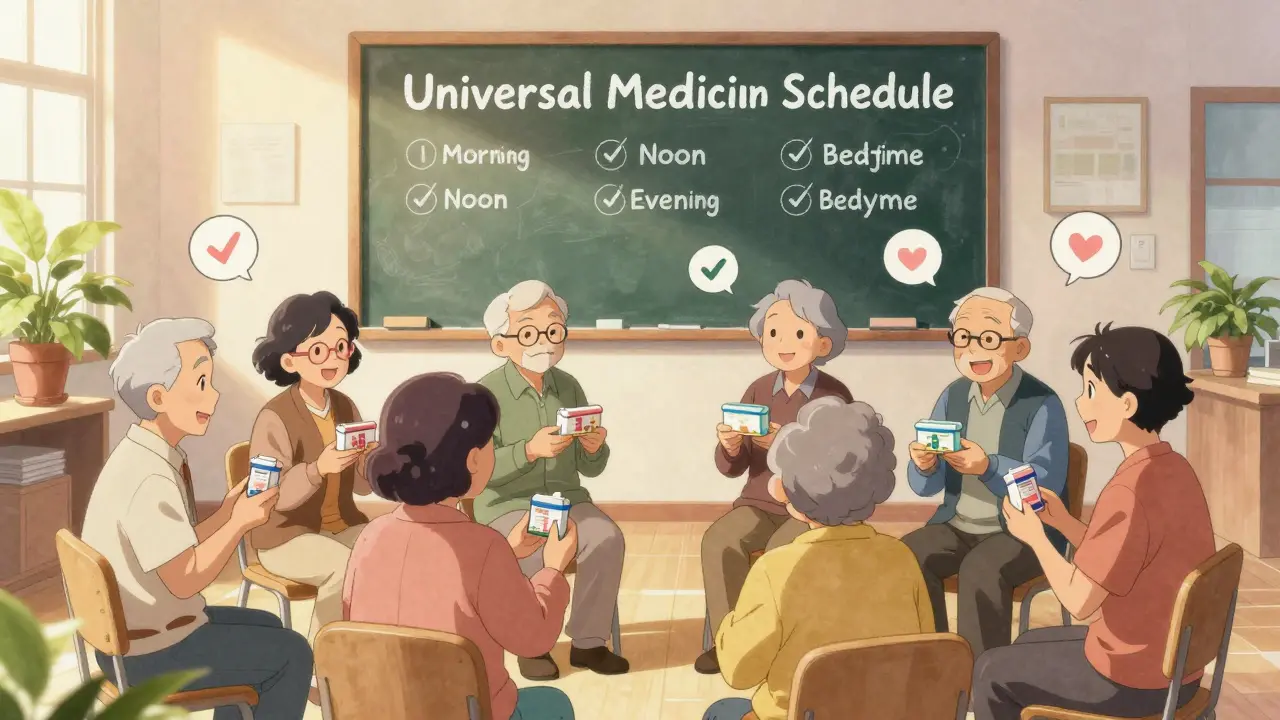
Think of it like a weekly pill organizer - but professionally made. Instead of 12 bottles, you get one box with labeled compartments: Morning, Noon, Evening, Bedtime. Each slot holds the exact pills you need for that time. This isn’t just a plastic tray from the drugstore - it’s pre-filled by your pharmacy using your current prescriptions. Research shows this method boosts adherence by 22% in elderly patients. For someone with memory issues or a caregiver helping out, it’s a game-changer. One caregiver on AgingCare.com said, “My mother’s confusion dropped overnight. We went from 12 bottles to one box.” The downside? It costs more. Some pharmacies charge $10-$20 per month for this service. But many insurance plans - especially Medicare Advantage - now cover it. Check with your provider.The Universal Medication Schedule
There’s a simple framework that’s gaining traction across hospitals and clinics: the Universal Medication Schedule (UMS). It divides the day into just four time blocks:- Morning (7-9 AM)
- Noon (12-2 PM)
- Evening (5-7 PM)
- Bedtime (9-11 PM)

What You Need to Do Next
Simplifying your regimen isn’t something you do alone. It requires teamwork. Here’s how to start:- Make a list. Write down every pill, supplement, and over-the-counter med you take - including when and why. Include doses and times. Don’t skip the vitamins or painkillers.
- Bring it to your next appointment. Ask your doctor: “Can we reduce the number of times I take medicine each day?” Don’t say, ‘Can we cut pills?’ Say, ‘Can we simplify the schedule?’ That opens the door to real options.
- Talk to your pharmacist. Pharmacists are the unsung heroes of medication simplification. They see your full history. Ask if FDCs are available, if your meds can be synchronized, or if you qualify for compliance packaging.
- Ask about insurance. Some simplification tools are covered - others aren’t. Ask: “Is this covered under my plan?” If they say no, ask if there’s an alternative that is.
- Try it for a month. Once you make changes, track your doses. Use a simple checklist or a phone app. Did you miss any? Did you feel more in control?
What Doesn’t Work - And Why
Not every simplification attempt succeeds. Here’s what goes wrong:- Ignoring drug interactions. You can’t just combine two pills because they’re both for blood pressure. One might raise your potassium; the other might lower it. Mixing them without checking can be dangerous.
- Assuming adherence = better outcomes. Studies show people take their meds more often after simplification - but that doesn’t always mean their blood pressure drops or their HbA1c improves. Sometimes, the body just needs time to adjust. Don’t expect instant results.
- Not involving caregivers. If you live alone, a simplified regimen helps. If you need help, your caregiver needs to understand the new schedule too. A 2022 survey found 42% of patients misused simplified packaging because they didn’t fully understand it.
- Insurance denials. A 2020 study found 45% of Medicare Advantage patients were denied access to once-daily formulations because they weren’t on the formulary. If your doctor recommends a new pill and your insurance says no, ask for a prior authorization. Many are approved on appeal.
Real-Life Success Stories
One man in his late 70s was taking 15 pills a day - five different times. His regimen included blood pressure meds, diabetes pills, cholesterol drugs, a diuretic, and supplements. After a pharmacist reviewed his list, they:- Switched two blood pressure pills to a single FDC.
- Changed his cholesterol med to a once-daily version.
- Synchronized all refills to the 1st of each month.
- Used compliance packaging for the rest.
What’s Changing in 2026
The field is evolving fast. In 2022, the FDA approved 12 new fixed-dose combinations - up 25% from 2020. AI tools are now helping pharmacists spot simplification opportunities by analyzing drug interactions, half-lives, and patient routines. Some Medicare Advantage plans are testing smart pill boxes that send alerts if a dose is missed - and even notify your doctor. The goal isn’t just to reduce pills. It’s to reduce stress, reduce errors, and restore control. Medication simplification isn’t a luxury - it’s a necessity for anyone managing multiple conditions.Can I just stop taking some of my meds to simplify my regimen?
No. Never stop or change a medication without talking to your doctor or pharmacist. What seems like an extra pill might be preventing a serious complication. Simplification means replacing or combining doses - not removing them. Always get professional advice before making any changes.
Are once-daily medications less effective than multiple doses?
No. Once-daily versions are designed to release the same total dose over 24 hours. They’re not weaker - they’re engineered to last longer. For example, a once-daily statin delivers the same cholesterol-lowering effect as a twice-daily version. The science behind extended-release formulations is well-tested and regulated.
What if my insurance won’t cover the simplified version?
Ask for a prior authorization. Your doctor can submit a letter explaining why the simplified version is medically necessary. Many denials are overturned on appeal. Also ask if there’s a generic alternative that’s covered. Sometimes, a different brand of the same drug works just as well and is cheaper.
Can I use a regular pill organizer from the store instead of professional packaging?
It’s better than nothing - but not ideal. Store-bought organizers don’t account for drug interactions, timing rules, or dosage accuracy. You might accidentally put two drugs together that shouldn’t be taken at the same time. Professional packaging is filled by pharmacists who check for safety. If you use a store organizer, double-check with your pharmacist first.
How long does it take to simplify a medication regimen?
It can take as little as one appointment - but often takes a few weeks. Medication reconciliation (reviewing what you’re really taking) takes 20-30 minutes. Finding alternatives, getting insurance approval, and waiting for new prescriptions can add time. Most people see changes within 2-4 weeks. Don’t rush it. Safety comes first.
Milad Jawabra
March 5, 2026 AT 14:58Pharmacist was the real MVP here. Don't just rely on your doctor. Walk into the pharmacy with your pill list and demand they help you. They can do things your doctor won't even think of.
Also - if your insurance says no to the fancy packaging? File an appeal. They overturn 60% of those denials if you cite adherence data. I did. Took two weeks. Worth it.
Lebogang kekana
March 6, 2026 AT 05:29My grandma was taking 19 pills a day. 6 different times. She was confused, scared, and kept hiding meds because she thought she was overdosing. We switched her to UMS + synchronized refills + one box. Now she laughs when she takes her pills.
One box. Four slots. Done.
Stop treating elderly patients like they’re computers. They’re humans. Give them structure, not chaos. 🙌
Jessica Chaloux
March 7, 2026 AT 18:38This isn’t about pills. It’s about dignity.
I wish someone had told me this before it was too late.
Mariah Carle
March 9, 2026 AT 05:50We live in a system that prioritizes pharmaceutical innovation over human cognition. We engineer drugs to last 24 hours… but still prescribe them 3x daily because that’s the historical norm.
It’s not medical. It’s bureaucratic inertia masquerading as science.
The UMS isn’t a hack - it’s a revolution in behavioral design. We’re finally aligning medicine with the architecture of the human mind.
And yet, insurance companies still balk at $15/month for compliance packaging. We value pills more than peace.
Raman Kapri
March 10, 2026 AT 16:08Adherence ≠ efficacy. I’ve seen patients stop taking diuretics because they "didn’t need them" - and ended up in the ER.
Also, FDCs aren’t always safe. I once had a patient on a combo pill that caused hyperkalemia because the doses weren’t titrated properly.
Before you push simplification, prove it doesn’t cause harm.
Tildi Fletes
March 11, 2026 AT 03:31Fixed-dose combinations reduce pill burden by an average of 58% in polypharmacy patients. Once-daily statins improve adherence by 27% (JAMA 2021). Compliance packaging increases dose accuracy by 34% (Annals of Internal Medicine, 2023).
Importantly, simplification must be individualized. Not every patient is a candidate for UMS. Some require timed dosing due to renal clearance or food interactions.
Pharmacists are trained to perform medication reconciliation - not physicians. This is why pharmacy-led interventions outperform clinic-based ones.
Always consult a pharmacist before making changes.
Siri Elena
March 12, 2026 AT 16:35How radical.
Next you’ll tell me we can put socks in the same drawer instead of one for left and one for right.
Wow. Groundbreaking.
PS: My cousin’s 80-year-old neighbor tried "simplifying" and mixed her warfarin with her fish oil. Died. Just saying.
Maybe next time, don’t make it sound like this is some new-age wellness hack? This is life-or-death. We’re not organizing a Spotify playlist.
Renee Jackson
March 14, 2026 AT 00:49As someone who manages chronic illness and supports elderly family members, I can attest: the emotional toll of medication complexity is underreported.
Patients don’t just forget pills - they forget themselves.
The Universal Medication Schedule is not merely practical - it is profoundly humane.
Pharmacists, please continue your vital work. And to prescribers: when you write a script, ask not just "What does this do?" but "How will this fit into their life?"
Thank you for seeing the person behind the regimen.
RacRac Rachel
March 15, 2026 AT 20:41She used to cry every Sunday trying to sort pills. Now she just grabs the box, says "Good morning, my little pill palace," and takes them like a pro.
It’s not just about fewer pills - it’s about restoring joy.
And yes, my insurance covered it! Just asked for prior auth and sent the doctor’s note. Took 4 days.
If you’re scared? Start with one med. Talk to your pharmacist. They’re waiting to help. 💙