
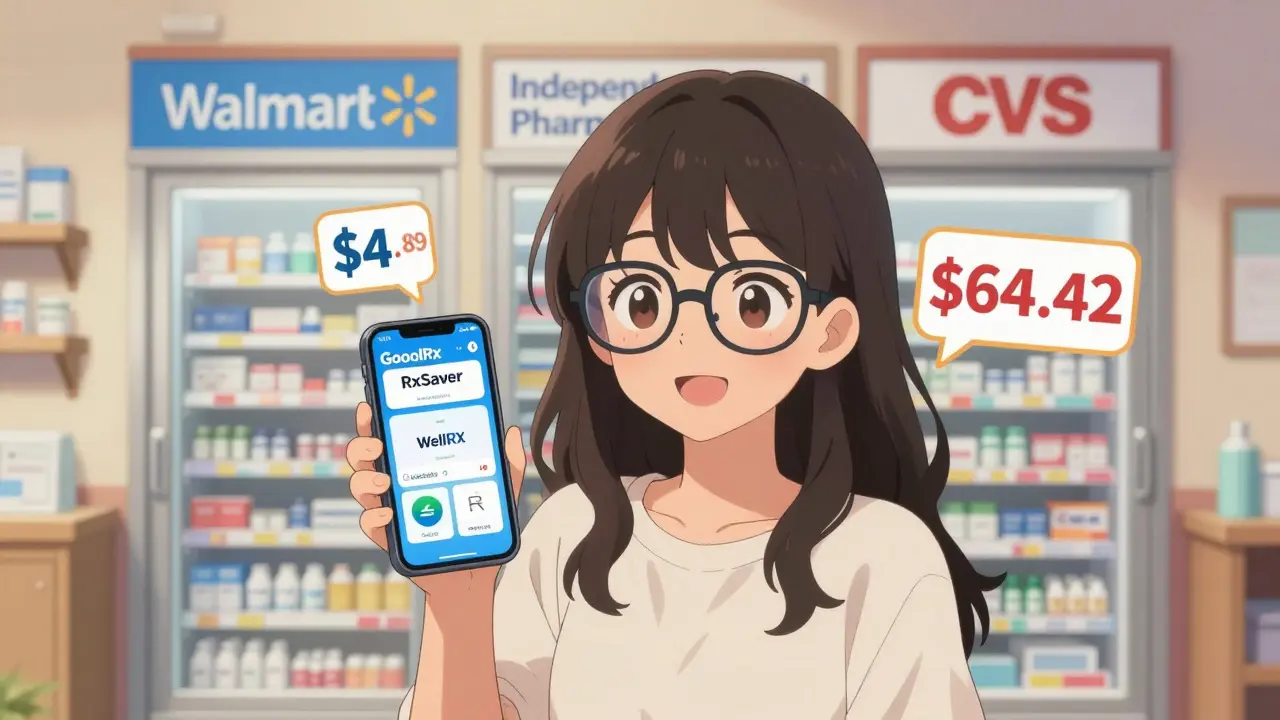
Ever paid $80 for a simple generic pill only to find out the same medicine costs $5 at the pharmacy down the street? You’re not alone. In 2026, cash prices for medications can vary by more than 300% between pharmacies just a few miles apart - even for the exact same drug, dose, and quantity. Insurance doesn’t always help. Sometimes, it makes things worse. The truth? If you’re paying full price without checking, you’re overpaying - often by hundreds of dollars a year.
Why Cash Prices Vary So Much
Pharmacies don’t have fixed prices. There’s no national list. A bottle of metformin might cost $1.89 at a local independent pharmacy, $15.99 at CVS, and $22.50 at Walgreens - all without insurance. Why? Because pharmaceutical companies sell the same drug to different buyers at wildly different rates. They give big discounts to big chains, small discounts to independents, and none at all to people who don’t ask. It’s not about cost. It’s about negotiation power.Here’s how it works: manufacturers set a list price, then offer secret rebates to Pharmacy Benefit Managers (PBMs). Those PBMs pass some of those savings to insurance companies - but rarely to you. When you pay cash, you’re seeing the full list price unless you use a discount tool. That’s where tools like GoodRx, RxSaver, and WellRX come in. They cut straight to the source and negotiate lower cash prices directly with pharmacies.
A 2020 NIH study found that for generic cardiovascular drugs, prices ranged from $4.50 to $140 in the same ZIP code. That’s not a typo. One pill. 30 times the cost. And it’s not just heart meds. Antibiotics, thyroid pills, diabetes drugs - all show the same pattern.
How to Find the Lowest Cash Price
You don’t need to be a pharmacy expert. You just need to know three steps.- Ask for the cash price before showing your insurance.
- Compare prices using at least three discount apps.
- Call the pharmacy and ask if they have an unadvertised discount.
Step one is critical. Many people assume insurance will always be cheaper. It’s not. A 2023 guide from LifeCare Advocates found that over 40% of patients paid more with insurance than they would have paid cash using a coupon. Why? Insurance plans have deductibles, copays, and formulary restrictions. Sometimes, the cash price with a coupon is lower than your copay.
Step two: use multiple apps. GoodRx is the most popular - used by over 200 million people - but it’s not always the cheapest. RxSaver often has better deals on insulin. WellRX sometimes beats both on antibiotics. Cross-checking just takes two minutes. Don’t rely on one app. Prices change daily.
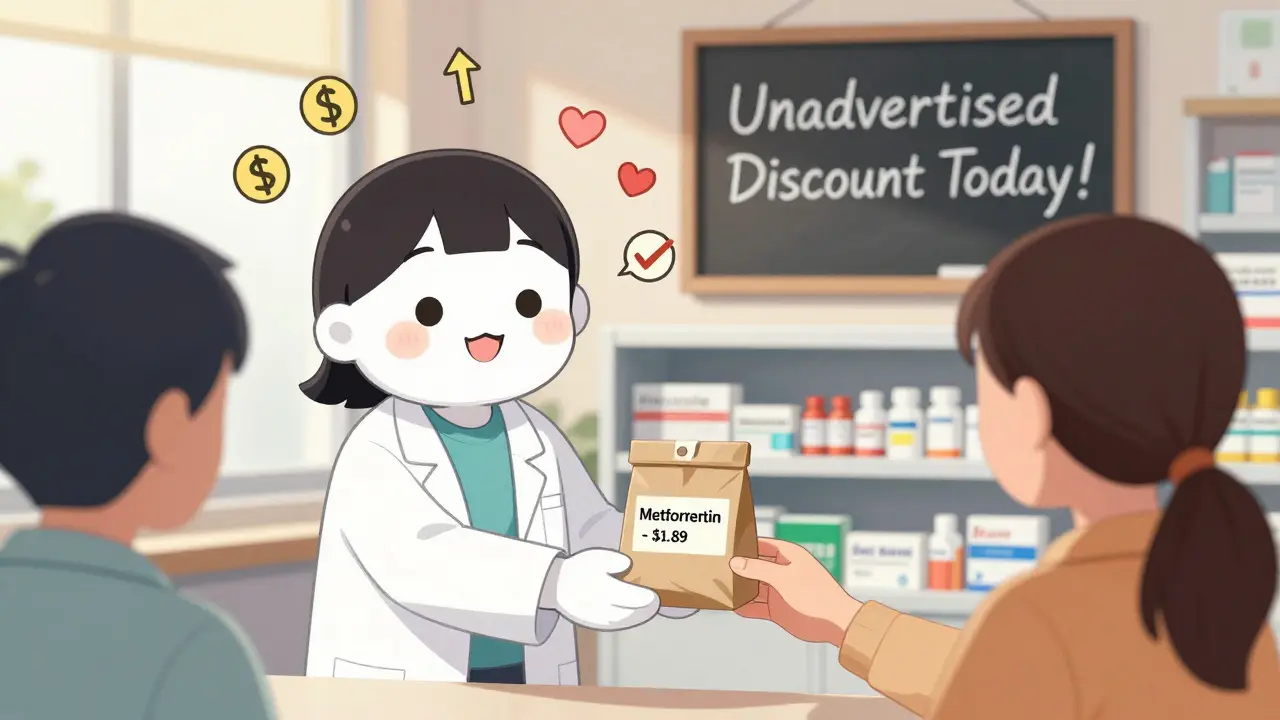
Step three: talk to the pharmacist. Independent pharmacies, especially, often have hidden discounts. UnityPoint Health reported in 2023 that 38% of small pharmacies offer unlisted deals to regular customers. Just say: “I’m paying cash. Do you have any current discounts on this?” No one will turn you away. Pharmacists want you to come back.
Best Pharmacy Types for Cash Prices
Not all pharmacies are created equal. Here’s what the data shows:| Pharmacy Type | Average Generic Price (GoodRx Discounted) | Best For |
|---|---|---|
| Supermarkets (Kroger, Safeway, Publix) | $28.17 | Most generics, $4/$9 programs |
| Mass Merchandisers (Walmart, Target) | $31.50 | Insulin, metformin, statins |
| Independent Pharmacies | $25.80 | Unadvertised discounts, personalized service |
| National Chains (CVS, Walgreens) | $64.42 | Only if insurance is required |
| Analytical Pharmacies (Mail-order) | $120+ | Not recommended for cash shoppers |
Walmart and Kroger have their own $4/$9 generic programs. You don’t need a coupon. Just ask. Metformin, lisinopril, atorvastatin - many are $4 for a 30-day supply. Kroger even has a free generic program for certain drugs with no minimum purchase.
Independent pharmacies often win on price and service. They’re not tied to big corporate contracts. They’ll match GoodRx. They’ll give you extra pills if you’re running low. They remember your name. And they’re more likely to call your doctor if a cheaper alternative exists.
When Discount Apps Don’t Work
GoodRx saves you 88% on generics - but almost nothing on brand-name drugs. If you’re on Humira, Enbrel, or any biologic, discount coupons rarely help. Why? These drugs have no generic versions. The manufacturer controls the price. But here’s the trick: ask your doctor if a biosimilar is an option. Biosimilars are cheaper, FDA-approved copies. For Humira, biosimilars like Amjevita can cut costs by 50% or more.Also, some drugs just don’t show up on discount apps. That’s when you call the pharmacy directly. Ask: “What’s your cash price for this?” Don’t say “I have GoodRx.” Just ask for the cash rate. Sometimes, the pharmacy’s internal price is lower than what’s listed online.
Mail-Order and Non-Profit Options
If you’re on a fixed income or have a high-deductible plan, consider mail-order pharmacies like RXOutreach.com. It’s a non-profit that helps people with household incomes under $45,000 (300% of federal poverty level in 2023). You can get generic medications for as little as $10 a month - even if you have insurance. You just need to fill out a simple form. No credit check. No application fee.Other options include NeedyMeds.org, which connects you to patient assistance programs from drug manufacturers. Many companies give free or low-cost drugs to people who qualify. You don’t need to be poor - just unable to afford your copay.
Medicare Users: Don’t Skip Open Enrollment
If you’re on Medicare Part D, your plan’s formulary and pharmacy network change every year. A plan that was great last year might now charge $100 for your insulin. During open enrollment (October 15 to December 7), log into Medicare.gov and use the Plan Finder tool. Look for plans with low premiums AND low copays on your specific drugs. Don’t just pick the cheapest premium. Pick the cheapest total cost.Also, check if your plan has preferred pharmacies. CVS, Walgreens, and Walmart often have lower copays for members. You might save 15-25% just by switching where you fill your scripts.
Real Savings, Real Stories
One Reddit user in Chicago paid $345 for a vial of insulin at Walgreens. At the local Walmart, it was $98. That’s $247 saved in one trip. Another user in Texas paid $15.99 for metformin at CVS. With GoodRx at a nearby independent pharmacy? $1.89. That’s 90% off. A woman in Florida used to pay $112 per month for Synthroid through her insurance. She switched to GoodRx at Walmart. Now she pays $8. That’s $1,248 saved a year. These aren’t outliers. They’re standard.What Not to Do
Don’t assume your insurance is helping. Always ask for the cash price first. Don’t use only one app. Compare at least three. Don’t ignore independent pharmacies. They’re often the cheapest. Don’t pay full price for brand-name drugs without asking about biosimilars. Don’t forget to ask the pharmacist for unadvertised discounts.Final Tip: Make It a Habit
It takes 10-15 minutes to compare prices for one prescription. That’s less time than waiting in line. Do it once, and you’ll never pay full price again. Set a reminder on your phone for every refill. Use GoodRx as your default. Call the pharmacy before you leave home. Keep a list of your medications and their best prices. You’ll save hundreds - maybe thousands - each year.Medication costs aren’t random. They’re negotiable. And the power to save is in your hands.
Is it legal to use GoodRx instead of insurance?
Yes, it’s completely legal. You have the right to choose how you pay for your prescription. If the cash price with a GoodRx coupon is lower than your insurance copay, you can opt out of insurance for that fill. Your pharmacy is required to honor the coupon. Just tell them you’re paying cash and using a discount.
Can I use GoodRx with Medicare?
You can use GoodRx with Medicare, but only if you’re paying cash and not using your Medicare Part D plan. Medicare doesn’t allow you to apply a GoodRx coupon to your copay. But if the GoodRx price is lower than your Medicare copay, you can choose to pay cash and skip using your plan for that prescription. Just make sure you don’t use your Medicare card at the register.
Why is my prescription cheaper at Walmart than at my local pharmacy?
Walmart and other big chains have bulk purchasing power and run their own $4/$9 generic programs. They lose money on these low-cost drugs to attract customers - hoping you’ll buy other things while you’re there. Independent pharmacies don’t have that scale, so they rely on higher margins. But many independents offer unadvertised discounts if you ask.
Do discount apps work on brand-name drugs?
Rarely. Brand-name drugs like Humira, Enbrel, or Ozempic have no generic versions, so discount apps can’t negotiate big savings. But you might still save money if your doctor switches you to a biosimilar - a cheaper, FDA-approved copy. Ask your doctor if one is available.
What if I can’t afford my meds even with discounts?
Check NeedyMeds.org or RxOutreach.com. Many drug manufacturers offer free or low-cost medications to people with incomes under $45,000 a year. You don’t need to be poor - just unable to pay your current copay. Fill out a simple form, get approved, and have your meds shipped to you for $10-$20 a month.
How often should I check pharmacy prices?
Every time you refill. Prices change daily. A drug that was $5 last month could be $12 this month. Set a reminder on your phone for every refill date. It takes two minutes. The savings add up fast - hundreds, sometimes thousands, per year.
Rhiannon Bosse
January 28, 2026 AT 20:48So let me get this straight - the pharmaceutical industry is basically a rigged casino, and the only way to not get fleeced is to become a part-time price detective? 🤡 I just spent 20 minutes comparing GoodRx, RxSaver, and WellRX for my blood pressure med… and still ended up paying $12. Meanwhile, my neighbor got it for $1.89 at a pharmacy that looks like it hasn’t changed its decor since 1997. I’m not mad. I’m just disappointed in humanity.
Also, who’s the genius who invented PBMs? Did they get a medal for turning healthcare into a game of Three Card Monte?
Lance Long
January 30, 2026 AT 09:37Y’ALL. I used to be one of those people who just handed over my insurance card and walked away. Then I found out my $45 insulin was $28 at Walmart - and that was BEFORE I asked the pharmacist if they had a ‘loyalty discount.’ He looked at me like I’d just offered him a million dollars and said, ‘Oh, yeah - we’ve got a $19 cash deal for regulars.’
Now I call every pharmacy before I leave the house. I’ve saved over $1,200 this year. I’m not a hero. I’m just not stupid anymore. You can do this. Start with one prescription. Just one. Then you’ll wonder how you ever lived without checking.
Irebami Soyinka
January 31, 2026 AT 04:56America still thinks healthcare is about ‘personal responsibility’? 😂 My sister in Lagos pays $0.50 for metformin at the local clinic - no app, no coupon, no drama. Here, you need a PhD in pharmacy logistics just to buy aspirin.
It’s not about ‘shopping smart.’ It’s about a system built to bleed the poor while pretending to help. You think Walmart’s $4 program is charity? Nah. It’s bait. They know you’ll buy chips, soda, and 3 packs of toilet paper while you’re there.
Meanwhile, Nigeria has free meds for diabetics. We don’t need GoodRx. We need revolution. 🇳🇬💪
doug b
February 2, 2026 AT 04:43Just did this yesterday. My mom’s thyroid med was $52 at CVS. Used GoodRx. $8. Called the independent pharmacy down the street - they matched it. No coupon needed. Just asked.
It’s not hard. It’s not magic. It’s just not something they teach you. I’m telling everyone I know now. One person at a time. We can fix this.
Mel MJPS
February 3, 2026 AT 03:49This post made me cry - not because I’m sad, but because I finally feel seen. I’ve been quietly doing all this for years, afraid people would think I was cheap. But then I realized - it’s not being cheap. It’s being smart. And it’s not just about money. It’s about dignity.
I used to skip doses because I couldn’t afford the copay. Now I check prices every time. I don’t feel guilty anymore. I feel powerful.
Thank you for saying this out loud.
SRI GUNTORO
February 3, 2026 AT 06:21People who use GoodRx are just avoiding their responsibility to the healthcare system. Insurance exists for a reason - it spreads the cost. You think you’re saving money? You’re just shifting the burden to everyone else who actually pays their fair share.
And don’t get me started on those ‘independent pharmacies.’ They’re not saving you. They’re just playing the same game with less transparency.
Stop gaming the system. Support real healthcare.
Kevin Kennett
February 4, 2026 AT 11:50Hey - I’m a pharmacist in Ohio. I see this every day. People walk in, hand over their insurance, and walk out paying $40 for a $3 drug.
I want to scream. But I don’t. I just say, ‘Hey, have you checked cash prices?’
90% of the time, they’re shocked. 70% of them come back next time with a coupon. And 50% of those start asking about other meds too.
You’re not ‘gaming the system.’ You’re using your power as a consumer. And honestly? We’re rooting for you. We’re just not allowed to say it out loud.
Keep asking. Keep checking. You’re doing the right thing.
Jess Bevis
February 5, 2026 AT 21:16Walmart $4. That’s it. That’s the tweet.