
Postoperative Opioid Equivalent Calculator
Postoperative ileus (POI) is a common complication that can significantly delay recovery. Opioid dosage plays a critical role in POI risk. This calculator helps estimate your morphine milligram equivalent (MME) dosage to identify potential POI risk. Guidelines from the article: Limit total opioids to under 30 MME in the first 24 hours after surgery to reduce POI risk. Patients receiving more than 50 MME in the first 48 hours report significantly higher POI rates.
Opioid Dosage Calculator
Enter the opioid medications you're receiving or have received to calculate your total morphine milligram equivalent (MME)
Your Postoperative Opioid Equivalent
Total MME for the first 24 hours
High-risk threshold: Over 50 MME in first 48 hours
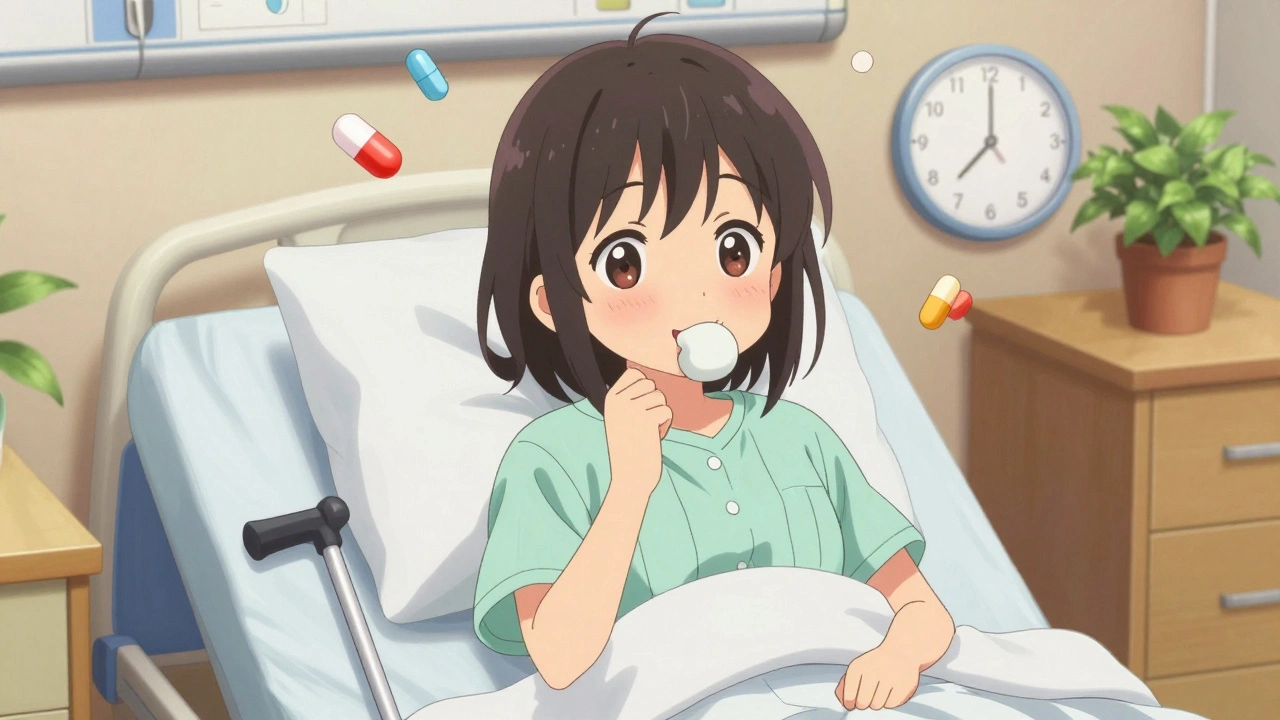
After surgery, many patients expect to feel better soon. But instead, they might feel bloated, nauseous, and unable to eat or pass gas. This isn’t just discomfort-it’s postoperative ileus (POI), a common and costly complication driven largely by opioids. While opioids help manage pain, they also shut down the gut. The result? Delayed recovery, longer hospital stays, and higher costs. The good news? We now know how to stop it-and how to fix it if it happens.
What Is Postoperative Ileus, and Why Do Opioids Make It Worse?
Postoperative ileus isn’t a blockage. It’s a temporary pause in the natural muscle contractions that move food through your digestive tract. After surgery, your gut goes quiet. Nausea, vomiting, bloating, and no bowel movements for days are signs. It’s not rare-up to 30% of patients develop it after major surgery. But when opioids are used heavily, that number jumps.
Opioids bind to mu-receptors in the gut wall, slowing down the nerves that control bowel movement. Studies show this can cut colonic motility by up to 70%. Even small doses-like 5 to 10 mg of morphine per hour-can delay gastric emptying by 50% to 200%. The problem isn’t just the painkillers you get in the hospital. Your body also releases its own natural opioids during surgery, compounding the effect.
It’s not just about feeling uncomfortable. Delayed bowel function means you can’t eat, which slows healing. Most patients stay in the hospital 2 to 3 extra days because of it. In the U.S. alone, POI adds $1.6 billion to healthcare costs every year.
The Real Cost: Longer Stays, Higher Bills, and Patient Suffering
Patients who get more than 50 morphine milligram equivalents (MME) in the first 48 hours after surgery report bloating scores nearly four times higher than those who get less than 20 MME. Their first bowel movement takes over five days-more than double the time of patients on lower doses.
One survey of 1,247 surgical patients found that those on high opioids were 2.7 times more likely to wait over five days for a bowel movement. Nurses on AllNurses.com describe seeing patients lie in bed for days, unable to get up because their stomachs are so distended. Some even develop opioid withdrawal when switching from IV to oral meds too fast-symptoms like sweating, anxiety, and cramps that last 3 to 4 days.
And it’s not just patients. Hospitals face penalties under Medicare’s Hospital Readmissions Reduction Program if too many patients come back because of POI. In 2022, 15.7% of general surgery programs were fined, averaging $187,000 per facility. Rural hospitals, where protocols are less consistent, see POI last an average of 5.1 days-nearly two days longer than in academic centers.
How to Prevent It: The Multimodal Approach That Works
Prevention starts before the first incision. The key is to reduce opioid use without leaving patients in pain. This is called multimodal analgesia-using several different pain control methods together.
- Start with acetaminophen (1g IV every 6 hours)-it’s safe, effective, and doesn’t slow the gut.
- Use ketorolac (30mg IV) if the patient has no kidney or bleeding risks. It’s a strong NSAID that cuts opioid needs by 30%.
- Regional anesthesia-spinal or epidural blocks-can reduce opioid use by half. Orthopedic surgeons report POI rates drop from 22% to under 9% when spinal anesthesia replaces general anesthesia with opioids.
- Limit total opioids to under 30 MME in the first 24 hours. That’s about 3 doses of 10mg oxycodone or 20mg morphine total. Studies show this cuts POI from 30% to just 18%.
There’s also a simple, low-tech trick: chew gum. Four times a day, starting right after surgery. It tricks your brain into thinking you’re eating, which wakes up your gut. Nurses in several hospitals saw POI duration drop from 4.1 days to 2.7 days just by adding gum chewing to their routine.
Early Movement Is Non-Negotiable
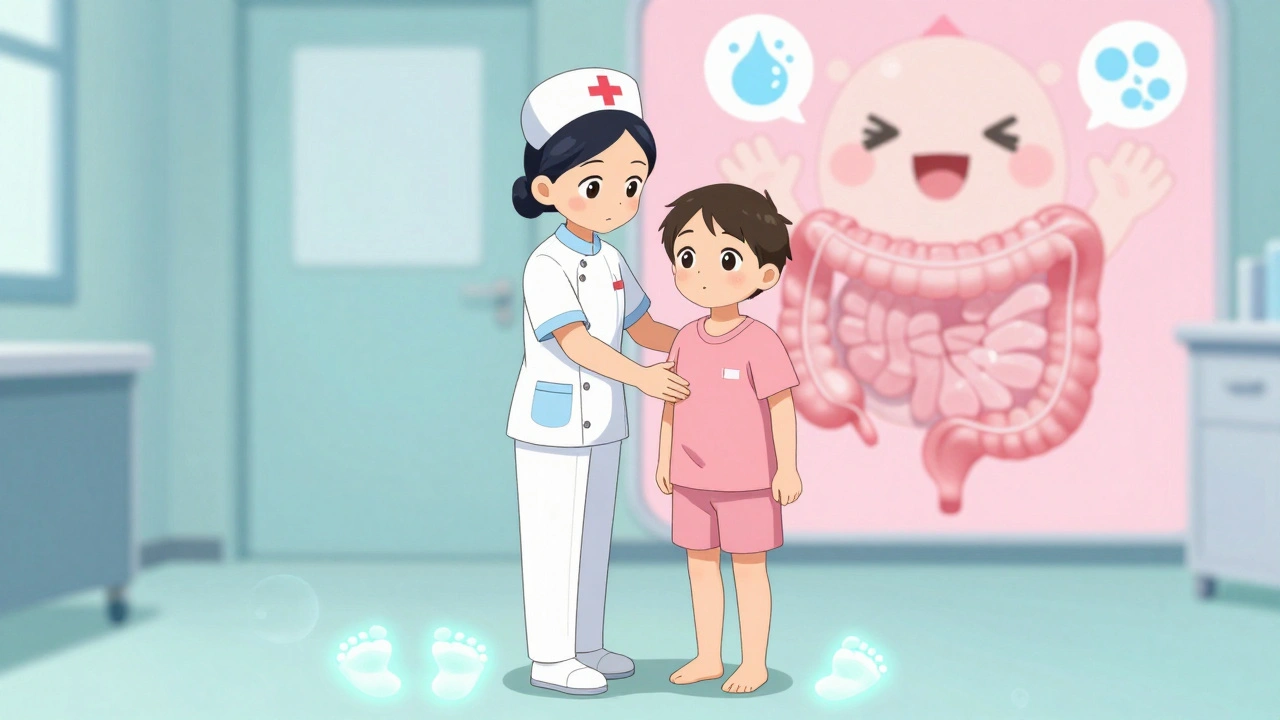
Getting up matters more than you think. Patients who walk within 4 hours after surgery recover bowel function 22 hours faster than those who wait. Even sitting up in a chair helps. It’s not about running laps-it’s about moving your body to stimulate nerves and blood flow to the gut.
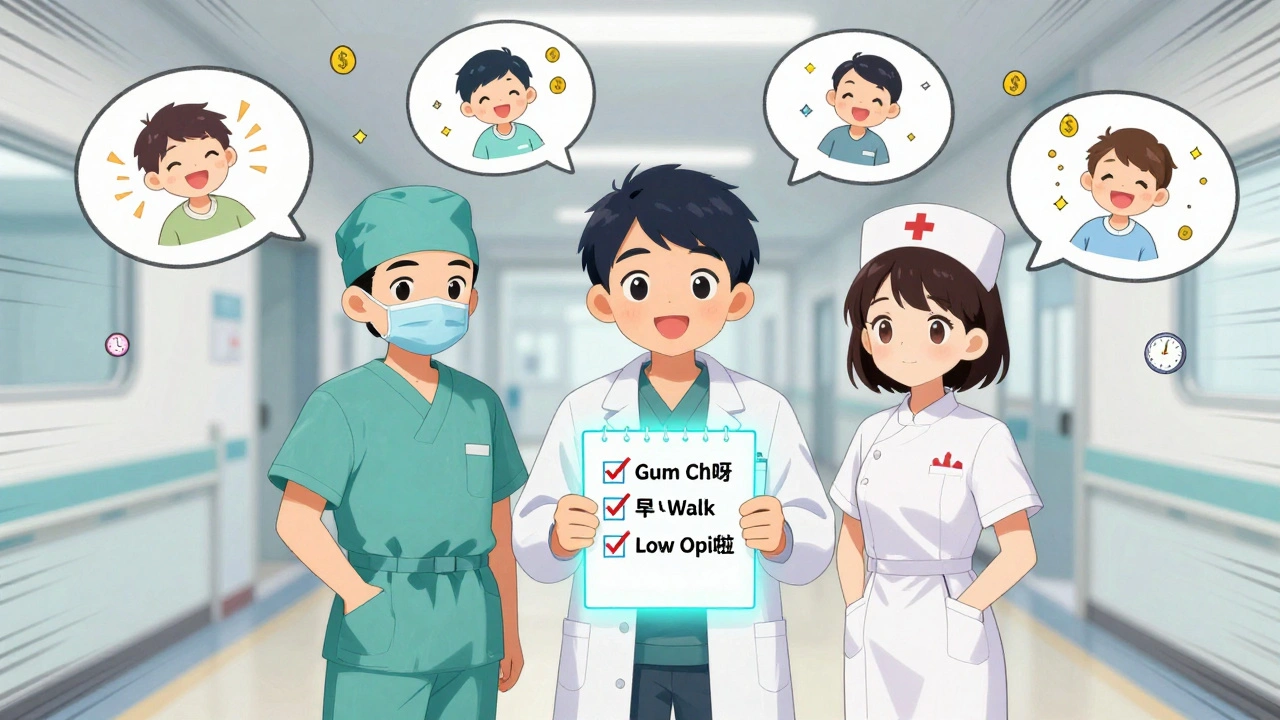
Hospitals with successful programs call this “POI bundles”-a checklist of actions done together: gum chewing, early walking, scheduled acetaminophen, minimal opioids, and no nasogastric tubes unless absolutely necessary. These bundles cut hospital stays by 1.8 days and save $2,300 per patient.
What If POI Still Happens? Treatment Options
Even with prevention, sometimes the gut stays quiet. When it does, you need to act.
Traditional methods like nasogastric tubes (NG tubes) help with vomiting but don’t speed up bowel recovery. Studies show they reduce POI duration by only 12%-barely better than doing nothing.
The real game-changers are peripheral opioid receptor antagonists. These drugs block opioids in the gut but not in the brain, so pain control stays intact.
- Alvimopan (oral) reduces recovery time by 18-24 hours after abdominal surgery. It’s approved for short-term use.
- Methylnaltrexone (injection) works fast-patients often pass gas or stool within 24 hours. It’s especially helpful for opioid-tolerant patients.
But these aren’t for everyone. They’re not safe if there’s a real bowel blockage (which happens in less than 0.5% of cases). And they’re expensive-methylnaltrexone costs $147.50 per dose. That’s why experts recommend using them only in high-risk patients: those having abdominal surgery, opioid-naive, or on high-dose opioids.
Why Some Hospitals Still Get It Wrong
Not all hospitals follow best practices. A 2019 study found 63% of anesthesia teams resisted switching from opioid-heavy protocols. Nurses often don’t know how to help patients walk early or track bowel function properly. Only 42% of staff in early adoption phases followed mobilization guidelines.
Success comes from teamwork. The best programs have daily “POI rounds” where surgeons, anesthesiologists, and nurses check three things:
- Has the patient passed gas within 72 hours?
- Has the patient had a bowel movement within 96 hours?
- Can they drink 1,000 mL of fluid without vomiting?
If not, they adjust meds or add a peripheral antagonist. Hospitals that do this consistently reach 85-90% compliance within a year-and see POI rates drop by more than half.
What’s Next? New Tools on the Horizon
The field is evolving fast. A new extended-release version of alvimopan is in late-stage trials and could be available by 2026. Researchers are testing naltrexone implants that slowly release blockers over days. Others are looking at fecal microbiome transplants for stubborn cases-early results show a 40% improvement in gut movement.
Even more exciting: AI models are being trained to predict who’s at risk. Mayo Clinic’s model uses 27 pre-op factors-age, BMI, surgery type, meds, even sleep patterns-to flag high-risk patients with 86% accuracy. That means you can start prevention before the patient even wakes up.
By 2027, experts believe comprehensive POI programs will become standard. The Agency for Healthcare Research and Quality estimates that if 90% of U.S. hospitals adopt these protocols, we could save $7.2 billion a year.
Bottom Line: Less Opioid, Faster Recovery
Postoperative ileus isn’t inevitable. It’s a side effect of how we manage pain-not a normal part of recovery. You don’t need to choose between pain control and gut function. With the right mix of non-opioid meds, early movement, gum chewing, and targeted drugs when needed, patients can get out of the hospital faster, feel better sooner, and avoid unnecessary complications.
The evidence is clear: reduce opioids. Move early. Use alternatives. Track progress. These aren’t fancy tricks-they’re simple, proven actions that save time, money, and discomfort. And for patients recovering from surgery, that’s everything.
Can opioids cause long-term bowel problems after surgery?
Opioids rarely cause permanent damage to the gut after surgery. Postoperative ileus is almost always temporary and resolves once opioids are reduced or stopped. However, in patients who already have slow gut motility (like those with chronic opioid use), recovery may take longer. There’s no evidence that a single surgical episode leads to lasting bowel dysfunction if opioids are managed properly.
Is chewing gum really effective for preventing postoperative ileus?
Yes. Multiple studies, including one with 347 patients, show that chewing sugar-free gum four times a day after surgery reduces the time to first bowel movement by about 14 hours. It’s thought to stimulate the vagus nerve, mimicking the brain-gut signal that happens when you eat. It’s low-cost, safe, and works better than many medications.
What’s the difference between alvimopan and methylnaltrexone?
Both block opioid receptors in the gut, but they’re used differently. Alvimopan is taken orally and works best after abdominal surgery-especially in opioid-naive patients. Methylnaltrexone is injected and works faster, making it better for patients already on high-dose opioids or those who can’t take pills. Alvimopan is limited to 15 doses total; methylnaltrexone can be given daily until bowel function returns.
Can I avoid opioids completely after surgery?
For many surgeries, yes-especially orthopedic, gynecological, or minor abdominal procedures. Combining acetaminophen, NSAIDs like ketorolac, and regional anesthesia can control pain well enough that opioids aren’t needed. But for major trauma, cancer surgery, or severe pain, some opioids may still be necessary. The goal isn’t zero opioids-it’s the minimum effective dose.
Why don’t all hospitals use these prevention methods?
Changing habits is hard. Many teams are used to relying on opioids because they’re familiar and fast-acting. Training staff, updating protocols, and tracking outcomes takes time and resources. Rural and smaller hospitals often lack the staff or funding to implement full ERAS programs. But when they do, results improve dramatically-so the gap is closing.
patrick sui
December 3, 2025 AT 04:06Wow, this is one of the most clinically nuanced posts I've seen on Reddit. The multimodal analgesia approach is textbook ERAS protocol, but what really stood out was the gum-chewing data-14 hours faster? That’s wild. Peripheral antagonists like alvimopan are underutilized because of cost, but the ROI is undeniable. We’re talking about reducing LOS by nearly two days. If hospitals tracked POI as a KPI like CAUTI or CLABSI, adoption would be mandatory. The AI risk-prediction models at Mayo? That’s the future right there. 🤖🧠
Conor Forde
December 3, 2025 AT 21:22So let me get this straight-you’re telling me chewing gum is more effective than half the drugs they give you after surgery? 😂 I mean, I get it, it’s like tricking your brain into thinking you’re eating, but come ON. Next they’ll say we should wave a flag and chant ‘digest, digest’ to stimulate peristalsis. I’m all for non-opioid stuff, but this feels like a TikTok hack dressed up as science. 🤷♂️
Declan O Reilly
December 4, 2025 AT 23:16There’s something deeply poetic about gum chewing as medicine. It’s so human. We’ve been trying to fix biology with pills and injections for a century, and the answer was in our mouths all along-chewing, moving, breathing. The gut doesn’t care about your hospital’s formulary. It cares about rhythm, stimulation, presence. Early ambulation? Gum? These aren’t protocols-they’re acts of rewilding the body after the trauma of surgery. We’ve over-medicalized recovery. Maybe the cure isn’t more drugs, but less interference. 🌿
ANN JACOBS
December 6, 2025 AT 00:02This is an absolutely comprehensive and meticulously researched overview of postoperative ileus management. The data presented-particularly regarding opioid milligram equivalents and the economic burden of prolonged hospital stays-is both compelling and alarming. I am particularly impressed by the emphasis on multimodal analgesia and the incorporation of non-pharmacological interventions such as early mobilization and gum chewing. These are not merely adjuncts; they are foundational pillars of patient-centered, evidence-based care. I would strongly advocate for institutional adoption of standardized POI bundles across all surgical units. The potential for cost savings and improved patient outcomes is immense. Thank you for this invaluable contribution to clinical discourse.
Nnaemeka Kingsley
December 7, 2025 AT 14:26Man, this is real talk. I seen my cousin go through surgery last year, they gave him like 10 pain pills a day, he couldn’t even sit up for 4 days. Then they told him chew gum? He thought they was joking. But he did it, and boom-broke wind after 30 hours. No NG tube, no drama. Simple stuff works. Why don’t more docs do this? Too busy with papers? 😅
Kshitij Shah
December 8, 2025 AT 05:42Oh wow, so the real ‘miracle drug’ is… gum? And walking? I mean, I’m not surprised, but it’s hilarious that we need a 3000-word essay to tell us that chewing sugar-free gum is better than opioids for gut motility. Next they’ll publish a 12-page study proving that breathing helps with oxygenation. 🤦♂️
Sean McCarthy
December 10, 2025 AT 00:51Let’s break this down. 30% incidence of POI. 1.6B annual cost. 50 MME threshold correlates with 4x bloating scores. 2.7x likelihood of >5-day ileus. 15.7% of hospitals fined. 85-90% compliance = 50%+ reduction in POI. Alvimopan = 18-24h faster. Methylnaltrexone = $147.50/dose. 86% predictive accuracy from AI model. 7.2B potential savings. These numbers are not just statistically significant-they’re morally indefensible if ignored. This isn’t medicine. It’s negligence with a white coat.
Jaswinder Singh
December 10, 2025 AT 21:50You people are overcomplicating this. Stop giving opioids if you don’t want the gut to shut down. That’s it. No magic gum, no fancy injections, no AI models. Just don’t poison patients with narcotics unless they’re dying. If your surgery doesn’t need morphine, don’t give it. Simple. Why is this even a debate? You’re treating symptoms instead of the cause. Pathetic.
Bee Floyd
December 11, 2025 AT 18:16I’ve seen this in my dad’s recovery after his colon resection. They skipped the NG tube, got him walking at 4am, gave him acetaminophen every 6 hours, and he chewed gum like it was his job. By day 2, he was eating soup. No drama. No crying. No opioid withdrawal. It felt… normal. Like the body was allowed to heal, not just be medicated into submission. I wish every hospital treated recovery like this. It’s not rocket science. It’s respect.
Courtney Co
December 11, 2025 AT 22:27Wait, so you’re saying if I chew gum after surgery, I won’t be stuck in the hospital for 5 days? But what about my anxiety? My fear? My trauma from past surgeries? Who’s going to hold my hand while I’m chewing? And why does this feel like a corporate cost-cutting scheme disguised as wellness? I need emotional support, not a gum wrapper. 😭
Shashank Vira
December 12, 2025 AT 23:04It’s fascinating how Western medicine has reduced the gut-a complex, autonomous, enteric nervous system-to a mere passive vessel to be manipulated by pharmacological levers. The fact that we need a ‘bundle’ to restore peristalsis speaks volumes about our reductionist paradigm. The vagus nerve doesn’t respond to algorithms. It responds to presence, rhythm, breath. Gum chewing? A crude proxy. The real solution? We must re-learn the art of healing, not just the science of dosing.
Eric Vlach
December 14, 2025 AT 12:57Good stuff. Gum works. Walking helps. Cut the opioids. Use ketorolac if kidneys are good. Spinal anesthesia beats general when you can. Alvimopan’s great but expensive. Methylnaltrexone for the tough cases. The real win? Tracking gas and BMs like a checklist. Hospitals that do that, they see results. Simple. No fluff. Just do the basics right. Why is this so hard?
Souvik Datta
December 16, 2025 AT 01:39This is a masterclass in surgical recovery optimization. The integration of non-opioid analgesia, early mobilization, and behavioral triggers like gum chewing represents a paradigm shift from reactive to proactive care. The data is irrefutable: reduced opioid exposure correlates directly with accelerated GI recovery. What’s more, the cultural shift required-nurses tracking bowel function, surgeons respecting ERAS protocols, pharmacists advocating for alternatives-is perhaps the most challenging aspect. But when done right, it transforms patient experience from suffering to dignity. This isn’t just medicine. It’s moral practice.
Priyam Tomar
December 16, 2025 AT 20:49Let’s be real-chewing gum is a placebo with a clinical trial. The real reason POI improves is because patients on low opioids aren’t sedated and can move. Gum is a distraction tactic for lazy hospitals that don’t want to train staff or invest in spinal anesthesia. The ‘bundle’ is just a fancy word for ‘do your damn job.’ And yes, if you’re still using 50 MME in 48 hours, you’re doing it wrong. Period.
Jack Arscott
December 17, 2025 AT 11:18Just read this whole thing. 🤯 Gum. Walking. Acetaminophen. No NG tubes. This is the stuff we should be teaching med students on day one. Not how to titrate morphine. How to prevent the problem in the first place. I’m so glad someone finally laid this out so clearly. 🙌