

When a pharmacist hands you a pill that looks different from what you’ve been taking for years, it’s natural to wonder: Is this the same thing? For many families and older adults, this moment triggers anxiety, confusion, or even refusal to take the medicine. Generic drugs are just as safe and effective as brand-name ones-but only if patients understand why the change happened. The real problem isn’t the science. It’s the way we talk about it.
Why Generic Substitution Feels Risky to Families and Seniors
Generic drugs are required by the FDA to contain the same active ingredient, strength, and dosage form as the brand-name version. They must also prove they are absorbed in the body within 80% to 125% of the original drug’s rate-a range called bioequivalence. That sounds precise, but it doesn’t tell the whole story. For children, especially those under five, the difference in taste or texture can be a dealbreaker. Brand-name amoxicillin for toddlers often comes as a sweet, fruit-flavored liquid. Generic versions? Sometimes they’re bitter, chalky, or too thick. A 2022 parent survey on Reddit found that 64% of families had trouble getting their kids to take a generic antibiotic because of taste alone. One mother wrote: "My 2-year-old spit out the generic, cried for hours, and wouldn’t touch the bottle. We switched back to the brand, even though it cost $40 more. He got better faster because he actually took it." For seniors, the issue is more about consistency. The average older adult takes nearly five prescription drugs. If their blood pressure pill changes color, shape, or size three times in a year, they start to think each new pill is a different medicine. A 78-year-old man in Florida told his doctor: "I stopped taking my pill because it looked like the one I used to take for anxiety. I didn’t know it was the same drug just repackaged." He ended up in the ER with uncontrolled hypertension.The Nocebo Effect: When Belief Hurts More Than the Pill
It’s not just about physical differences. The mind plays a big role. The nocebo effect happens when people expect a treatment to cause harm-and then experience it, even if the treatment is harmless. In a 2021 study, 58% of seniors reported side effects after switching to a generic, even though their blood tests showed no change in drug levels. They felt dizzy, nauseous, or tired because they believed the cheaper pill was "less good." This effect is stronger in people with long-standing routines. If someone has taken the same blue oval pill for 15 years, a new white capsule feels wrong-even if it’s chemically identical. A 2020 Drug Patent Watch analysis showed that patients who were told "this is just a generic" without reassurance were 37% more likely to stop taking their medicine entirely.How to Talk to Parents About Generic Substitution for Kids
Talking to parents requires more than saying "it’s the same drug." You need to address their fear that their child might suffer because of cost-cutting. Here’s how to do it right:- Start with empathy: "I know you want the best for your child. Many parents feel the same way."
- Explain the science simply: "The FDA requires generics to work the same way as the brand-name drug. They have to prove it by testing how the body absorbs it."
- Address formulation: "Sometimes, the generic version doesn’t come in the same flavor or liquid form. If that’s the case, we can check if there’s a better option or adjust how it’s given."
- Use the teach-back method: Ask the parent to explain back what you said. "Can you tell me how you’ll explain this to your child?"
- Offer alternatives: "If the taste is a problem, we can try a different generic, or ask the pharmacy to order the brand if it’s covered."
A 2020 Pediatrics study found that when pediatricians used this approach, 62% of hesitant parents agreed to the switch. Without it, only 23% did.
How to Talk to Seniors About Generic Substitution
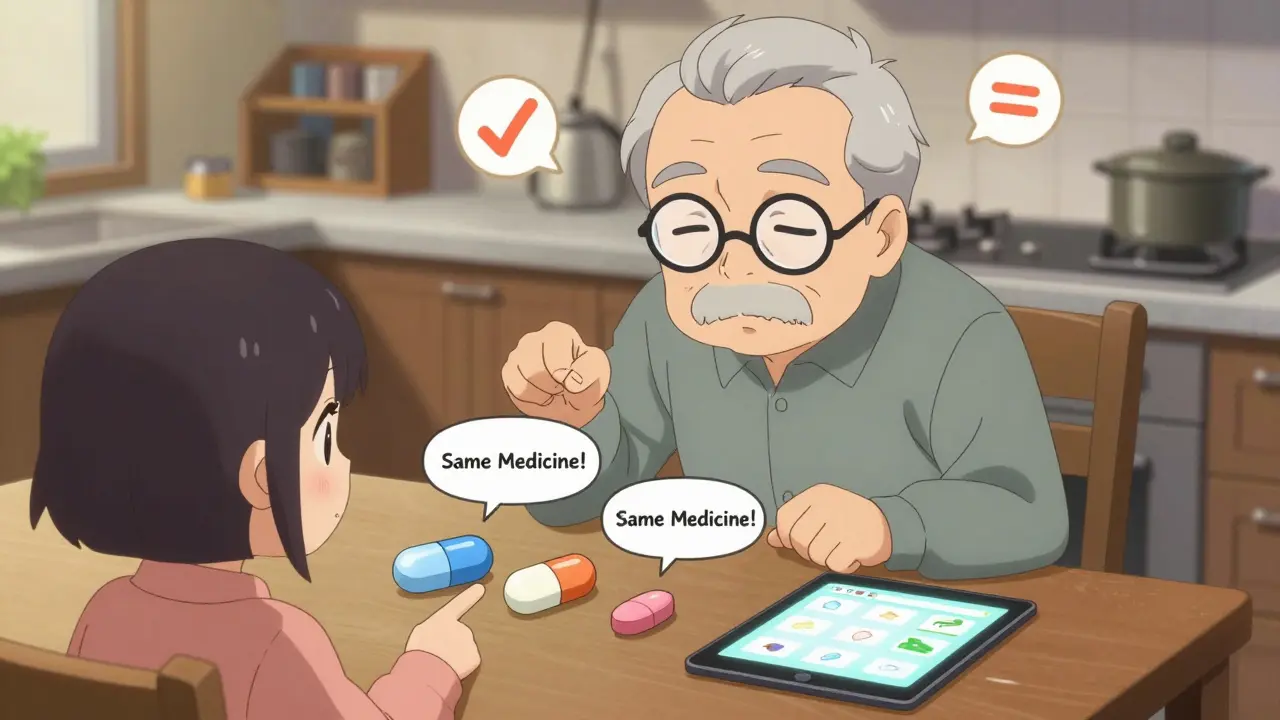
Seniors often need more time, simpler language, and visual help. Many have trouble reading small print, remembering names, or distinguishing between similar-looking pills.- Use large-print handouts with clear photos of the pill before and after substitution.
- Always say: "This is the same medicine, just made by a different company. It has the same active ingredient and works the same way."
- Explain bioequivalence in plain terms: "It’s like two different brands of aspirin. One costs $1, the other $3. Both have acetaminophen. Both work the same."
- Involve caregivers: If a family member helps manage medications, include them in the conversation.
- Use the teach-back method: "Tell me how you’ll know this is the right pill next month."
- Preempt confusion: "Your pill might change again in the future. That doesn’t mean it’s wrong. We’ll always let you know before it happens."
A 2022 study in the Journal of the American Pharmacists Association found that seniors who received this kind of counseling had 32% better adherence. Those who didn’t were twice as likely to miss doses or stop taking their medicine.
What You Should Never Say
Some phrases, even if well-intentioned, backfire:- "It’s just a generic." → Sounds dismissive. Patients hear: "It’s second-rate."
- "It’s cheaper, so it’s fine." → Implies quality is sacrificed.
- "Everyone uses generics." → Doesn’t address individual concerns.
- "The doctor approved it." → Shifts blame. Patients still feel uncertain.
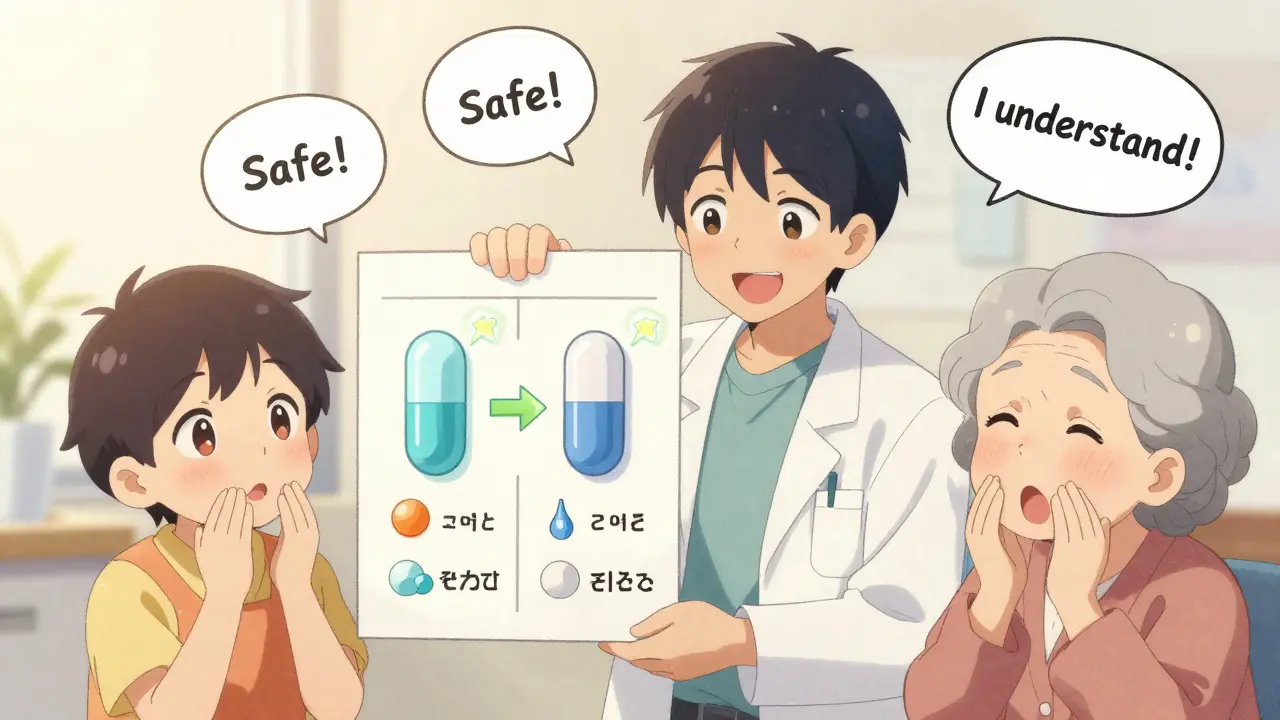
Instead, say: "I understand this change might feel strange. Let me explain why it’s safe and how we’ll make sure it works for you."
What’s Changing in 2026
In June 2023, the FDA launched the Generic Drug Communications Initiative, requiring manufacturers to include clearer information about formulation differences in patient handouts. Starting in 2024, pharmacists in 28 states will be required to get patient consent before substituting generics for drugs with narrow therapeutic indexes-like epilepsy or heart medications-especially for children and seniors.Also, new apps are being tested that let seniors snap a photo of their pill. The app compares it to the original and says: "This is the same medicine as your last bottle. Here’s what changed." Early tests show 67% of seniors felt more confident using these tools.
Bottom Line: Trust Comes From Clarity, Not Assumptions
Generic drugs save the U.S. healthcare system over $370 billion a year. But for kids and older adults, the cost savings mean nothing if they don’t take the medicine. The difference between success and failure isn’t chemistry. It’s communication.Don’t assume they understand. Don’t assume they’re okay with it. Ask. Explain. Show. Let them repeat it back. That’s how you turn fear into confidence-and pills into healing.
Are generic drugs really as effective as brand-name drugs?
Yes, for most people, generic drugs are just as effective. The FDA requires them to contain the same active ingredient, strength, and dosage form as the brand-name version. They must also prove they are absorbed in the body at the same rate and amount-within 80% to 125% of the brand. This is called bioequivalence. However, for children and seniors, differences in inactive ingredients (like flavoring or fillers) can affect how well the medicine is taken, not how well it works.
Why does my child refuse to take the generic version of their medicine?
Many generic versions of pediatric medications don’t have the same taste, texture, or form as the brand. Brand-name liquid antibiotics often come in sweet, fruit-flavored suspensions designed for kids. Generics may be bitter, chalky, or too thick. A 2022 study found that 64% of parents reported their child refused the generic version due to taste alone. If this happens, ask your pharmacist or doctor if there’s a different generic option or if the brand can be covered under your insurance.
My senior parent’s pill changed shape and color three times in six months. Should I be worried?
It’s common for generic medications to change appearance because different manufacturers supply them over time. But for seniors, this can cause confusion and lead to missed doses or errors. A 2023 AARP survey found that 52% of seniors felt unsure if they were still taking the right medicine after multiple changes. Always keep a list of each pill’s appearance, name, and dose. Ask your pharmacist to notify you before any changes, and consider using a pill identification app that can scan and confirm what the pill is.
Can switching to a generic cause side effects?
The generic drug itself doesn’t cause new side effects-it has the same active ingredient. But some people experience side effects because they believe the cheaper pill won’t work as well. This is called the nocebo effect. A 2021 study found 58% of seniors reported new symptoms after switching to a generic, even though lab tests showed no change in drug levels. If symptoms appear, talk to your doctor. It could be the nocebo effect… or a real reaction to a different filler in the pill.
What should I do if my insurance forces a generic switch?
You have the right to ask for an exception. If your child or senior parent has had trouble with a generic before, or if the drug has a narrow therapeutic index (like seizure or heart medications), your doctor can request a brand-name exception from your insurer. Many states now require pharmacists to get consent before switching for these high-risk drugs. Always ask: "Can we try to keep the original version?" It’s worth the effort.