

Hashimoto’s thyroiditis is the most common cause of hypothyroidism in countries where people get enough iodine in their diet. It’s not just a simple thyroid problem-it’s an autoimmune disease where your immune system attacks your own thyroid gland. Over time, this attack damages the gland’s ability to make thyroid hormones, leading to fatigue, weight gain, cold intolerance, and brain fog. But here’s the thing: managing Hashimoto’s isn’t just about taking a pill. It’s about understanding how your body responds, when to test, and why your TSH levels might still feel off even when they’re "normal."
What Actually Happens in Your Thyroid?
In Hashimoto’s, your immune system mistakes thyroid cells for invaders. Special immune cells called T-cells flood into the thyroid, and your body starts producing antibodies-mainly thyroid peroxidase antibodies (TPOAb) and thyroglobulin antibodies (TgAb). These antibodies don’t just sit around; they actively destroy the hormone-producing cells. By the time most people are diagnosed, up to 80% of their thyroid tissue may already be damaged.This process doesn’t happen overnight. It usually moves in four stages. First, you have normal thyroid function but positive antibodies-many people don’t know they have it yet. Then comes subclinical hypothyroidism: TSH starts creeping up above 4.5 mIU/L, but your free T4 is still fine. Next, overt hypothyroidism hits: TSH jumps past 10, free T4 drops, and symptoms become impossible to ignore. Finally, the thyroid shrinks and the goiter (if you had one) disappears. This final stage can take years, sometimes decades.
Why TSH Is the Main Tool-But Not the Whole Story
Doctors rely on TSH (thyroid-stimulating hormone) because it’s the body’s most sensitive early warning system. When your thyroid slows down, your pituitary gland pumps out more TSH to try to kickstart it. So a high TSH usually means your thyroid isn’t keeping up.But TSH isn’t perfect. About 5-10% of people with Hashimoto’s have what’s called TSH autoantibody interference. These antibodies stick to the TSH molecule and make lab tests show falsely high numbers-even when your thyroid is working fine. That’s why, if you’re still tired, gaining weight, or feeling depressed despite a "normal" TSH, your doctor should check your free T4 too.
And here’s something most patients don’t know: timing matters. TSH levels drop temporarily if you take your levothyroxine right before a blood test. That’s why labs recommend testing in the morning, before you take your pill, and at least 24 hours after taking biotin supplements (common in hair and nail vitamins). Biotin can mess with the test and make TSH look lower than it is-by as much as 30%.
What’s a "Normal" TSH Level Really?
The old standard was 0.5 to 5.0 mIU/L. But that’s outdated. The American Thyroid Association now recommends tighter targets depending on your age and life stage.For healthy adults under 60, aim for 1.0 to 2.5 mIU/L. For those over 65 or with heart disease, a higher range-up to 4.5 or even 6.0 mIU/L-is safer. Why? Because pushing TSH too low increases the risk of bone loss and irregular heart rhythms in older adults.
If you’re trying to get pregnant, the rules change again. A TSH above 2.5 mIU/L during the first trimester raises miscarriage risk by 2.3 times. That’s why many endocrinologists target 0.1 to 2.5 mIU/L for women trying to conceive and during pregnancy.
And if you’ve had thyroid cancer? Your target might be near zero-suppressing TSH to keep any remaining cancer cells from growing. But that’s a whole different situation.
Levothyroxine: The Standard, But Not Always Enough
Levothyroxine (T4) is the go-to treatment. It replaces the hormone your thyroid can’t make anymore. Most people feel better within weeks. But here’s the catch: 10-15% of patients still have symptoms-brain fog, muscle aches, weight gain-even when their TSH is perfect.Some of them try combination therapy-adding T3 (like Cytomel) to their T4. But a major 2017 meta-analysis of 87% of patients showed no consistent benefit. The American Association of Clinical Endocrinologists doesn’t recommend it routinely. It’s only considered if you’ve been on optimized T4 for at least six months and still feel awful.
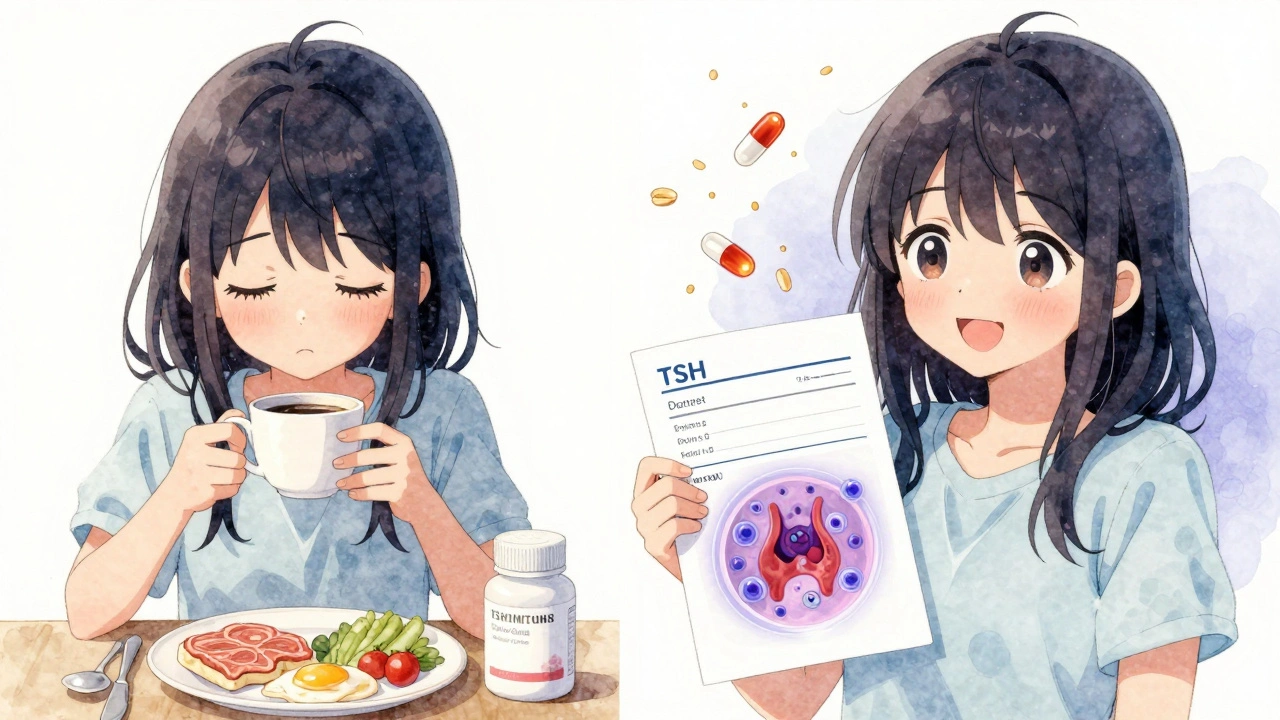
There’s also the issue of absorption. Calcium, iron, soy, and even coffee can block levothyroxine from being absorbed. If you take a calcium supplement or drink coffee within four hours of your pill, your body might only get half the dose. That’s why doctors tell you to take it on an empty stomach, 30-60 minutes before breakfast.
Hashitoxicosis: When You Feel Hyper for a While
It sounds impossible, but some people with Hashimoto’s go through a phase called "hashitoxicosis." It happens early in the disease, when the immune attack causes thyroid cells to leak stored hormones into the bloodstream. You might suddenly feel anxious, have heart palpitations, lose weight, or feel hot-even though you later develop full-blown hypothyroidism.This phase lasts weeks to a couple of months. It’s not Graves’ disease. It’s just the thyroid dying in a hurry. Many patients panic, thinking they’ve switched diseases. But it’s part of the same process. Your doctor should check your free T4 and T3 during this time. No treatment is usually needed-just monitoring. The thyroid will burn out, and you’ll move into the hypothyroid phase.
What Triggers Fluctuations? (And Why Your TSH Keeps Changing)
If your TSH keeps bouncing up and down despite taking your pill on time, you’re not alone. Real-world data from patient forums shows:- 41% say stress triggers symptoms
- 32% notice worse symptoms after eating gluten
- 27% see higher TSH in winter
Seasonal changes are real. In colder months, TSH averages 1.8 mIU/L higher than in summer. Your body may need more hormone in winter. That’s why some doctors adjust doses seasonally.
Weight gain or loss also changes your dose needs. A 10-pound change can mean a 12.5-25 mcg adjustment. And yes-some people need dose changes every few months during the first year. That’s normal. It’s not your fault. Your thyroid is still in flux.
Testing and Tracking: How Often and When
After starting or changing your levothyroxine dose, wait 6-8 weeks before retesting. It takes that long for your body to stabilize. Test too soon, and you’ll get misleading numbers.Once you’re stable, annual testing is fine for most people. But if you’re pregnant, over 65, or have heart disease, test every 6 months. And if you’re still symptomatic, don’t accept "your TSH is normal" as the end of the conversation. Ask for free T4, free T3, and antibody levels.
Some clinics now offer point-of-care TSH tests-results in 10 minutes. A 2022 trial showed this cuts the time to reach stable levels by 42 days. If your doctor has this tool, ask if you can use it during visits.
The Future: What’s Coming Next?
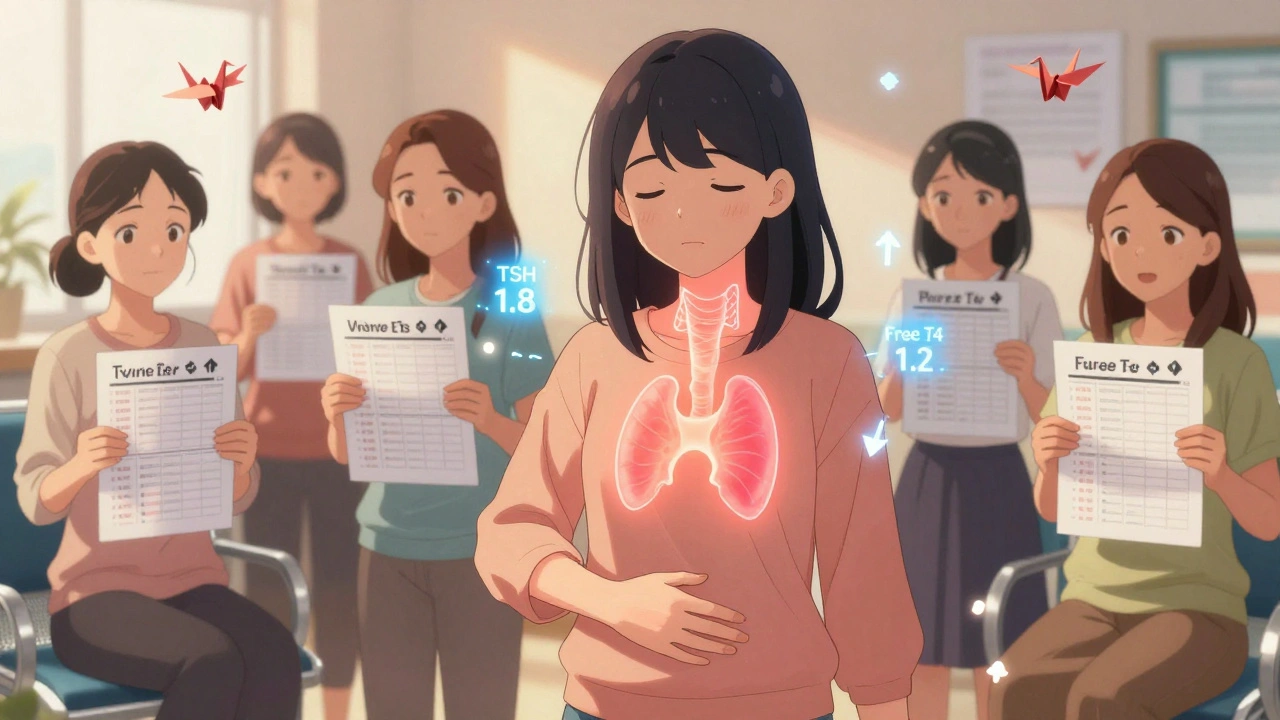
Right now, levothyroxine is the only proven treatment. But research is moving fast. Scientists are studying drugs that calm the immune attack-targeting specific T-cells involved in Hashimoto’s. There are already 12 phase II clinical trials underway, with results expected by 2028.One exciting discovery: 25% of treatment-resistant cases have antibodies that block TSH receptors-something thought to exist only in Graves’ disease. This could lead to new targeted therapies.
Long-term, doctors may use your genetics to personalize TSH targets. Variants in genes like CTLA-4 and PTPN22 are linked to how aggressive your Hashimoto’s is. By 2030, your TSH goal might be based on your DNA, not just your age.
What You Can Do Today
You can’t cure Hashimoto’s. But you can manage it well.- Take your levothyroxine on an empty stomach, 30-60 minutes before food or coffee.
- Avoid calcium, iron, and soy within 4 hours of your dose.
- Test TSH in the morning, before taking your pill, and without biotin for 24 hours.
- Ask for free T4 if you still feel bad-even if TSH is "normal."
- Track your symptoms and TSH trends over time. Patterns matter more than single numbers.
- Consider reducing gluten if you notice symptom flare-ups after eating it. Many patients report improvement.
- Manage stress. It doesn’t cause Hashimoto’s, but it can make symptoms worse.
Hashimoto’s isn’t a death sentence. It’s a chronic condition-like high blood pressure or type 2 diabetes. With the right monitoring, adjustments, and awareness, you can live a full, energetic life. The key isn’t perfection. It’s consistency, communication with your doctor, and knowing your body well enough to speak up when something feels off.
Can Hashimoto’s thyroiditis be cured?
No, Hashimoto’s thyroiditis cannot be cured. It’s a lifelong autoimmune condition where the immune system continues to attack the thyroid. However, it can be effectively managed with levothyroxine replacement therapy. Most people achieve normal thyroid function and symptom relief with consistent dosing and regular monitoring.
Why does my TSH keep changing even though I take my pill every day?
TSH levels can fluctuate due to seasonal changes (higher in winter), weight shifts, stress, or changes in how your body absorbs medication. Taking calcium, iron, or soy within 4 hours of your pill can reduce absorption. Even small changes in diet, sleep, or illness can affect your dose needs. Regular testing and dose adjustments every 6-8 weeks after changes are normal during the first year.
Is it safe to take T3 (Cytomel) with levothyroxine?
Combination T4/T3 therapy is not routinely recommended. Large studies show most patients don’t feel better on it than on levothyroxine alone. The American Association of Clinical Endocrinologists only considers it after six months of optimized T4 therapy and persistent symptoms. It can cause heart rhythm issues and bone loss if not carefully monitored.
Do I need to avoid gluten if I have Hashimoto’s?
There’s no universal rule, but many patients report fewer symptoms-like fatigue and bloating-when they cut out gluten. This may be due to molecular mimicry, where gluten proteins resemble thyroid tissue, confusing the immune system. While not required, a gluten-free trial for 3-6 months is a low-risk way to see if it helps you personally.
How often should I get my thyroid levels checked?
After starting or changing your levothyroxine dose, test TSH every 6-8 weeks until stable. Once stable, annual testing is usually enough. But if you’re pregnant, over 65, have heart disease, or still have symptoms, test every 6 months. Always test in the morning before taking your pill and avoid biotin for 24 hours beforehand.
Can Hashimoto’s lead to thyroid cancer?
Hashimoto’s itself doesn’t cause thyroid cancer. However, people with Hashimoto’s have a slightly higher chance of developing thyroid nodules, some of which may be cancerous. That’s why doctors often use ultrasound to monitor thyroid structure. If a nodule looks suspicious, a biopsy is done. Most nodules in Hashimoto’s patients are benign.
What’s the difference between Hashimoto’s and Graves’ disease?
Both are autoimmune thyroid diseases, but they have opposite effects. Hashimoto’s destroys the thyroid, leading to hypothyroidism (low hormones). Graves’ stimulates the thyroid, causing hyperthyroidism (too many hormones). Hashimoto’s is marked by TPOAb and TgAb, while Graves’ has TSH receptor antibodies (TRAb). Hashimoto’s often causes a goiter that shrinks over time; Graves’ causes a swollen, overactive gland.
What to Do Next
If you’ve just been diagnosed, don’t panic. Hashimoto’s is manageable. Get your baseline labs: TSH, free T4, TPOAb, and TgAb. Ask your doctor about your target TSH range based on your age and health. Start the medication as prescribed, track your symptoms, and schedule your first follow-up in 6-8 weeks.If you’ve been on levothyroxine for years but still feel off, ask for a full thyroid panel-not just TSH. Bring your symptom log. Ask about seasonal patterns and absorption issues. You’re not imagining things. Your body is trying to tell you something.
Hashimoto’s isn’t just a lab number. It’s your energy, your mood, your sleep, your body. Learning how to read your own signals-and how to talk to your doctor about them-is the real key to living well with it.
Allan maniero
December 3, 2025 AT 08:40Man, I’ve been living with Hashimoto’s for 12 years now, and honestly, the biggest shift for me wasn’t the meds-it was realizing how much my thyroid is just one part of a whole system. I used to blame everything on my TSH, but then I started tracking sleep, stress, and even the weather. Turns out, my TSH spikes every November like clockwork. My doc thought I was crazy until I showed him 5 years of logs. Now he adjusts my dose seasonally. No magic pill, just patience and paying attention.
Also, biotin? Yeah, I stopped all those hair gummies. My TSH dropped 1.8 points overnight. Turns out, I was basically lying to my lab results. Dumb move, but I’m not alone. So many people don’t know this.
Anthony Breakspear
December 3, 2025 AT 17:32Let’s be real-TSH is the thyroid’s annoying roommate who yells at you for leaving the lights on, but doesn’t actually fix the broken heater. You gotta check the free T4, the free T3, the antibodies, the moon phase (kidding… maybe). I was on levothyroxine for 3 years, felt like a zombie, and my doc kept saying, ‘Your numbers look fine.’
Finally, I demanded a full panel. My T3 was in the basement. We added Cytomel. Within 3 weeks, I went from ‘can’t get out of bed’ to ‘went hiking on Sunday.’ Not everyone needs it, but if you’re still suffering while your TSH is ‘normal’? You’re not weak. You’re just being ignored. Fight for your energy.
Also, coffee 20 mins before your pill? That’s like pouring gasoline on a candle. Don’t be that guy.
Zoe Bray
December 3, 2025 AT 21:39While the clinical management of Hashimoto’s thyroiditis is generally well-documented in contemporary endocrinological literature, it is imperative to underscore the necessity of rigorous biochemical monitoring in accordance with the 2023 American Thyroid Association guidelines. The current paradigm of TSH-centric management remains insufficient for a subset of patients exhibiting euthyroid sick syndrome or TSH receptor antibody interference.
Furthermore, the empirical use of combination T4/T3 therapy remains unsupported by Level 1 evidence per Cochrane meta-analyses, and its off-label application may precipitate iatrogenic thyrotoxicosis, particularly in patients with concomitant cardiovascular pathology. Dietary interventions such as gluten exclusion, while popular in functional medicine circles, lack robust double-blind RCT validation and should not supplant evidence-based pharmacotherapy.
Seasonal TSH variation, though anecdotally reported, remains a confounding variable in longitudinal studies and is not yet incorporated into standard dosing algorithms. Until prospective trials confirm clinical utility, such adjustments remain speculative.
Girish Padia
December 4, 2025 AT 18:23People think medicine is about science. Nah. It’s about who you know and how loud you scream. I had a doctor tell me my TSH was fine, so I should just ‘get over it.’ I went to another clinic, brought my own lab reports, and asked for T3. They laughed. Then I showed them my gluten-free journal. They gave me a script. Coincidence? I think not.
Also, if you’re not eating clean, you’re just wasting everyone’s time. No gluten, no sugar, no dairy. That’s the real treatment. Pills are just Band-Aids on a bullet wound.
william tao
December 5, 2025 AT 16:46Wow. What a masterpiece of overcomplicated medical fluff. You could’ve just said: ‘Take your pill, don’t drink coffee with it, and stop Googling everything.’
But no. You had to write a 2000-word essay with 17 subheadings. Did you get paid by the word? Because this feels like a pharmaceutical ad disguised as patient education.
Also, ‘25% of treatment-resistant cases have antibodies blocking TSH receptors’? Where’s your citation? I’m not falling for this ‘sciencey’ nonsense.
Sheryl Lynn
December 7, 2025 AT 05:10Oh honey. You’ve clearly never met a real autoimmune warrior. I’ve got a 7-page binder on my thyroid, color-coded by moon phase and cortisol spike. I don’t just take levothyroxine-I ritualize it. Cold water. Fasting. Sun salutations. And yes, I’ve been gluten-free since 2017. My TSH? It’s a whisper now. A *beautiful*, silent whisper.
Also, biotin? Darling, that’s for people who still think kale is a spice. You don’t need a PhD to know that if your nails aren’t growing like a weed, you’re doing it wrong.
And if your doctor doesn’t get it? Find one who does. Preferably one who wears crystals and has a Tesla. Because if you’re not optimizing your aura, you’re not optimizing your thyroid.
John Biesecker
December 8, 2025 AT 08:56bro i’ve been on levothyroxine for 5 years and i still forget to take it sometimes 😅 but honestly? the biggest thing that helped was just… chillin. like, i used to stress about every little bump in my TSH and now i just check it once every 6 months and eat avocado and nap when i can. also, coffee after the pill, not before. duh. my doc was like ‘you’re doing better than 90% of your peers’ and i was like ‘wait, i’m not broken?’ 🤯
also, i think my thyroid is just a lazy roommate who needs a little more sleep. and maybe less gluten. maybe. 🌱
Michael Campbell
December 9, 2025 AT 16:01They’re lying. The whole thing is a scam. Big Pharma made up Hashimoto’s so they could sell you pills forever. Your thyroid’s fine. You just need to stop eating processed food and start drinking alkaline water. I read a blog from a guy in Bulgaria who cured himself with saunas and raw garlic. Your doctor won’t tell you this because he gets paid by the pill.
Also, TSH? That’s just a number they invented to keep you scared. I stopped taking my meds. I’m fine. Just don’t tell anyone.