
Every pill you take - whether it’s branded or generic - should work the same way. But how do you know it’s real? In a world where counterfeit drugs are increasingly sophisticated, the only thing standing between you and a dangerous fake is the manufacturing standard behind it. And that standard isn’t optional. It’s built into every step of production, from the raw ingredients to the final package.
Why Generic Drugs Need Tighter Controls Than You Think
Generic drugs make up 90% of all prescriptions filled in the U.S. But they only cost 23% of what brand-name drugs do. That price difference doesn’t mean lower quality - if the system works right. The problem? Counterfeiters don’t care about cost. They care about profit. And they’ve learned to copy the look, color, and even the imprint on pills. Some fakes even contain the right active ingredient - but in the wrong form. That’s where things get dangerous. A 2018 recall of the blood pressure medication valsartan exposed a hidden flaw: the chemical was correct, but the crystal structure was off. That tiny difference meant the drug didn’t dissolve properly in the body. Standard lab tests missed it. Only after patients started having unexpected side effects did regulators dig deeper. That’s why quality control can’t just test the final product. It has to build safety into every single step.The cGMP Rule: Quality Can’t Be Tested In
The foundation of all legitimate generic drug manufacturing is cGMP - Current Good Manufacturing Practices. This isn’t a suggestion. It’s a legal requirement enforced by the FDA under 21 CFR Part 211. The rule is simple: quality cannot be tested into a finished product; it must be built into the design and manufacturing process at every single step. That means:- Every batch of raw material must be tested against a known reference standard - no exceptions.
- Manufacturing rooms must maintain ISO Class 5 cleanroom conditions - fewer than 3,520 airborne particles per cubic meter.
- Equipment must be cleaned and validated to prevent cross-contamination between batches.
- Every step of the process is documented, tracked, and audited.
The SQUIPP Framework: What Makes a Generic Drug Safe
The pharmaceutical industry uses a simple acronym to define what a real generic drug must be: SQUIPP - Safety, Quality, Identity, Potency, and Purity.- Identity: Does the pill contain the right chemical? Tests like infrared spectroscopy and high-performance liquid chromatography verify this with 99.9% accuracy.
- Potency: Is there enough of the active ingredient? Dissolution testing checks if the drug releases properly in simulated stomach fluid - 80% must dissolve within 30 to 45 minutes.
- Purity: Are there harmful impurities? Modern labs use mass spectrometry to detect contaminants at parts-per-million levels.
- Quality: Does the pill hold its shape? Does it break apart correctly? Does the coating protect it from moisture?
- Safety: Is the drug bioequivalent to the brand version? Generic manufacturers must prove their product behaves the same way in the body - with 90% confidence that absorption levels fall within 80-125% of the original.
Track-and-Trace: The Digital Shield Against Fakes
Even the best lab tests can’t catch every fake. That’s why the system now has a second layer: digital tracking. Since 2023, every package of prescription drugs in the U.S. must have a unique serial number - like a barcode with a digital fingerprint. This is part of the Drug Supply Chain Security Act. Each number is scanned at every point: manufacturer, distributor, pharmacy, and finally, the patient. If a pill turns up in a pharmacy with a serial number that doesn’t match the database, it’s flagged immediately. The system works with 99.99% accuracy. By 2023, 92% of the top 50 generic manufacturers had fully implemented this system. Smaller companies? Only 45% have caught up - mainly because the cost to install the full system runs $3.5 million per site. Companies like Veeva QualityOne and TrackWise have built cloud-based platforms that monitor over 15,000 quality parameters per batch in real time. One quality manager at Teva told Reddit users it took 18 months and $2.3 million to get their system up and running - but now, they resolve quality issues in 48 hours instead of two weeks.Where the System Still Fails
No system is perfect. The biggest blind spot? Polymorphs - different crystal forms of the same chemical. Two pills can have identical ingredients, but one might be made with a crystal structure that doesn’t dissolve in the body. Standard tests won’t catch it unless they’re specifically looking for it. That’s what happened with valsartan. The impurity wasn’t a contaminant - it was the wrong form of the molecule. It took a patient safety crisis to force regulators to update their testing protocols. Another weakness? Enforcement. In countries with weak regulatory oversight, counterfeiters thrive. Interpol’s 2022 Operation Pangea X seized $21 million in fake medicines - 78% of them falsely labeled as generics. In some African and Southeast Asian markets, up to 30% of medicines are fake. In the U.S. and EU? Less than 1%. The European Union has an extra layer: the Qualified Person (QP) system. Every batch must be personally signed off by a certified pharmaceutical expert before it leaves the factory. The U.S. relies more on process validation - which works well, but only if the company follows the rules.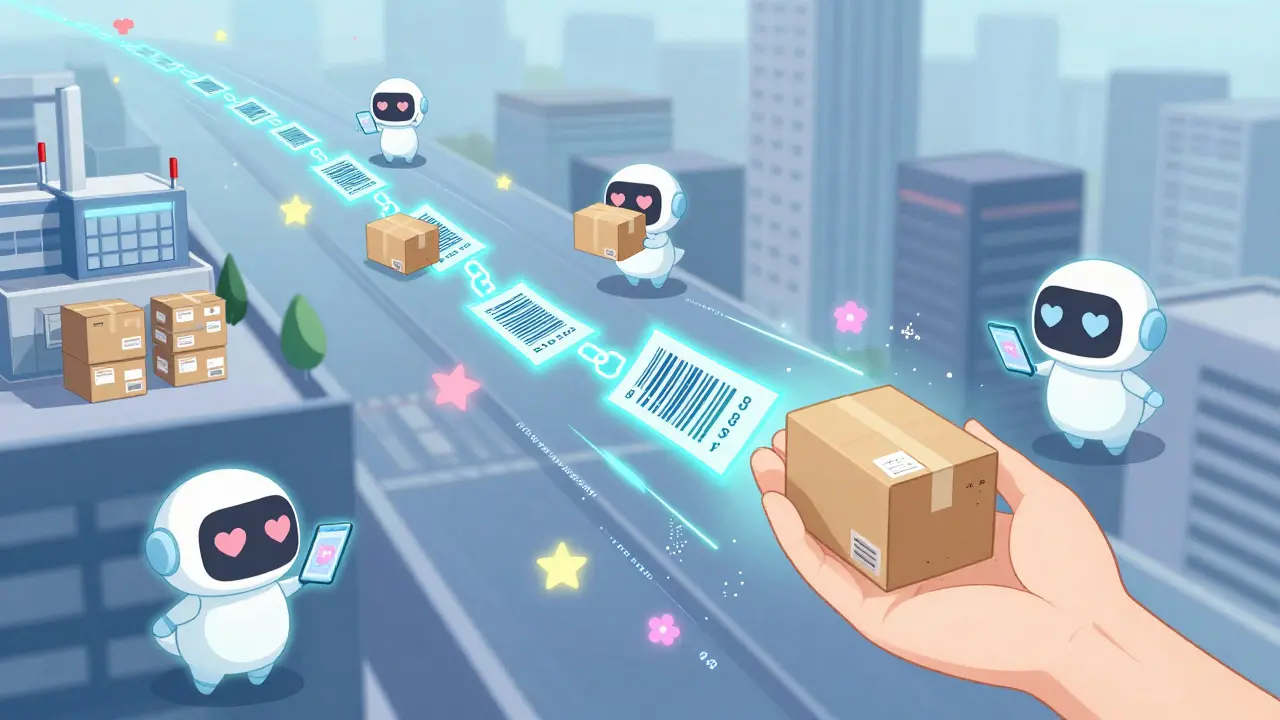
What’s Next? AI, Blockchain, and Molecular Taggants
The fight against counterfeits is moving faster than ever. By 2025, the FDA expects all manufacturers to use continuous manufacturing - where the drug is made in a constant flow, not in batches. Sensors collect data every 5 seconds, catching deviations before a single pill is made. In Africa, the WHO is testing blockchain-based verification for antimalarial generics. Each package is logged on a tamper-proof digital ledger. Patients can scan a code with their phone to confirm the drug is real - even without internet access. And in labs right now, scientists are developing molecular taggants - invisible markers added to the drug that can only be detected with specialized scanners. These aren’t chemicals you can copy. They’re like DNA for pills. By 2027, AI-powered quality control systems are expected to cut counterfeit incidents by 40%. IBM and Siemens have already invested $1.2 billion in these tools. They can spot patterns humans miss - like a slight shift in the color spectrum of a tablet that signals a change in manufacturing conditions.What You Can Do
As a patient, you don’t need to understand chromatography or polymorphs. But you can protect yourself:- Only buy prescription drugs from licensed pharmacies - online or in person.
- Check the packaging. Real generics have consistent labeling, fonts, and batch numbers.
- If a pill looks different from your last refill, ask your pharmacist. It might be a different manufacturer - but it should still be safe.
- Report suspicious drugs to the FDA’s MedWatch program. One report can trigger an investigation.
Why This Matters
Counterfeit drugs don’t just waste money. They kill. A fake antibiotic might not work, letting an infection spread. A fake heart medication might contain too little active ingredient - or worse, a toxic substitute. The cost of quality control is high - 8-12% of total manufacturing costs. But the cost of failure? Billions in lost lives and trust. In 2023, these systems prevented an estimated $200 billion in counterfeit drug sales worldwide. The truth? Generic drugs aren’t cheaper because they’re worse. They’re cheaper because competition drives down prices - not because corners are cut. And that’s only possible because of the strict standards that keep them safe.Are generic drugs as safe as brand-name drugs?
Yes - when they’re made under proper quality control. The FDA requires generic drugs to meet the same safety, strength, and purity standards as brand-name drugs. In fact, FDA data shows generic drugs have a slightly lower adverse event rate (0.02%) compared to brand-name drugs (0.03%). The difference isn’t because generics are better - it’s because the system forces both to be equally safe.
How do I know if my generic drug is real?
Check the packaging for consistent branding, batch numbers, and expiration dates. Buy only from licensed pharmacies - not random websites. If the pill looks different from your previous refill, ask your pharmacist. It could be a different manufacturer, which is normal. But if the color, shape, or imprint is off and the pharmacy can’t explain why, report it. You’re not being paranoid - you’re helping protect others.
Can counterfeit drugs pass lab tests?
Sometimes - but only if they’re made with extreme sophistication. Most fakes fail basic tests for identity or potency. But the most dangerous counterfeits mimic the chemical structure perfectly while using the wrong crystal form or impurity profile. These are rare and usually only found in high-end fakes. That’s why modern systems use multiple layers - physical testing, digital tracking, and process controls - not just one.
Why are some generic drugs cheaper than others?
It’s about competition, not quality. Multiple manufacturers can make the same generic drug. The one with the lowest cost wins the contract. But all must still meet the same FDA standards. A cheaper pill isn’t a worse pill - unless it comes from an unregulated source. Always buy from reputable pharmacies. If a price seems too good to be true, it probably is.
What’s the biggest threat to generic drug safety today?
The biggest threat isn’t bad manufacturing - it’s weak enforcement. In countries with poor regulatory systems, counterfeiters operate with little risk. Even in the U.S., the biggest compliance issues are inadequate investigation of test failures and poor cleaning validation. These aren’t about fraud - they’re about sloppy processes. That’s why training, technology, and culture matter as much as rules.
Annie Choi
January 15, 2026 AT 06:00Just saw my last generic prescription and noticed the pill looked slightly different than last time. Didn’t panic-asked the pharmacist. Turns out it’s a different manufacturer but same FDA specs. That’s the system working. We don’t need brand names, we need trust in the process.
And yeah, the crystal structure thing? Wild. One tiny molecular twist and your blood pressure med becomes a time bomb. No wonder they’re pushing continuous manufacturing now.
Amy Vickberg
January 15, 2026 AT 13:50This is the kind of post that makes you realize how much you take for granted. People think generic = cheap = risky. But the truth? The system’s designed to make sure it’s not. The real risk is when enforcement slips, and that’s where global supply chains get messy.
Big pharma wants you scared. But the data doesn’t lie-generic adverse events are actually lower. That’s not luck. That’s cGMP.
Nat Young
January 16, 2026 AT 11:55Let’s be real. The FDA’s 94% pass rate in the US is a joke. They inspect once a year. What happens in the other 360 days? And don’t get me started on the fact that 78% of generic APIs come from India and China, where inspections are performative at best.
The ‘SQUIPP’ framework sounds nice, but if your lab can’t detect polymorphs unless someone dies first, you’re not protecting patients-you’re just doing damage control.
And that $3.5 million track-and-trace cost? That’s not a barrier to entry-it’s a cartel enabler. Big players can afford it. Small ones get squeezed out. Guess who wins?
Frank Geurts
January 17, 2026 AT 01:23It is, indeed, a matter of profound significance that the Current Good Manufacturing Practices, as codified under 21 CFR Part 211, constitute the foundational bedrock upon which pharmaceutical integrity rests.
Without the rigorous, non-negotiable adherence to these protocols-from raw material authentication to cleanroom particulate thresholds-the entire edifice of public trust in pharmacotherapy would collapse.
Moreover, the implementation of the Drug Supply Chain Security Act, with its unique serial numbering and blockchain-enabled verification systems, represents not merely regulatory advancement, but a moral imperative in the defense of human life.
One must pause, and reflect, upon the fact that the cost of quality-though substantial-is infinitesimal compared to the cost of failure.
Therefore, we must not only support these systems, but demand their universal adoption, and unwavering enforcement, across all jurisdictions.
Arjun Seth
January 19, 2026 AT 00:20India makes 40% of the world’s generics. And you think they care about crystal structures? Ha.
My cousin works in a factory in Gujarat. They reuse solvents. They skip dissolution tests. They print fake batch numbers. And the FDA? They show up, get shown the clean room they built just for the inspection, and leave happy.
Don’t believe the propaganda. Your generic pill? It’s probably made by someone who doesn’t know what a polymorph is. And that’s not a bug-it’s the system.
Ayush Pareek
January 19, 2026 AT 21:52Hey Arjun, I get your frustration. I’ve seen the factories too. But let’s not throw the baby out with the bathwater.
Yes, some places cut corners. But the good ones? They’re doing incredible work. I’ve visited a plant in Hyderabad that’s got better documentation than some U.S. startups.
The answer isn’t to boycott Indian generics-it’s to push for more transparency, more audits, more investment in training. We can fix this. But only if we don’t give up on the people who want to do it right.
Nishant Garg
January 21, 2026 AT 04:39So here’s the thing: we’re treating pills like they’re iPhones. We want them barcoded, tracked, scanned, and verified like they’re coming off a Tesla assembly line.
But here’s the twist-they’re not. Pills are molecules. They don’t care about QR codes. They care about crystal lattices and dissolution curves.
The real revolution isn’t blockchain-it’s AI catching a color shift in a tablet that means the binder’s degraded. That’s the future. Not the barcode. The science.
And honestly? The fact that we’re even having this conversation means we’re finally starting to take this seriously. Progress isn’t perfect. But it’s happening.
Amy Ehinger
January 22, 2026 AT 23:05I used to be terrified of generics. Thought they were just placebo pills with cheaper packaging. Then I started reading the FDA’s bioequivalence reports. Turns out, most generics are *more* consistent than brand names because they’re made in bigger batches with tighter controls.
Also, I once got a generic version of my antidepressant and felt better. Not worse. Weird, right?
Anyway, I still check the pill shape. Just in case. But now I know it’s not about the brand. It’s about the batch. And the people behind it.
Tom Doan
January 24, 2026 AT 18:47How convenient that the FDA’s 94% compliance rate aligns perfectly with the fact that 90% of U.S. prescriptions are generic. Is this a coincidence? Or is the agency incentivized to avoid bad press?
And let’s not forget: the valsartan recall happened because patients died. Not because someone ran a test. That’s not quality control. That’s triage.
Also, why is it that every time a new tech solution is proposed-AI, blockchain, taggants-it’s always funded by the same corporations that profit from the status quo?
Just saying.
Sohan Jindal
January 25, 2026 AT 22:29China and India are poisoning our medicine. And our government lets them. Why? Because they’re getting rich off it. Our politicians are in their pocket. That’s why your pills are made overseas. That’s why your kids are getting sick. That’s why you’re being lied to.
Buy American. Or don’t take pills at all.
Nicholas Urmaza
January 26, 2026 AT 01:49Quality isn’t optional. It’s the only thing standing between life and death. And if you’re still skeptical about generics, you’re not being careful-you’re being ignorant.
The system works. Not perfectly. But well enough. The real threat isn’t the pill. It’s the people who spread fear without facts.
Trust the science. Trust the process. Or don’t take the medicine. But don’t pretend you’re protecting anyone by spreading panic.
Sarah Mailloux
January 26, 2026 AT 22:54I just got my generic blood thinner and the pill was a different color. Looked weird. Asked my pharmacist. She said, 'Different maker, same formula.' Showed me the FDA database. It matched.
So I took it. No issues.
My point? Don’t freak out over color. Freak out when you buy from sketchy websites. That’s the real danger.
Nilesh Khedekar
January 28, 2026 AT 15:22Oh, so now we’re trusting AI to catch polymorphs? Brilliant. Next they’ll use facial recognition to identify fake insulin pens.
Meanwhile, in rural Bihar, people are buying fake malaria pills from street vendors who don’t even know what a tablet is. And you’re worried about color shifts in Ohio?
The real problem isn’t manufacturing-it’s poverty. And until we fix that, no blockchain will save a child in Malawi from a counterfeit drug.
But hey, let’s spend $1.2 billion on AI. That’ll fix everything.