
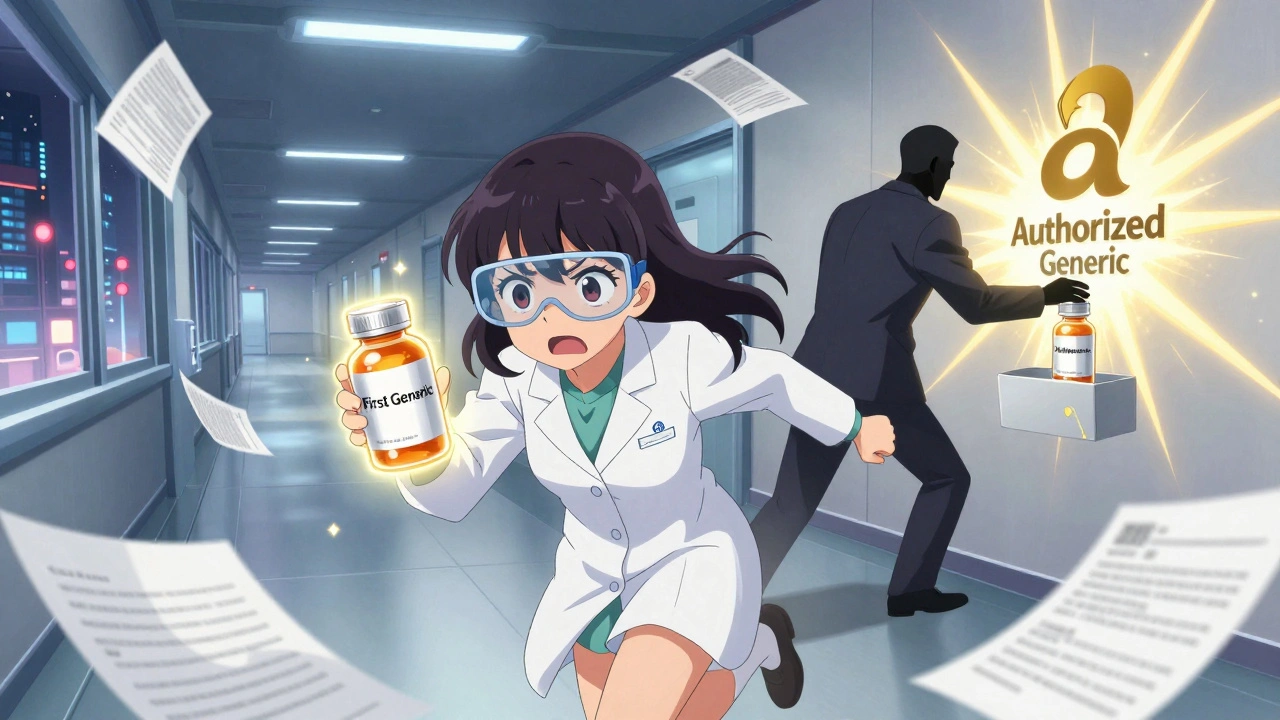
When a brand-name drug loses its patent, the race to bring the first generic version to market isn’t just about speed-it’s about survival. But here’s the twist: the company that wins that race might not be the one that ends up making the most money. Why? Because the brand-name drugmaker might already have a plan ready to undercut them before they even get started. That plan is called an authorized generic.
What’s the difference between a first generic and an authorized generic?
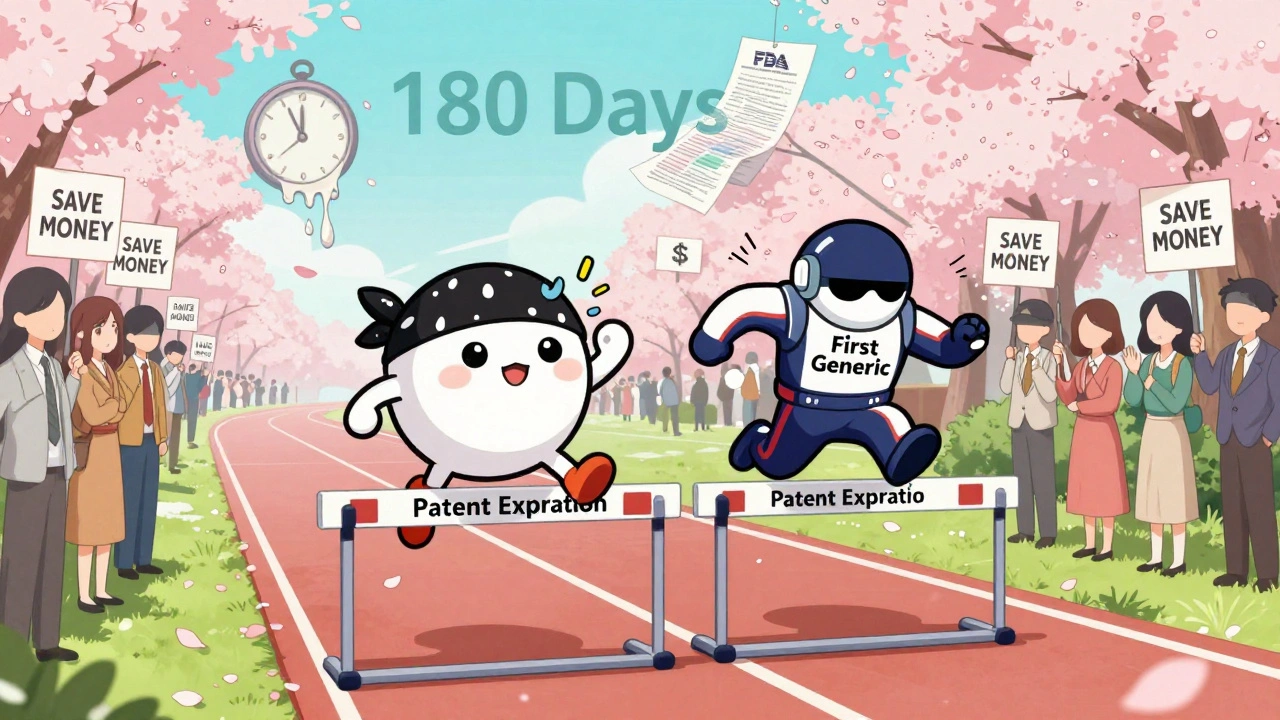
A first generic is the first company to successfully challenge a brand-name drug’s patent and get FDA approval to sell a generic version. This is a big deal. Under the Hatch-Waxman Act of 1984, that company gets 180 days of exclusive rights to sell the generic before anyone else can join. During that window, they usually capture 70-90% of the market. Prices drop fast. Patients save money. And the generic company makes a killing-sometimes hundreds of millions of dollars.
An authorized generic, on the other hand, isn’t a challenger at all. It’s made by the brand-name company-or by a company they’ve partnered with-and sold under a generic label. It’s the exact same pill, made in the same factory, with the same ingredients. But it’s priced like a generic. And here’s the key: it doesn’t need to go through the FDA’s full approval process. It can launch the moment the brand company decides to.
So while the first generic is fighting through years of legal battles and FDA reviews, the authorized generic is just waiting in the wings. And when that first generic finally hits shelves, the brand company flips the switch-and suddenly, there are two identical products on the market. One from the challenger. One from the original maker.
Why does timing matter more than anything else?
Timing is everything. The whole point of the 180-day exclusivity period was to reward the first generic company for taking the risk. Patent challenges cost $5-10 million and can take 2-3 years. The payoff? A monopoly on the generic market.
But in practice, that monopoly rarely lasts.
According to research from Health Affairs covering 2010-2019, 73% of authorized generics launched within 90 days of the first generic’s approval. Over 40% launched on the exact same day. That’s not coincidence. That’s strategy.
Take Lyrica (pregabalin), a $2 billion-a-year drug from Pfizer. When Teva launched the first generic in July 2019, Pfizer immediately rolled out its own authorized generic through Greenstone LLC. Within weeks, Teva’s market share dropped from 80% to under 50%. Pfizer’s version grabbed about 30% of sales. Teva didn’t lose the race-they just lost the prize.
That’s the pattern now. It’s happened with Lipitor, Neurontin, Prilosec, and dozens more. The brand companies aren’t waiting for the generic to erode their profits. They’re launching their own version before the generic even has time to build momentum.
What happens to prices when both enter at once?
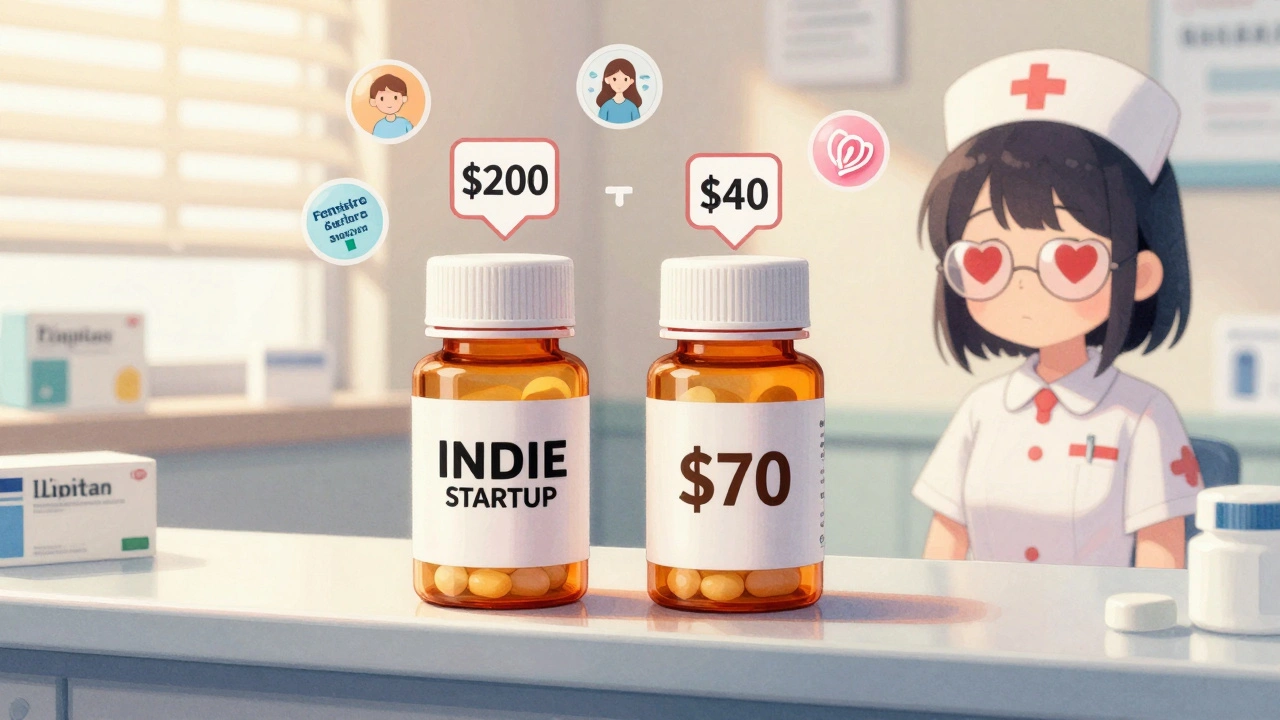
Without an authorized generic, a first generic usually drives prices down by 80-90%. That’s the whole point of generics.
But when the brand company jumps in with an authorized version, the drop is only 65-75%. That might sound small, but it’s billions of dollars in lost savings for patients and insurers.
Why? Because now there’s competition-but not the kind the law was designed to encourage. Instead of one low-price generic taking over, you’ve got two: one from the challenger, one from the brand. They split the market. Neither has to drop prices as low to stay competitive. And the brand company still makes money, just under a different label.
The RAND Corporation found that this tactic alone cost the U.S. healthcare system an extra $1.5 billion in avoided savings between 2010 and 2019.
How do authorized generics bypass the rules?
Here’s the loophole: authorized generics don’t need an Abbreviated New Drug Application (ANDA). They piggyback on the original brand’s New Drug Application (NDA). That means no bioequivalence studies. No lengthy FDA review. No waiting 10 months-or even 3 years-like first generics do.
The FDA’s own data shows that brand-name drugs get approved in under 10 months on average. First generics? They wait an average of 10 months just for the first review cycle. And if there’s a backlog, it can stretch to 3+ years. That’s why the first generic is always behind.
Meanwhile, the brand company has been preparing their authorized generic for years. The pills are already made. The packaging is ready. The distribution network is in place. All they need is the green light from the patent expiration-and they’re in the market before the first generic even gets a chance to celebrate.
Who wins? Who loses?
It’s not a fair fight.
The brand company wins. They keep a chunk of the market. They maintain pricing control. They turn a potential threat into a revenue stream.
The first generic loses. They spent millions. They waited years. And then they’re undercut before they can even build a customer base. Many mid-sized generic manufacturers now say their profitable window has shrunk from 180 days to just 45-60 days because of this tactic.
Patients? They still get lower prices than before the generic entered-but not as low as they should. Insurers pay more. Medicare pays more. The system pays more.
Even the FDA acknowledges the problem. In 2022, the Inflation Reduction Act explicitly said authorized generics don’t count as true generic competitors when calculating Medicare drug prices. That’s a rare admission: the government knows these aren’t the same as independent generics.
What’s changing now?
Generic manufacturers aren’t sitting still. Companies like Teva, Mylan, and Sandoz are adapting. Some are building faster ANDA submission systems. Others are partnering with multiple suppliers to spread risk. A few are even investing in their own authorized generic deals-turning the tables by licensing their own generics to brand companies.
But the biggest shift is in strategy. Instead of betting everything on one first-generic launch, companies are now building portfolios. They’re chasing multiple drugs at once. They’re targeting less competitive markets where brand companies don’t bother fighting back.
And they’re watching closely. If a brand company has a history of launching authorized generics, they’ll skip it. No point in spending $8 million to get undercut.
Meanwhile, authorized generics are growing. In 2022, they made up 18% of all generic prescriptions. By 2027, Evaluate Pharma predicts that number will hit 25-30%. That’s not a trend. That’s a new normal.
What does this mean for the future of drug pricing?
The Hatch-Waxman Act was meant to break monopolies. Instead, it created a system where monopolies learned to fake competition.
Authorized generics aren’t bad by themselves. They can help get lower-priced drugs to market faster. But when they’re used as weapons to crush the very companies the law was designed to protect, they undermine the entire system.
Patients still benefit from lower prices-but not as much as they should. The savings are real, but they’re smaller. The competition is real, but it’s rigged.
The question now isn’t whether authorized generics will keep happening. They will. The question is: will regulators step in to protect the integrity of the generic market? Or will the first generic become a relic of a system that no longer works the way it was supposed to?
For now, the race isn’t about who gets there first. It’s about who can survive the moment after.
Jennifer Taylor
December 13, 2025 AT 11:56Shelby Ume
December 13, 2025 AT 20:47Jade Hovet
December 14, 2025 AT 20:19nithin Kuntumadugu
December 15, 2025 AT 19:37Harriet Wollaston
December 17, 2025 AT 11:55Lauren Scrima
December 18, 2025 AT 02:13sharon soila
December 18, 2025 AT 08:44nina nakamura
December 19, 2025 AT 03:01Constantine Vigderman
December 20, 2025 AT 13:38Jamie Clark
December 22, 2025 AT 08:21Bruno Janssen
December 23, 2025 AT 06:23