
When you take a pill for high blood pressure or antibiotics, there’s a good chance it was made in either China or India. These two countries together supply over 80% of the world’s active pharmaceutical ingredients (APIs) - the core chemical components that make medicines work. But behind the low cost and high volume lies a complex reality: regulatory risk isn’t the same in both places. The U.S. Food and Drug Administration (FDA) doesn’t treat them equally. And for global drugmakers, that difference can mean the difference between a reliable supply chain and a dangerous bottleneck.
Why the FDA Watches China More Closely
China dominates the API market. It produces an estimated 80% of the world’s generic drug ingredients - everything from metformin to amoxicillin. That scale comes with cost advantages. Labor, land, and production are cheaper than anywhere else. But low cost doesn’t always mean low risk. Between 2020 and 2023, FDA inspection reports showed Chinese facilities received nearly twice as many Form 483 observations - the official notices of violations - as Indian ones. In 2023, 37% of Chinese pharmaceutical plants faced import alerts, meaning the FDA blocked shipments due to quality concerns. That’s up from 22% just five years earlier. These alerts aren’t random. They’re tied to recurring problems: data manipulation, unclean facilities, and failure to validate manufacturing processes. One U.S. drugmaker told industry analysts they once received 17 batches of API from a Chinese supplier - and 14 of them failed internal quality checks. The supplier had altered test results to pass inspection. That’s not an isolated case. The FDA has shut down entire Chinese plants multiple times for falsifying records. These aren’t small errors. They’re systemic failures that put patients at risk.India’s Compliance Edge - But With a Hidden Weakness
India has 100+ FDA-approved manufacturing sites. China has 28. That’s not a typo. India leads the world in the number of facilities cleared for export to the U.S. Why? Because Indian companies have spent decades aligning with FDA standards. They train their staff in 21 CFR Part 211. They use digital systems to track every batch. They’ve built a culture of compliance because their market depends on it. In 2023, Indian facilities received 30% fewer FDA observations than Chinese ones. Their audit success rate is higher. U.S. drug companies say they trust Indian factories more. That’s why the "China+1" strategy - diversifying supply chains away from China - has pushed so many firms toward India. Companies like Pfizer, Merck, and Teva now rely on Indian partners for their generic drug production. But here’s the catch: India doesn’t make its own APIs. It imports 72% of them from China. That’s up from 66% just two years ago. So while India may be the cleanest manufacturer, it’s still dependent on the riskiest supplier. Think of it like this: India is the chef preparing your meal, but China is the one who bought the spoiled meat. If China’s API quality drops, India’s finished drugs will too - no matter how clean their factory is.What the FDA Actually Does - And Doesn’t Do
The FDA doesn’t inspect every plant. It inspects about 10% of foreign facilities each year. That means 90% of the time, compliance is based on paperwork, past records, and random sampling. The agency prioritizes based on risk. Plants with a history of violations get flagged. Plants in countries with poor track records get more attention. That’s why Chinese plants get inspected more often - and harder. The FDA knows the risk. They’ve seen the data. They’ve seen the recalls. They’ve seen the lawsuits. Indian plants are still inspected, but less frequently. When they are, they’re more likely to pass. That’s not because India is perfect. It’s because their systems are built to meet the standard - not just to pass the audit. The FDA also uses import alerts as a tool. When a plant fails, the FDA can block all future shipments until the issues are fixed. China has over 1,000 active import alerts on its pharmaceutical exports. India has fewer than 500. That’s a big gap - and it’s growing.
Cost vs. Control - The Real Trade-Off
You can’t ignore price. Manufacturing in China is still cheaper. But the hidden costs add up. A single FDA import alert can delay shipments for months. A product recall can cost millions. A damaged reputation? That’s priceless. One U.S. pharmaceutical executive said it plainly: "We paid 15% less to source from China. But we spent 300% more on audits, testing, and legal fees trying to prove the product was safe." That’s not a savings. That’s a gamble. India’s pricing has risen slightly - but not enough to offset the risk. Labor costs are still among the lowest in the world. And the quality? Consistent. That’s why more companies are willing to pay a 5-10% premium for Indian-made drugs. It’s not about being expensive. It’s about being predictable.India’s Big Push - And China’s Strategic Shift
India isn’t resting. The government has launched a $3 billion incentive program called Production-Linked Incentives (PLI) to boost domestic API manufacturing. They want to cut that 72% import dependency. New rules under revised Schedule M (2023) demand stricter quality controls. Companies are investing in biosimilars and cell therapies - higher-value products that require more skill and fewer imports. China, meanwhile, is moving up the value chain. They’re not trying to be the cheapest API maker anymore. They’re becoming the leader in biologics - complex drugs like insulin and cancer treatments. Their biopharmaceutical market is growing at 19.3% per year. That’s faster than India’s 22% growth - but India’s base is smaller. China is betting on innovation, not volume. For Western buyers, that means two things: India is still the safer bet for generics. China is becoming the only option for cutting-edge biologics. Neither is perfect. But they’re no longer the same.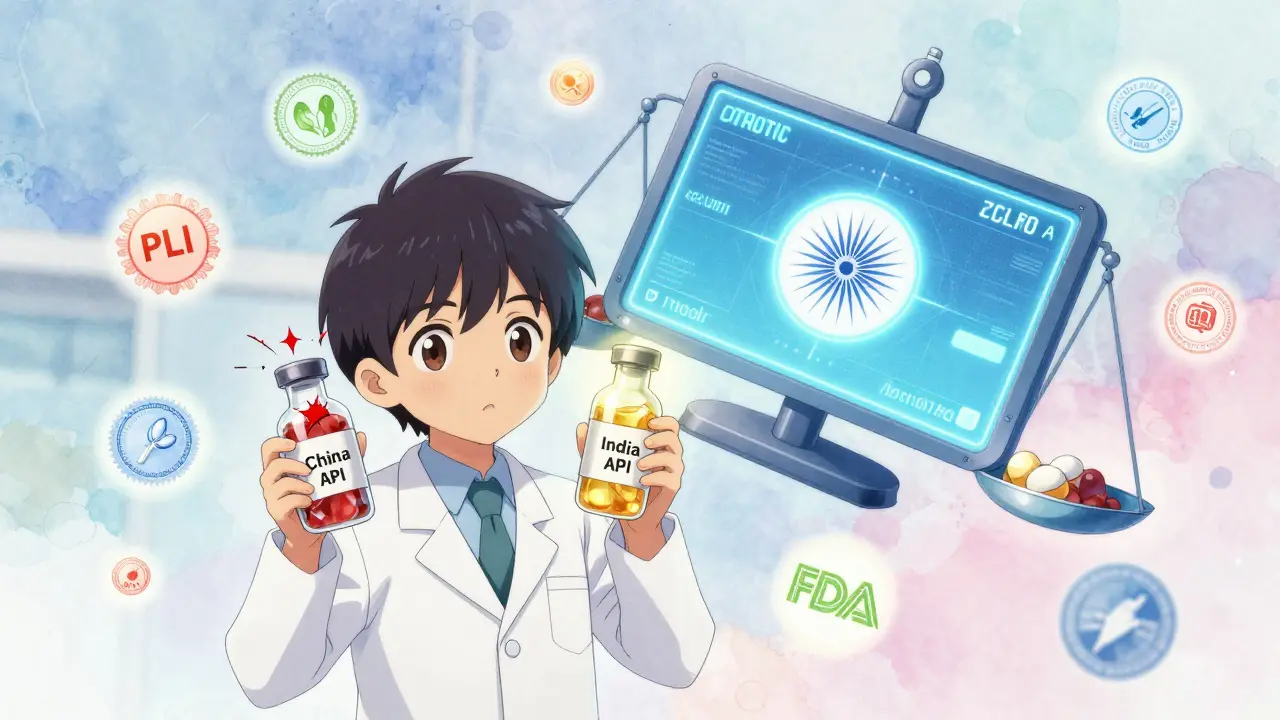
Lu Jelonek
December 24, 2025 AT 05:51It’s wild how little most people know about where their meds come from. I work in hospital procurement, and we’ve been shifting more to Indian suppliers over the last two years-not because they’re cheaper, but because we stopped getting batches that failed QC without warning. One Chinese supplier had a 40% failure rate on metformin. We had to pull 3,000 bottles. No one even knew until the pharmacy flagged it.
Harsh Khandelwal
December 25, 2025 AT 04:24Bro, China’s just being framed as the villain because the West doesn’t wanna admit they outsourced their entire healthcare backbone to a country they’re scared of. Meanwhile, India’s got 72% of its APIs from China and still gets a gold star? That’s not compliance, that’s delusion. 😅
Lindsey Kidd
December 26, 2025 AT 09:15OMG this is so real 😭 I had a friend who got sick from a generic antibiotic made in China-turned out the API was tainted. We thought it was just bad luck. Turns out it’s systemic. Please, everyone, ask your pharmacist where the *ingredients* come from, not just where it’s ‘made.’ 🙏
Rachel Cericola
December 27, 2025 AT 06:52Let’s be clear: the FDA doesn’t ‘prefer’ India-it’s just that Indian manufacturers have been forced by market pressure to build systems that are audit-proof. Chinese factories, meanwhile, are still stuck in a race-to-the-bottom mentality where cutting corners is baked into the business model. The cost difference isn’t worth it when you factor in recall lawsuits, supply chain delays, and the fact that patients die when APIs are falsified. This isn’t just about economics-it’s about bioethics. And if you think the FDA’s inspections are enough, you haven’t been paying attention to the 90% of plants they never see. Transparency isn’t a bonus-it’s the bare minimum.
Blow Job
December 28, 2025 AT 07:13Big respect to the author for calling out the China+1 myth. India’s not perfect, but they’re the only one playing the long game. Also, shoutout to the Indian chemists who actually read the FDA guidelines instead of just gaming the audit checklist.
Christine Détraz
December 29, 2025 AT 15:54I think the real story here is how we’ve outsourced our health to two countries that don’t always have our interests at heart. Maybe we need to start investing in domestic API production-not just for security, but so we stop treating medicine like a commodity you can bargain for on Alibaba.
CHETAN MANDLECHA
December 30, 2025 AT 16:15India’s PLI scheme is a good step, but without massive R&D investment and skilled labor retention, it’s just a band-aid. Also, most Indian factories still use legacy ERP systems-can’t automate QC if your software was built in 2008.
Ajay Sangani
December 31, 2025 AT 10:34we are all just pawns in a global game where the only thing that matters is profit and the human cost is just a footnote on a balance sheet. we take pills like they’re candy, never wondering who made them, or if they were made in a room where someone falsified data just to meet quota. we are the problem.
Payson Mattes
January 2, 2026 AT 08:30Wait-so the FDA only inspects 10% of plants? That’s not oversight, that’s negligence. I bet the FDA has Chinese and Indian lobbyists on speed dial. Remember when they approved those fake COVID tests? This whole system is rigged. I’ve got sources who say the FDA gets paid to clear shipments. No one talks about it, but it’s happening.
Bhargav Patel
January 4, 2026 AT 05:28While India’s compliance infrastructure is commendable, it is imperative to recognize that the structural dependency on Chinese APIs constitutes a critical vulnerability in the pharmaceutical value chain. The strategic imperative for India lies not merely in substitution, but in vertical integration-encompassing synthesis, purification, and analytical validation within sovereign borders. The PLI initiative, though laudable, remains insufficient without concurrent investment in chemical engineering education and intellectual property protection.
Steven Mayer
January 5, 2026 AT 00:55The data is clear: Chinese facilities have a 37% import alert rate versus India’s 14%. That’s not anecdotal-it’s statistical. But the real issue is the lack of harmonized global GMP standards. The FDA’s risk-based model is inherently biased toward geography, not process. We need ISO 13485 for APIs, not country-based scrutiny.
Charles Barry
January 5, 2026 AT 18:20Of course India’s ‘cleaner’-they’ve been laundering Chinese API with their own labels for decades. The FDA knows. The pharma execs know. But nobody wants to admit that the ‘Made in India’ label is just a fancy sticker on a Chinese bag of powder. This isn’t a supply chain-it’s a shell game.
Blow Job
January 7, 2026 AT 03:11And here’s the kicker-China’s moving into biologics because they realized they can’t win on volume anymore. They’re playing 4D chess while we’re still arguing over who’s better at checkers. The real winners? The patients who get safe meds. The losers? The ones who think ‘cheap’ means ‘safe’.