
Most people assume that a generic pill is just a cheaper copy of the brand-name drug. And for the most part, they’re right. But here’s the part no one talks about: excipients-the invisible ingredients in your medicine-can trigger side effects you never had before.
Let’s say you’ve been taking your brand-name blood pressure medication for years. No issues. Then your pharmacy switches you to the generic version. Suddenly, you’re dizzy, nauseous, or your heart feels off. You didn’t change your dose. You didn’t start a new supplement. But something’s different. It’s not the active ingredient. It’s what’s holding it together.
What Are Excipients, Really?
Excipients are the non-active ingredients in a medication. Think of them as the scaffolding: fillers, binders, dyes, preservatives, flavorings, and coatings. They help the pill hold its shape, dissolve at the right time, or taste less bitter. They don’t treat your condition. But they can make you feel worse.
Brand-name drugs use specific excipients chosen during years of clinical testing. Generic manufacturers can-and often do-swap them out. The FDA requires generics to have the same active ingredient, strength, and dosage form. But for excipients? Anything goes, as long as it doesn’t change how the drug works for most people.
That’s fine for the 90% of users. But for the rest? It’s a gamble.
Why Some People React to Generic Pills
Take lactose. It’s a common filler in pills. If you’re lactose intolerant, even a tiny amount can cause bloating, cramps, or diarrhea. One patient switched from a branded antiarrhythmic to a generic version and started having severe stomach issues. The generic used lactose. The brand didn’t. The active ingredient was identical. The problem? The filler.
Another case: croscarmellose sodium. A common disintegrant. One patient with a known sensitivity developed an allergic reaction after switching to a generic version of furosemide. The brand used a different binder. The generic didn’t. The reaction didn’t happen until the switch.
These aren’t rare. A 2023 survey by GoodRx found that 12% of people who switched to generics reported new side effects they didn’t have with the brand. Five percent said the generic just didn’t work as well.
And it’s not just allergies. For people with autoimmune conditions, celiac disease, or severe food sensitivities, even trace amounts of gluten, corn starch, or artificial dyes can trigger flares. These ingredients are rarely listed on the pill bottle. You have to dig.
When Switching Can Be Dangerous
Not all drugs are created equal. Some have a narrow therapeutic index-meaning the difference between a safe dose and a toxic one is razor-thin. These include:
- Warfarin (blood thinner)
- Levothyroxine (thyroid hormone)
- Phenytoin and other anti-seizure meds
- Digoxin (heart medication)
- Immunosuppressants like cyclosporine
For these, even a 5% change in how fast the drug is absorbed can mean treatment failure or overdose. The FDA requires stricter bioequivalence standards for these drugs (90-110% instead of 80-125%), but that still leaves room for variation.
Parkinson’s patients know this well. Levodopa, the main treatment, is absorbed in the gut. If the generic tablet dissolves slower-or faster-because of a different binder or coating, symptoms can swing from “controlled” to “locked in” in hours. A 2023 study from the Michael J. Fox Foundation found that 18% of 5,247 Parkinson’s patients reported worse symptoms after switching to generic levodopa. Many described sudden “off” periods, increased tremors, or nausea that vanished when they switched back.
One Reddit user wrote: “I switched to generic Sinemet. Within two days, I couldn’t walk without falling. My doctor said it was ‘just in my head.’ I switched back to the brand. Within 48 hours, I was myself again.”
Why Generic Drugs Are So Cheap
Generics cost 80-85% less than brand-name drugs. In 2023, they made up 90% of all prescriptions in the U.S. but only 23% of drug spending. That’s huge savings-for insurers, for Medicare, for you.
But here’s the trade-off: generic manufacturers compete on price. To cut costs, they use cheaper excipients. A brand might use purified, pharmaceutical-grade starch. A generic might use a bulk, food-grade version. The FDA allows it. The difference? One might dissolve faster. One might trigger a reaction.
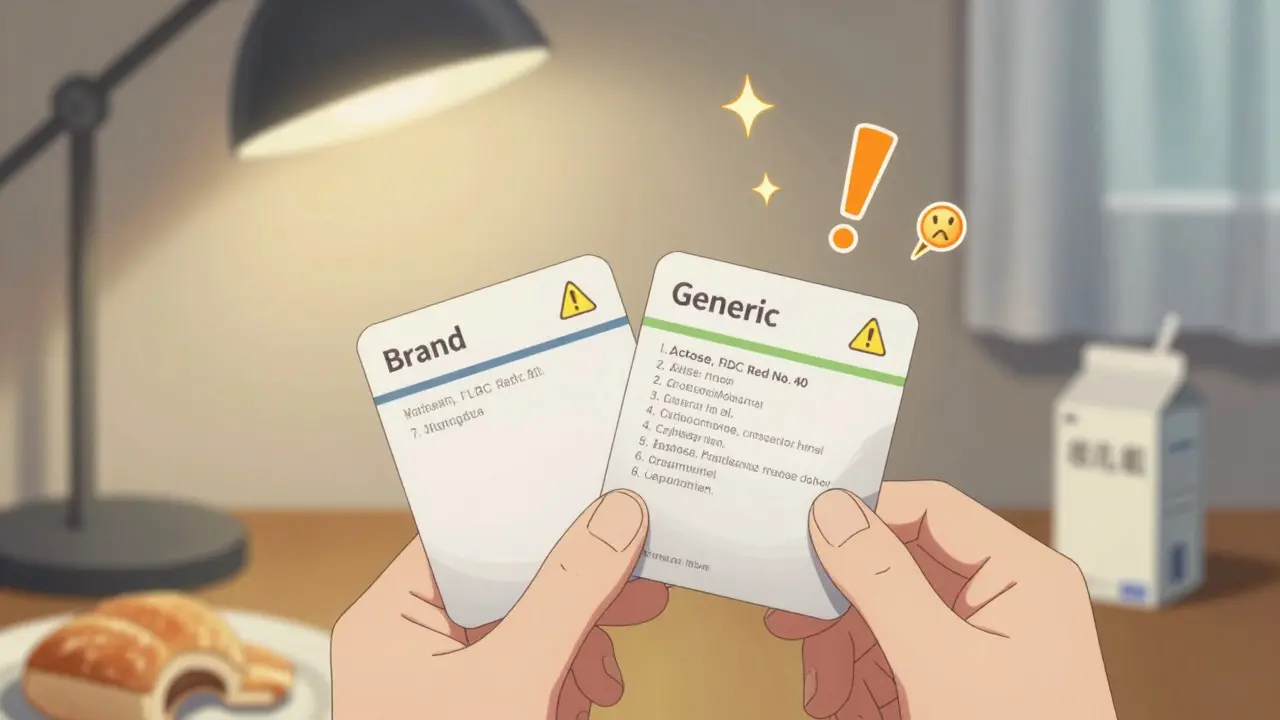
And it’s not just the filler. Colorants like FD&C Red No. 40 or titanium dioxide are common in brand-name pills for branding. Generics often skip them-or use cheaper alternatives. For someone with dye sensitivity, that’s enough to cause hives, headaches, or even asthma.
What You Can Do
You don’t have to accept side effects as normal. Here’s what works:
- Ask your pharmacist-not your doctor-for the exact excipients in your generic. Most won’t know offhand, but they can look up the package insert or contact the manufacturer.
- Check the FDA’s website for the “Active Ingredient” and “Inactive Ingredients” listed for both brand and generic versions. You can compare them side by side.
- Keep a medication diary. Note when you switch, what symptoms appear, and when they go away. This gives you proof if you need to push back.
- Ask your doctor to write “Dispense as Written” or “Do Not Substitute” on your prescription. It’s legal. It’s your right. Insurance might push back, but many will approve if you show documentation of prior reactions.
- Stick with the same generic manufacturer. If you’ve had a good experience with one brand of generic, ask your pharmacy to keep ordering that version. Generic manufacturers change formulations often. Your “generic” today might not be the same as last month.
The Bigger Picture
The system was built for efficiency. It works-for most. But it doesn’t account for individual biology. The FDA is starting to wake up. In 2024, they announced plans for a public database of excipients in all brand and generic drugs. That’s a big step. Until then, you’re the only one watching out for you.
Pharmaceutical companies are starting to notice too. Some generic makers now market their products as “low-allergen” or “excipient-free” for sensitive populations. It’s early, but it’s happening.
Don’t assume a generic is always safe just because it’s cheap. Don’t assume your reaction is “all in your head.” If you’ve had a change in how you feel after switching-especially with heart, thyroid, or seizure meds-there’s a real reason. And you have the power to do something about it.
What to Do If You Think Your Generic Is Causing Problems
If you suspect your generic medication is causing side effects:
- Don’t stop taking it without talking to your doctor.
- Write down exactly what changed: symptoms, timing, dose.
- Call your pharmacy and ask for the manufacturer name and inactive ingredients list.
- Compare it to your old brand’s list. Look for new fillers: lactose, gluten, dyes, sodium, sulfites.
- Ask your doctor to request the brand or a different generic.
- Report the reaction to the FDA’s MedWatch program. Your report helps others.
You’re not being difficult. You’re being informed.
Are generic medications always safe?
For most people, yes. Generic medications are required to have the same active ingredient and meet strict bioequivalence standards. But for people with allergies, intolerances, or narrow therapeutic index conditions, differences in inactive ingredients (excipients) can cause side effects or reduced effectiveness. About 12% of patients report new reactions after switching to generics.
Can excipients in generics cause allergic reactions?
Yes. Common excipients like lactose, corn starch, dyes (FD&C Red No. 40), and preservatives can trigger allergic or intolerance reactions in sensitive individuals. One documented case involved a patient with a croscarmellose sodium allergy who developed hives after switching to a generic furosemide. Another had severe GI distress from lactose in a thyroid generic.
Which medications are riskiest to switch to generic?
Drugs with a narrow therapeutic index are most sensitive to changes in absorption. These include warfarin, levothyroxine, phenytoin, digoxin, cyclosporine, and levodopa. Small differences in how quickly the drug enters the bloodstream can lead to treatment failure or toxicity. Patients on these drugs should be especially cautious about switching generics.
How can I find out what’s in my generic pill?
Check the package insert that comes with your medication. If it’s not there, ask your pharmacist for the manufacturer’s product information sheet. You can also search the FDA’s DailyMed database using the drug name and manufacturer to find the full list of inactive ingredients. Brand-name labels rarely list excipients either-so you need to dig deeper.
Can I request the brand-name drug instead of the generic?
Yes. Your doctor can write “Dispense as Written” or “Do Not Substitute” on your prescription. Insurance may require prior authorization, but if you have documented side effects or a medical need, they often approve it. For patients with allergies, autoimmune conditions, or narrow therapeutic index drugs, this is a reasonable and common request.
Why don’t pharmacies tell me about excipient differences?
Most pharmacists aren’t trained to routinely screen for excipient intolerances. Their focus is on dosage accuracy and drug interactions. But they can access the inactive ingredient data if asked. You have to bring it up. Keep a list of your known intolerances (lactose, gluten, dyes, etc.) and share it with your pharmacist every time you get a new prescription.
Will the FDA make excipients easier to find in the future?
Yes. In 2024, the FDA announced plans to launch a public database listing excipients for all approved brand and generic drugs. This will help patients with allergies and sensitivities make informed choices. Until then, you’ll need to ask your pharmacist or check the FDA’s DailyMed site manually.
Sean Feng
January 10, 2026 AT 20:50Generic pills are fine for most people. I’ve switched dozens of times and never had an issue. If you’re having side effects, maybe it’s your body being dramatic.
Priya Patel
January 11, 2026 AT 10:36OMG this is SO real!! I switched to generic levothyroxine and felt like a zombie for two weeks. My doctor laughed until I showed him the ingredient list-lactose everywhere. Now I pay extra and never look back. You’re not crazy, you’re just allergic to corporate shortcuts 😭
Priscilla Kraft
January 12, 2026 AT 07:43This is such an important post. I’m a pharmacist and I can’t tell you how many patients come in saying ‘I feel off’ after a switch-and we never think to check excipients. I started keeping a printed list of common allergens in my drawer. Now I proactively ask: ‘Do you have any food or dye sensitivities?’ It changes everything. The FDA’s new database is long overdue. 🙌
Alfred Schmidt
January 14, 2026 AT 00:57Why are people so lazy?? If you can’t read a pill bottle, don’t blame the system. The FDA has standards. If you’re allergic to lactose, then don’t take pills with lactose. Simple. Stop whining and do your own research. And stop expecting everyone else to cater to your rare allergies like you’re the only person in the world with a gut!
Michael Patterson
January 15, 2026 AT 17:37Look, I get it, people have sensitivities, but let’s be real-how many of these so-called reactions are just placebo or anxiety? I’ve seen patients switch back and forth between brand and generic and swear the generic is ‘worse’-but when you check the actual bioequivalence data, it’s within 2% of the brand. The excipient argument is overblown. Unless you’re literally anaphylactic to cornstarch-which is rare-this is just fearmongering dressed up as science. Also, typos are everywhere in this post, btw. ‘Dye’s’ not a word. It’s ‘dyes.’
Matthew Miller
January 15, 2026 AT 21:59This is why America is collapsing. You want to pay $200 for a pill? Fine. But don’t act like you’re entitled to the same brand because you can’t handle a $5 generic. You think your body is special? It’s not. The FDA doesn’t care if your ‘heart feels off’-they care about statistical equivalence. If you’re one of the 12% who reacts, tough. The system works for 88%. Stop being a medical drama queen.
Jennifer Littler
January 16, 2026 AT 22:41From a clinical pharmacology standpoint, the narrow therapeutic index drugs are where this matters most. Warfarin INR fluctuations, levothyroxine TSH shifts-these aren’t anecdotes, they’re documented in journals like JAMA and Annals of Internal Medicine. The 80-125% bioequivalence range is statistically valid but biologically insufficient for vulnerable populations. We need pharmacogenomic labeling for excipients. Until then, patient advocacy is the only safety net. Also, the DailyMed API is underutilized-here’s the link: dailymed.nlm.nih.gov
Jason Shriner
January 17, 2026 AT 17:13So… the system is designed to save money, but the people who need the most care are the ones getting screwed? Wow. What a surprise. Next they’ll tell us the air we breathe is ‘equivalent enough’ if it’s 90% clean. I mean, I guess if you’re not dying, who cares if you’re trembling and nauseous for three days? 😌
Adewumi Gbotemi
January 18, 2026 AT 15:22I live in Nigeria. We use mostly generics here. But we don’t have brand names to compare. If the medicine works, we take it. If it makes us sick, we go to another pharmacy. Simple. Maybe the problem is too many choices.
Madhav Malhotra
January 19, 2026 AT 19:04In India, we have this problem too. My aunt switched to a generic for epilepsy and had seizures again. We found out the new version used talc instead of microcrystalline cellulose. She cried. We switched back. I’m glad someone’s talking about this. In my family, we always ask for the manufacturer name. It’s not about money-it’s about trust.