
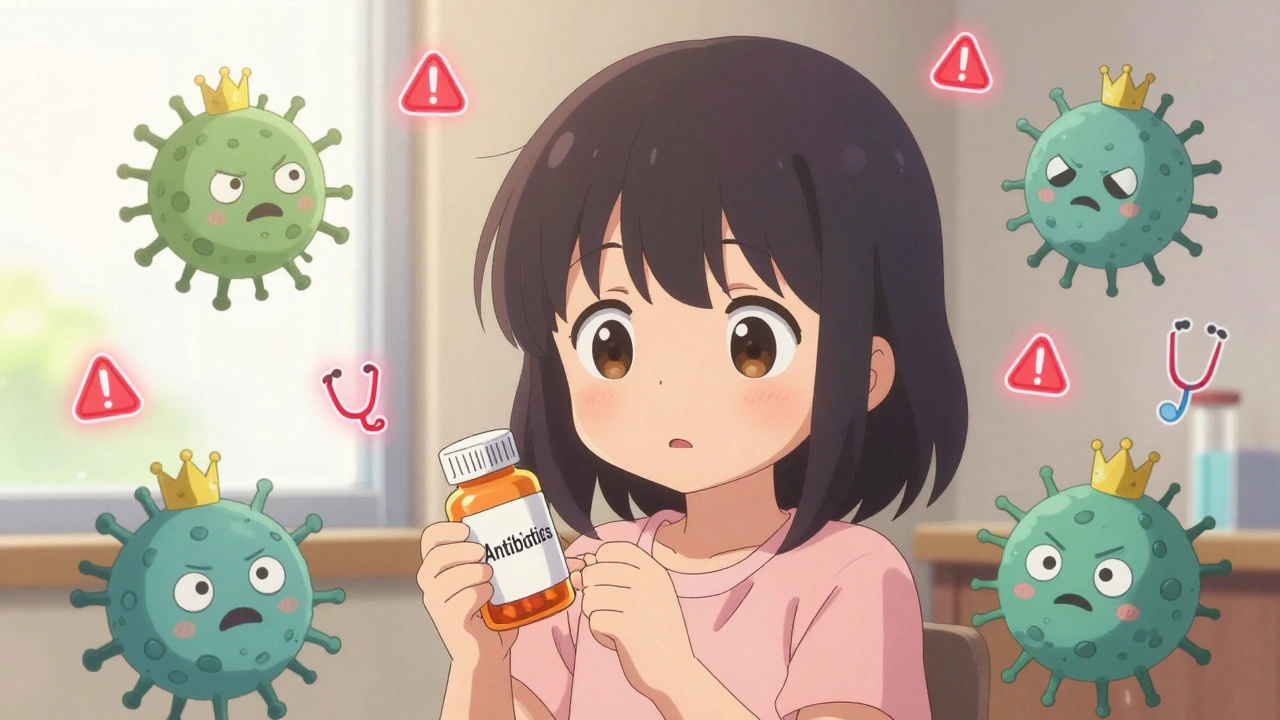
Every time you take an antibiotic when you don’t need it, you’re not just helping yourself-you’re helping bacteria become stronger. It sounds simple, but the consequences are anything but. Antibiotic overuse isn’t just a doctor’s mistake or a patient’s bad habit. It’s a global crisis quietly rewriting the rules of modern medicine. Right now, antibiotic resistance is killing over a million people every year. And it’s getting worse.
What Happens When Antibiotics Stop Working?
Antibiotics were once miracles. A simple pill could cure pneumonia, a throat infection, or a urinary tract infection. Today, that’s not always true. In 2023, one in six bacterial infections worldwide didn’t respond to standard antibiotics, according to the World Health Organization. That number has been climbing 5% to 15% every year since 2018. This isn’t magic. It’s evolution. Bacteria don’t sit still. When you take antibiotics-especially the wrong ones, at the wrong dose, or for the wrong reason-you kill off the weak ones. The tough ones survive. They multiply. And soon, the whole population becomes resistant. This is antimicrobial resistance, or AMR. And it’s not theoretical. It’s happening in hospitals, nursing homes, and even in your own gut. The most dangerous resistant bacteria? Acinetobacter, E. coli, Klebsiella, Staphylococcus aureus, and others. Some strains of MRSA (methicillin-resistant Staphylococcus aureus) are now resistant to nearly every antibiotic. In some countries, 35% of Staph infections can’t be treated with the usual drugs. For urinary tract infections caused by E. coli, one in five cases no longer respond to ampicillin or fluoroquinolones-the go-to treatments for decades. And it’s not just about common infections. Last-resort antibiotics like carbapenems, used when everything else fails, are losing their power. By 2035, resistance to these drugs could double compared to 2005 levels. That means a simple cut could turn deadly. A C-section could become life-threatening. Chemotherapy could become too risky to even try.How C. difficile Takes Over When Antibiotics Clear the Way
One of the most direct and deadly consequences of antibiotic overuse is Clostridioides difficile, or C. difficile. You’ve probably never heard of it-until you or someone you know gets it. And then you never forget. C. difficile isn’t a new germ. It’s always been there, quietly living in the gut of about 3% of healthy adults. But it doesn’t cause problems-until you take antibiotics. Antibiotics don’t just kill bad bacteria. They wipe out the good ones too. The healthy microbes in your intestines that normally keep C. difficile in check? Gone. And suddenly, C. difficile has the run of the place. It doesn’t just cause diarrhea. It causes violent, watery bowel movements, fever, stomach pain, and in severe cases, colon damage, sepsis, and death. In the U.S. alone, C. difficile caused nearly half a million infections in 2017. Around 29,000 people died from it that year. And while newer data isn’t fully available, the trend is clear: as antibiotic use goes up, so do C. difficile cases. It’s especially common in hospitals and long-term care facilities. But it’s not just patients. Healthy people who’ve taken antibiotics-even a single course for a sinus infection-are at risk. The CDC found that nearly 80% of C. difficile infections are linked to antibiotic use. That means if you’ve taken an antibiotic in the past six months, your gut is still recovering. And vulnerable.Why Are We Still Overusing Antibiotics?
If we know this is dangerous, why does it keep happening? One big reason: pressure. Patients ask for antibiotics. Doctors feel rushed. A parent wants their sick child to feel better yesterday. A doctor doesn’t want to risk missing a bacterial infection. So they prescribe-just in case. But most sore throats, colds, and bronchitis are caused by viruses. Antibiotics do nothing. Yet, in many countries, doctors still prescribe them for these conditions. Another reason: poor diagnostics. In places without quick lab tests, doctors can’t tell if an infection is bacterial or viral. So they guess. And guess wrong. In low-resource settings, up to 70% of antibiotics are used without proper testing. That’s not just bad medicine-it’s fuel for superbugs. And then there’s agriculture. More than 70% of all antibiotics sold globally are used in livestock-not to treat sick animals, but to make them grow faster or prevent disease in crowded, unsanitary conditions. These drugs don’t disappear. They end up in soil, water, and food. Resistant bacteria from farms travel to humans through meat, water, and even dust. It’s a loop no one talks about enough.
The Human Cost: More Deaths, Longer Hospital Stays, Higher Costs
This isn’t just about numbers. It’s about people. Imagine needing surgery. You’re scheduled for a hip replacement. But your doctor says, “We can’t do it. We don’t know if your body can handle a post-op infection. The antibiotics might not work.” That’s not science fiction. That’s happening now. Or picture a child with an ear infection. The first antibiotic doesn’t work. The second doesn’t work. The third? Still no. Now they’re in the hospital, on IV antibiotics. They’re in pain. They miss school. Mom misses work. The bill climbs. And still, the infection lingers. In 2019, antibiotic resistance directly caused 1.27 million deaths. It contributed to nearly 5 million more. By 2050, if nothing changes, it could kill 10 million people a year-more than cancer. The economic cost? $100 trillion in lost global output. And here’s the cruel twist: the drugs we need to fight these resistant infections are vanishing. Pharmaceutical companies aren’t investing in new antibiotics. Why? Because antibiotics aren’t profitable. You take them for seven days. A diabetes drug? You take it for life. So the pipeline is dry. Only 118 antibiotic projects are in development worldwide, funded mostly by public grants. That’s not enough.What Can You Do?
You’re not powerless. You have more control than you think.- Don’t demand antibiotics. If your doctor says it’s a virus, trust them. Ask: “What else could this be?” or “Are there other ways to manage symptoms?”
- Never take leftover antibiotics. A course meant for a throat infection won’t work for a urinary tract infection. And it might make things worse.
- Finish your full course-if you really need them. Stopping early leaves behind the toughest bacteria. But only take them if they’re truly necessary.
- Ask about testing. Can we do a rapid test to confirm it’s bacterial? If your clinic doesn’t offer it, ask why.
- Choose meat raised without routine antibiotics. Look for labels like “raised without antibiotics” or “organic.” It’s not perfect, but it helps reduce the flow of resistant bacteria into the food chain.
- Wash your hands. Simple, old-school hygiene stops the spread of resistant germs before they even get a chance to infect someone else.
Rebecca M.
December 3, 2025 AT 11:45Oh wow, another ‘antibiotics are evil’ lecture. Let me grab my tin foil hat and join the cult. 🙄
Lynn Steiner
December 4, 2025 AT 00:49I had C. diff after one round of amoxicillin for a sinus infection… I lost 15 lbs in two weeks. I cried in the bathroom so hard I peed myself. My mom said ‘you’re just being dramatic.’ Now she won’t let me near her kitchen. 💔
मनोज कुमार
December 5, 2025 AT 21:32Antibiotic resistance is just evolution playing the long game. Pharma and doctors are lazy. We need genomic surveillance not handwringing. Simple.
Zed theMartian
December 7, 2025 AT 09:41So let me get this straight. We’re supposed to trust doctors who prescribed me antibiotics for a cold in 2012? The same ones who told me ‘it’s fine’ when my kid had a fever for 72 hours? Please. This isn’t science. It’s corporate theater with a side of guilt.
And don’t even get me started on ‘organic meat.’ You think the chickens in your $12 salad are living in a spa? They’re just slightly less poisoned. The real problem? Global capitalism. Antibiotics are a symptom, not the disease.
Meanwhile, the WHO publishes reports like they’re writing a children’s book. ‘Oh no, the superbugs are coming!’ while Big Pharma stocks rise 200% in five years. Wake up. This system is rigged.
And yes, I’ve taken antibiotics when I didn’t need them. Because I was tired of being told to ‘wait it out’ while my throat swelled shut. So now I’m part of the problem. Good job, medicine.
Don’t lecture me on ‘personal responsibility.’ You don’t get to tell someone who’s been sick for a week and can’t afford a rapid test to just ‘trust the process.’
And yes, I know about the 10 million deaths by 2050. But guess what? The rich will have access to last-resort drugs. The rest of us? We’ll be the ones dying quietly in rural clinics. Again.
This isn’t about pills. It’s about who gets to live. And right now? The answer is written in bank accounts, not microbiology.
So go ahead. Wash your hands. Eat organic. Feel virtuous. Meanwhile, the real villains are in boardrooms and WHO committees sipping champagne while the world burns.
Ella van Rij
December 9, 2025 AT 01:02Ugh. I read this whole thing. And now I feel guilty. Like I’m a villain for taking that Z-Pack for my ‘bronchitis’ last winter. 🤦♀️
Also, why does every article about antibiotics have to sound like a TED Talk written by a grad student who just finished their third espresso? Can we just… say it plainly?
Also, who decided ‘C. difficile’ was a better name than ‘C. diff’? I’m not a doctor. I don’t need the Latin.
Alicia Marks
December 10, 2025 AT 20:19You’re not alone. I was scared too. But small choices matter. I ask for tests now. I don’t pressure my doctor. And I tell my friends. We’ve got this. 💪❤️
Joel Deang
December 11, 2025 AT 03:57bro i took antibiotics for a toothache last year and now i feel like my gut is a war zone 😭 i switched to kefir and probiotics and my poop is kinda normal again?? maybe?? idk but i feel better
Steve World Shopping
December 13, 2025 AT 01:34Antibiotic stewardship is not a moral imperative-it’s a systems engineering problem. The microbiome is a complex adaptive system, and we’re applying linear, reductionist interventions with non-linear outcomes. The selective pressure from subtherapeutic dosing in agriculture, combined with diagnostic inertia in primary care, creates a positive feedback loop that accelerates horizontal gene transfer of resistance determinants like blaCTX-M and mecA. We need genomic surveillance integrated with real-time prescribing analytics, not behavioral nudges.
And let’s be clear: the ‘just say no’ narrative is a neoliberal distraction. The real issue is the collapse of public health infrastructure. In Nigeria, where I’m from, antibiotics are sold over the counter without prescriptions because there are no labs, no trained clinicians, and no alternatives. Telling someone to ‘wait it out’ when their child is feverish and dehydrated isn’t responsible-it’s cruel.
Meanwhile, in the U.S., we’re debating whether to label chicken ‘raised without antibiotics’ while the CDC reports that 70% of resistant infections originate in community settings-not hospitals. The disconnect between policy and practice is staggering.
And yes, pharma is failing us. But the R&D model is broken because antibiotics are priced like commodities, not life-saving tools. We need push-pull incentives: upfront funding for development, plus market entry rewards tied to public health impact, not sales volume. The CARB-X initiative is a start, but it’s $1.2 billion over ten years. The Pentagon spends that on a single missile system.
What we’re seeing isn’t just resistance. It’s the collapse of the social contract of medicine. We were promised that science would conquer infection. Instead, we got profit-driven neglect and systemic inequity.
So yes, wash your hands. But also demand policy change. Hold your representatives accountable. Support global surveillance networks. And stop blaming patients. The system failed us first.
Roger Leiton
December 13, 2025 AT 15:49So I just read this whole thing and I’m honestly terrified 😰
But also… kinda hopeful? Like, I didn’t realize how much power I actually have. I always thought it was just doctors’ fault. But now I get it-I can ask for tests. I can refuse leftover pills. I can even ask my grocery store for antibiotic-free meat. 🤯
And I just started eating yogurt with live cultures. My stomach feels better already. 🙌
Also, shoutout to the person who said ‘it’s not just about pills’-that hit me. We need to fix the whole system. But starting with me? That’s a good first step.
ATUL BHARDWAJ
December 14, 2025 AT 03:30Antibiotics misuse. Farm. Hospital. Home. All connected. Simple. Do better.
Paul Keller
December 14, 2025 AT 16:25Let’s not romanticize the past. Before antibiotics, the average life expectancy was 47. We didn’t live longer because we were tougher-we lived shorter because we died of infections we couldn’t treat. This isn’t a moral failure. It’s a medical one. And the solution isn’t guilt-it’s innovation.
Yes, we overprescribed. Yes, agriculture abused them. But we’re also developing phage therapy, CRISPR-based antimicrobials, and AI-driven diagnostics. The pipeline is thin, yes-but it’s not empty. And the public is finally paying attention.
What’s missing? Funding. Not just from governments, but from investors who understand that the next great medical breakthrough won’t be a cancer drug. It’ll be the one that stops a child from dying of a scraped knee.
So yes, be informed. Be cautious. But don’t demonize antibiotics. They saved your life. Now help us save the next one.
Rebecca M.
December 15, 2025 AT 20:52Wow. Someone actually read the whole thing and didn’t just scroll past the C. diff part. You’re the reason I still believe in Reddit.