
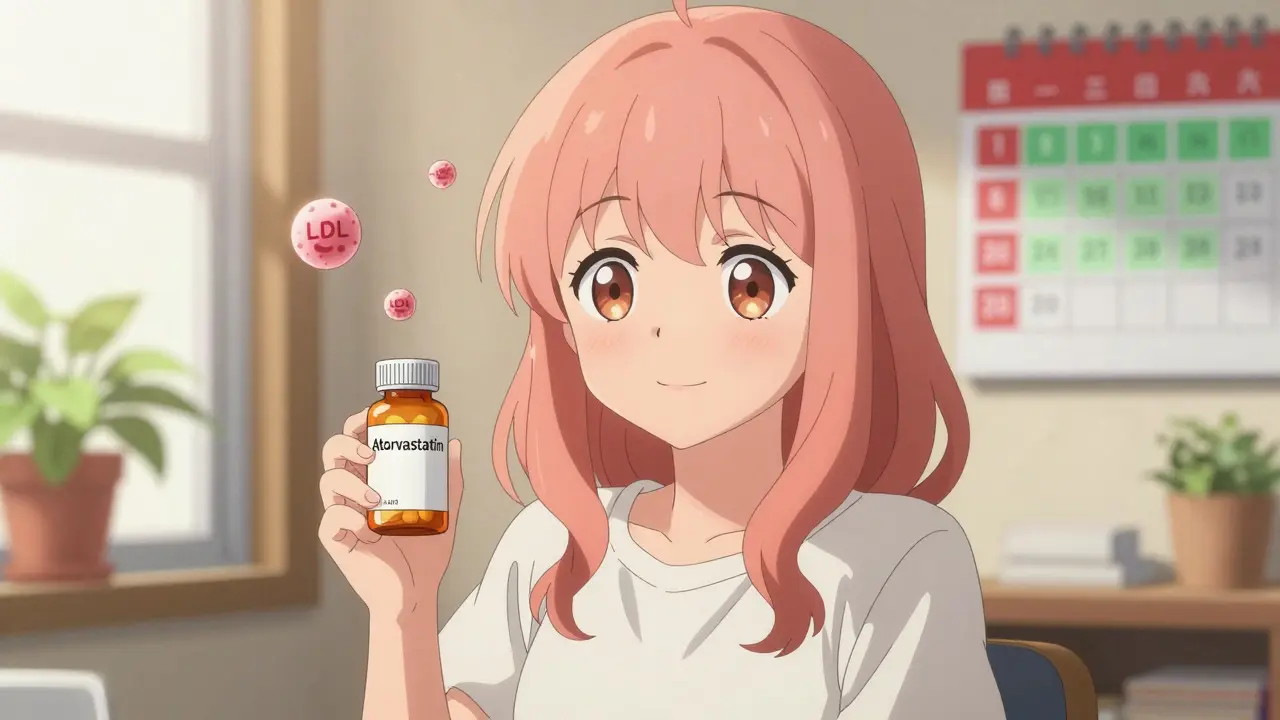
LDL Reduction Calculator
How Alternate-Day Dosing Works
This calculator estimates your potential LDL cholesterol reduction when switching from daily to alternate-day dosing with atorvastatin or rosuvastatin. Based on clinical studies, alternate-day dosing typically maintains 92-95% of LDL-lowering effects while reducing side effects for eligible patients.
Expected LDL Reduction
What if you could cut your statin dose in half - and still keep your LDL cholesterol low - while saying goodbye to muscle pain, fatigue, and the constant fear of side effects? For millions of people who can’t tolerate daily statins, this isn’t science fiction. It’s a real, evidence-backed option: alternate-day statin dosing.
Statin intolerance is more common than most people realize. Around 10 to 15% of users report muscle aches, weakness, or cramps so bad they stop taking their medication. And for many, that’s not just discomfort - it’s a dealbreaker. If you’ve tried simvastatin, atorvastatin, or rosuvastatin daily and still feel like you’re dragging through the day, you’re not alone. But here’s the thing: you might not need to take it every day.
How Alternate-Day Dosing Works
Alternate-day statin dosing means taking your pill every other day instead of daily. Sounds simple, right? But it’s not just about cutting the dose in half. It’s about working with how your body processes certain statins over time.
Not all statins are built the same. Short-acting ones like simvastatin and fluvastatin break down quickly - their effects fade within hours. That’s why daily dosing works for them. But atorvastatin and rosuvastatin? They stick around. Atorvastatin has a half-life of 14 to 30 hours. Rosuvastatin lasts about 19 hours. That means even if you take it on Monday, enough of it is still in your system on Tuesday to keep lowering LDL cholesterol.
A 2012 study by S. Pramanik followed 38 people with high cholesterol who switched from daily atorvastatin 20 mg to every-other-day. The result? LDL dropped by 42.3% on the alternate-day schedule - almost identical to the 44.1% drop they got on daily dosing. Total cholesterol? Same story. The difference wasn’t statistically meaningful. In other words: you didn’t lose much control over your numbers… but you cut your exposure in half.
What You Lose - and What You Gain
Let’s be clear: daily statin therapy is still the gold standard. It’s backed by decades of outcome data showing fewer heart attacks and strokes. But for people who can’t take it daily, the goal shifts. It’s not about being perfect. It’s about being safe and sustainable.
Alternate-day dosing doesn’t just reduce side effects - it can dramatically reduce them. In one study, 23 patients who couldn’t tolerate daily atorvastatin or rosuvastatin were switched to the same drug every other day, plus ezetimibe and colesevelam. Of those 23, 87% could stick with it. Zero of them tolerated daily dosing. That’s not a small win. That’s life-changing.
And it’s not just about muscle pain. Fewer pills mean fewer trips to the pharmacy, less chance of missed doses, and lower costs. Generic atorvastatin costs as little as $0.10 per 20 mg tablet. On alternate-day dosing, you’re using half the pills - so roughly $1,200 less per year than a PCSK9 inhibitor. Even compared to ezetimibe ($300/month), the savings are real.
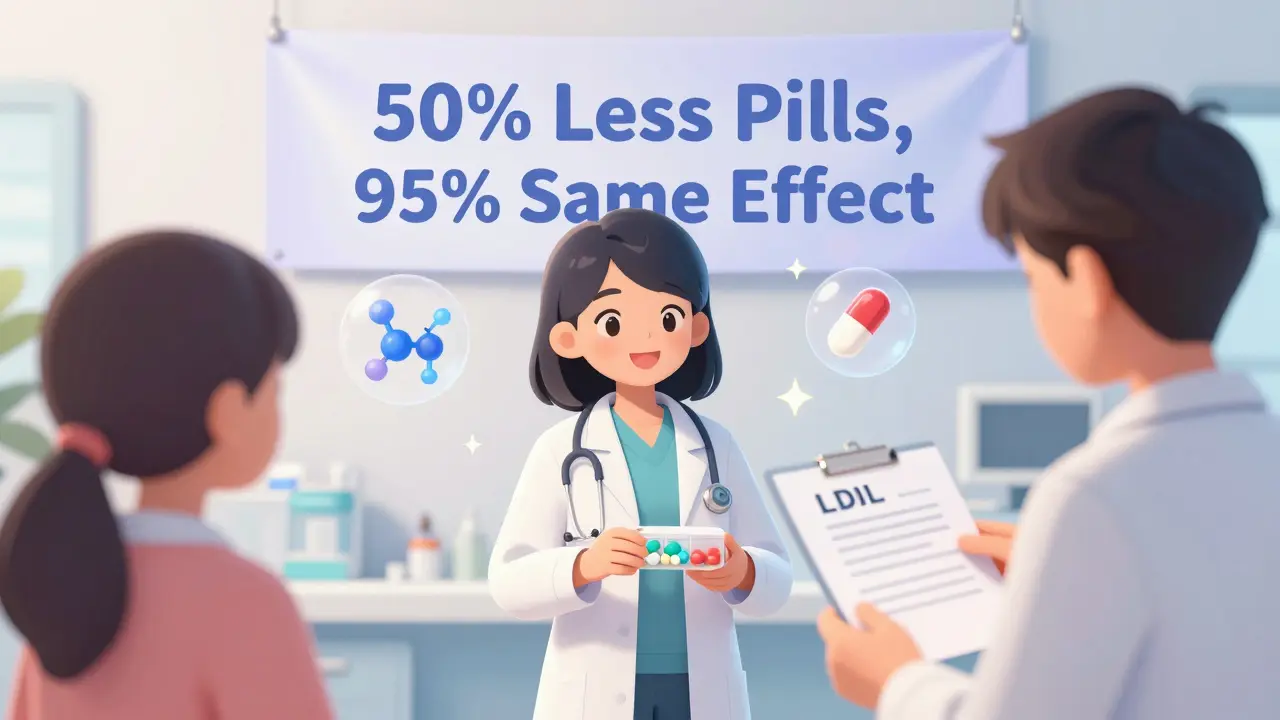
But here’s the trade-off: you won’t always hit the same LDL targets. The 2017 meta-analysis by Awad et al. showed that alternate-day dosing delivers about 92-95% of the LDL-lowering power of daily dosing. That’s great for most people. But if your target is below 55 mg/dL - say, if you’ve had a heart attack or have diabetes - you might fall short. That’s why this isn’t a first-line fix. It’s a rescue plan.
Who It Works For - And Who It Doesn’t
This isn’t for everyone. You need to meet a few key criteria:
- You’ve tried at least two different daily statins and had clear muscle symptoms (not just vague aches).
- Your creatine kinase (CK) levels are normal or only mildly elevated (under 10x the upper limit).
- You have a history of heart disease, diabetes, or very high LDL - so you still need strong lipid control.
- You’re taking atorvastatin or rosuvastatin. No other statin has enough evidence.
If you’re on simvastatin or pravastatin? Alternate-day dosing likely won’t help. The half-life is too short. The drug just disappears too fast. Same goes if you’re trying to get your LDL below 70 mg/dL and have no other options - you might need something stronger than a half-dose statin.
But if you’ve been told to “just push through the pain,” or if you stopped your statin because your legs felt like lead - this could be your next step.

Real-World Experience: What Patients Say
Doctors aren’t the only ones noticing the difference. Patients do too.
One 62-year-old woman in Perth, who’d been off statins for two years after muscle pain made walking painful, started on alternate-day rosuvastatin 10 mg. Within six weeks, her LDL dropped from 145 to 88. More importantly? She could climb stairs again. “I didn’t realize how much I’d been holding back,” she told her lipid specialist. “Now I’m gardening again.”
Another man, 58, switched from daily atorvastatin 40 mg to 20 mg every other day. His muscle pain vanished. His LDL went from 130 to 92. He cut his monthly pill count from 30 to 15. He said it felt like getting his life back.
But it’s not perfect. Some struggle with the rhythm. “I forget if today’s the day,” one patient admitted. Others find the combo regimens - like adding ezetimibe or colesevelam - overwhelming. Six pills a day? That’s a lot to remember.
That’s why clear instructions matter. A simple calendar, a phone reminder, or a pill box labeled “Day 1” and “Day 3” can make all the difference.
What the Experts Say
The American College of Cardiology doesn’t endorse alternate-day dosing as a standard. They call it “off-label” and warn that there’s no outcome data proving it prevents heart attacks or strokes. That’s true. No long-term trial has been done specifically on this schedule.
But here’s what they do say: “Alternate-day statin administration seems to decrease the incidence of its adverse effects, particularly myopathy.”
Dr. Robert Rosenson, a leading cardiologist at Icahn School of Medicine, calls it “a rational approach” for patients who truly can’t tolerate daily dosing. And Dr. Kamal Awad’s 2017 meta-analysis - which looked at 11 studies involving over 1,000 patients - found no significant difference in LDL reduction or safety between daily and alternate-day regimens for atorvastatin and rosuvastatin.
The bottom line? It’s not about replacing daily therapy. It’s about giving people who’ve been pushed out of treatment a way back in.
How to Get Started
If you think this might be for you, here’s what to do:
- Confirm your statin intolerance. Did you stop because of muscle pain? Was your CK level checked? If not, ask your doctor.
- Check which statin you’re on. Only atorvastatin or rosuvastatin have solid data for this approach.
- Ask your doctor to try half your current dose every other day. Example: If you’re on atorvastatin 40 mg daily, try 20 mg every other day.
- Get your LDL checked in 4-6 weeks. You should see a drop of 30-40%. If not, your doctor may add ezetimibe - a non-statin pill that blocks cholesterol absorption.
- Monitor symptoms. If muscle pain returns, stop and talk to your doctor. If it improves, keep going.
Most doctors need 3-6 months of experience with a handful of patients before they feel confident. Don’t be surprised if you have to educate your provider. Bring the studies. Ask if they’ve seen this work before.
What’s Missing - And What’s Next
The biggest gap? Long-term data. We know alternate-day dosing lowers LDL. We know it reduces side effects. But we don’t know if it cuts heart attacks like daily statins do. That’s the million-dollar question.
Right now, it’s being used quietly in specialist clinics - especially in academic centers where doctors see complex cases. A 2020 survey found 68% of lipid specialists use it. But only 59% of community doctors do. Why? Lack of awareness. Lack of guidelines. Lack of insurance support.
But with generic statins costing pennies, and PCSK9 inhibitors costing thousands, the economic pressure is mounting. More people will ask for this option. And more doctors will learn how to offer it.
The future of statin therapy isn’t just about stronger drugs. It’s about smarter dosing. For millions of people, alternate-day dosing isn’t a compromise. It’s the only way to stay on treatment - and stay alive.
Can I switch to alternate-day statin dosing on my own?
No. Never change your statin dose without talking to your doctor. Even though atorvastatin and rosuvastatin have long half-lives, your individual response depends on your liver function, other medications, and overall health. What works for one person might not work for another. Your doctor needs to monitor your LDL levels and check for signs of muscle damage before and after the switch.
Will alternate-day dosing work with simvastatin or pravastatin?
Unlikely. Simvastatin and pravastatin have very short half-lives - just 1 to 3 hours. That means they clear out of your system too fast to maintain LDL-lowering effects over 48 hours. Studies show no meaningful benefit for these statins on alternate-day schedules. Stick with atorvastatin or rosuvastatin if you’re considering this approach.
How long does it take to see results?
Most people notice improved muscle symptoms within 2 to 4 weeks. LDL levels usually stabilize by 6 weeks. That’s why your doctor will want a blood test around that time - to make sure your cholesterol is still dropping enough. If it’s not, they may add ezetimibe or adjust your dose.
Is alternate-day dosing covered by insurance?
Insurance covers the medication - not the dosing schedule. Since alternate-day dosing is off-label, your pharmacy will still fill your prescription as normal. But some insurers may question why you’re taking it less often. Be ready to explain: you’re managing side effects, not reducing efficacy. Your doctor’s note should clearly state “statin intolerance” and that alternate-day dosing is being used to maintain therapy.
What if my LDL doesn’t drop enough on alternate-day dosing?
You’re not out of options. The next step is usually adding ezetimibe (Zetia), which blocks cholesterol absorption in the gut. It’s safe, cheap, and works well with statins. In studies, combining alternate-day rosuvastatin with ezetimibe brought LDL levels down as much as daily statin therapy alone. If that’s still not enough, your doctor might consider bempedoic acid (Nexletol) - a newer non-statin option with fewer muscle side effects.
Scott Easterling
March 10, 2026 AT 10:35So let me get this straight-you’re telling me I can just skip a day, and my LDL stays down? Like, magic? 😏 Meanwhile, Big Pharma is out here selling PCSK9 inhibitors for $14,000 a year. This is either genius… or a cult. I’ve seen this before. Remember when people swore you could cure diabetes with apple cider vinegar? Same energy. I’m skeptical. Where’s the 10-year outcome data? If it’s so good, why isn’t it in the guidelines? Hmmmm?
Mantooth Lehto
March 11, 2026 AT 04:55OMG YES. I’ve been on atorvastatin for 3 years and my legs felt like concrete. I switched to every other day and I CAN WALK AGAIN. I’m crying. I’m gardening. I’m alive. 🥹❤️ Thank you for writing this. My cardiologist thought I was crazy. Now he’s ordering it for three other patients. This is REAL.
Melba Miller
March 12, 2026 AT 14:28This is why America is falling apart. We’ve turned medicine into a buffet. You don’t like side effects? Skip a day. You don’t like the cost? Take half. You don’t like the science? Ignore the guidelines. This isn’t innovation-it’s self-sabotage. The CDC says statins reduce heart attacks by 30%. Half-dosing? We’re playing Russian roulette with our arteries. And now we’re glorifying it as a ‘lifestyle hack’? No. Just no.
Katy Shamitz
March 14, 2026 AT 02:30Oh honey. I love you. But this is dangerous. I’ve seen too many patients think ‘I’m fine’ and then drop their meds entirely. This isn’t a ‘hack’-it’s a medical decision. If you’re going to do this, you need labs, monitoring, and a doctor who actually knows what they’re doing. And if your doc doesn’t? Find a new one. I’m not mad. I’m just… concerned. ❤️
Nicholas Gama
March 14, 2026 AT 16:34Half-dosing? Pathetic. If you can’t tolerate a daily statin, you’re not a candidate. Period. The data is clear: non-adherence = higher mortality. You want to live? Take the pill. Or die. There’s no third option. This article is just enabling weakness.
Mary Beth Brook
March 14, 2026 AT 16:54Pharmacokinetic rationale is sound-atorvastatin’s t1/2 >14h, rosuvastatin’s >19h, so QOD dosing maintains steady-state inhibition of HMG-CoA reductase. But pharmacodynamic variability? Uncontrolled. We’re extrapolating from small cohorts. We need RCTs. Also, ezetimibe’s mechanism is NPC1L1 inhibition-synergistic, yes, but not a substitute for LDL-C reduction magnitude. Still, pragmatic for statin-intolerant phenotypes.
Neeti Rustagi
March 15, 2026 AT 11:01Thank you for sharing this thoughtful and evidence-based overview. As a healthcare professional from India, I have seen many patients who discontinue statins due to muscle discomfort. The concept of alternate-day dosing, particularly with long-half-life agents, is indeed a pragmatic and compassionate approach. However, patient education and structured follow-up remain critical. This could be a model for resource-limited settings as well.
Dan Mayer
March 16, 2026 AT 06:40Wait so if i take atorvastatin every other day i can still get my ldl down? i thought that was just a myth. my doc said no way. but i read this and now im like… maybe? i’m gonna try it. i’ve got 30 pills left and i’m already halfway through. fingers crossed. 🤞
Janelle Pearl
March 17, 2026 AT 04:41I’ve been a nurse for 18 years. I’ve watched people quit statins because they were too tired to play with their kids. I’ve seen them get sicker. Then I saw one patient try alternate-day dosing-and she came back smiling. She was gardening again. She said, ‘I didn’t realize how much I’d been holding back.’ That’s why I’m here. Not because it’s perfect. But because sometimes, the best medicine is the one you’ll actually take.
Ray Foret Jr.
March 18, 2026 AT 16:52My dad tried this and it worked! He went from hating his meds to actually remembering to take them. He even made a little calendar with stickers. 🎉 I’m so proud of him. I didn’t think he’d stick with it. But this? This gave him his life back. Thanks for sharing this. You’re a lifesaver. 💙
Samantha Fierro
March 19, 2026 AT 16:11This is an important and nuanced discussion. While daily statin therapy remains the gold standard for high-risk patients, we must acknowledge that adherence is a critical component of therapeutic success. For patients with documented statin intolerance, alternate-day dosing represents a clinically valid, evidence-supported, and patient-centered alternative. It is not a compromise-it is a recalibration of treatment goals to align with individual tolerability and long-term sustainability. Clinicians should be empowered to offer this option with appropriate monitoring.
Scott Easterling
March 21, 2026 AT 08:43Oh wow. So now we’re romanticizing non-adherence? ‘Gardening again’? Cute. But what about the 12% of people who get a heart attack because their LDL didn’t drop enough? You think they’ll be gardening too? This isn’t empowerment-it’s negligence dressed up as compassion. I’ve seen this movie. It ends with a stent. And a funeral.
Robert Bliss
March 22, 2026 AT 01:51Hey Scott-I get your skepticism. But not everyone’s a statistic. My sister’s LDL was 160. She couldn’t even lift her arms. After switching? 90. And she walks her dog every morning. That’s not ‘negligence.’ That’s hope. Maybe the answer isn’t ‘always daily’… but ‘always alive.’ 🤷♂️