
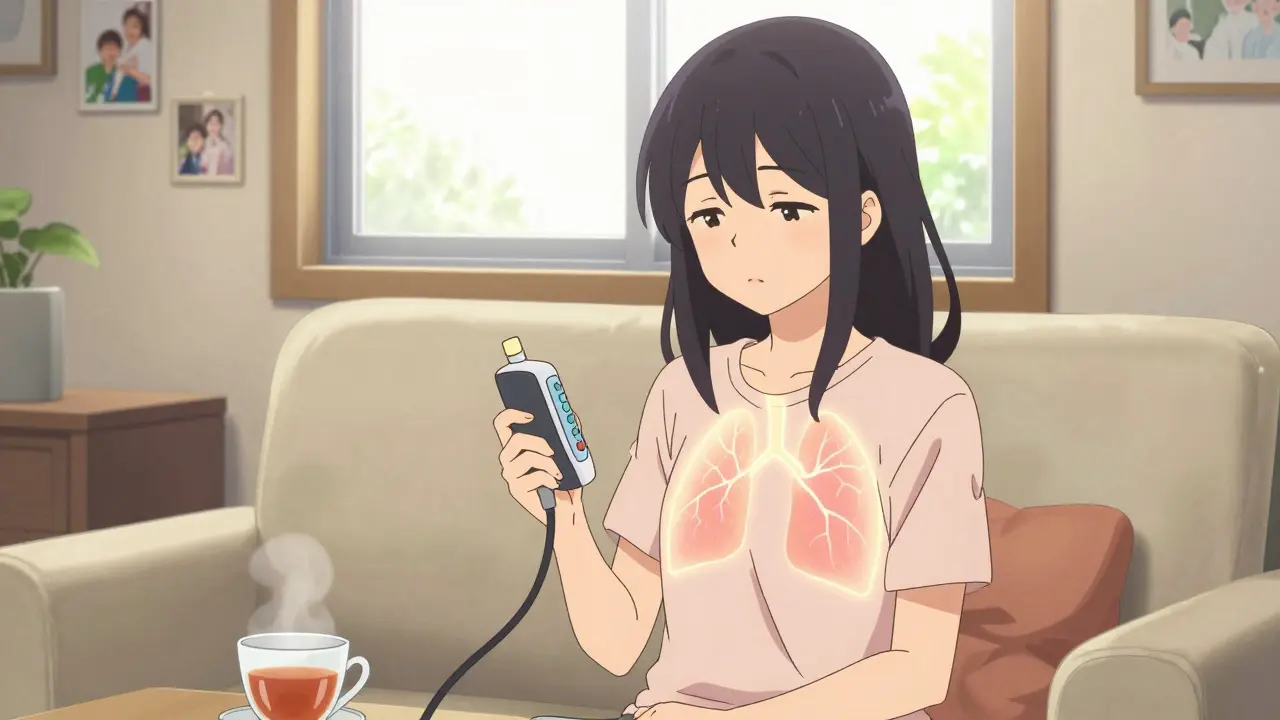
Imagine being told you have COPD at 38. You’ve never smoked. Your lungs are failing, but no one can explain why. For thousands of people around the world, this isn’t a hypothetical-it’s reality. Alpha-1 Antitrypsin Deficiency (AATD) is a hidden genetic condition that causes early-onset emphysema and liver damage, often mistaken for asthma or smoking-related COPD. It’s not rare. It’s just badly missed.
What Is Alpha-1 Antitrypsin Deficiency?
Alpha-1 antitrypsin (AAT) is a protein made in the liver. Its job? To protect your lungs from damage caused by white blood cells called neutrophils. These cells fight infection, but they also release an enzyme-neutrophil elastase-that can tear apart lung tissue if left unchecked. AAT steps in to neutralize it.
In people with AATD, a faulty gene-SERPINA1-makes a misshapen version of this protein. Instead of flowing freely into the bloodstream, it gets stuck in the liver. That means two things happen at once: your lungs don’t get enough protection, and your liver gets clogged with bad protein. Over time, this leads to emphysema and, in some cases, cirrhosis or liver cancer.
The most common bad gene variant is called the Z allele. If you inherit two copies (one from each parent)-known as the ZZ genotype-you’re at highest risk. Your AAT levels drop to just 11-17 mg/dL, compared to the normal range of 100-200 mg/dL. That’s not a small drop. It’s a crash.
Why Is AATD So Often Missed?
Most doctors aren’t trained to look for it. And because the symptoms-coughing, wheezing, shortness of breath-look exactly like smoking-related COPD, patients are often misdiagnosed for years. On average, it takes eight years and three different doctors before someone with AATD gets the right diagnosis.
That delay is dangerous. Every year without treatment means more lung damage. By the time most people are diagnosed, they’ve already lost 30-50% of their lung function. And if they’re still smoking? The damage accelerates. Studies show quitting smoking after diagnosis can reduce lung decline by up to 60%.
Here’s the kicker: AATD-related emphysema hits differently. Instead of damage in the upper lobes of the lungs-typical in smokers-it shows up in the lower lobes. That’s a red flag for doctors who know what to look for. But too few do.
Who Should Be Tested?
You don’t need to be a medical expert to know when to ask for a test. If you have any of these, get checked:
- COPD or asthma with fixed airflow obstruction before age 45
- Unexplained liver disease, especially in children or young adults
- Necrotizing panniculitis (a rare, painful skin condition)
- Family history of COPD, liver disease, or AATD
- Emphysema without a smoking history
The American Thoracic Society and European Respiratory Society both recommend testing everyone with COPD. Yet less than 10% of people with severe AATD in the U.S. have been diagnosed. That’s not a failure of patients. It’s a failure of systems.
How Is It Diagnosed?
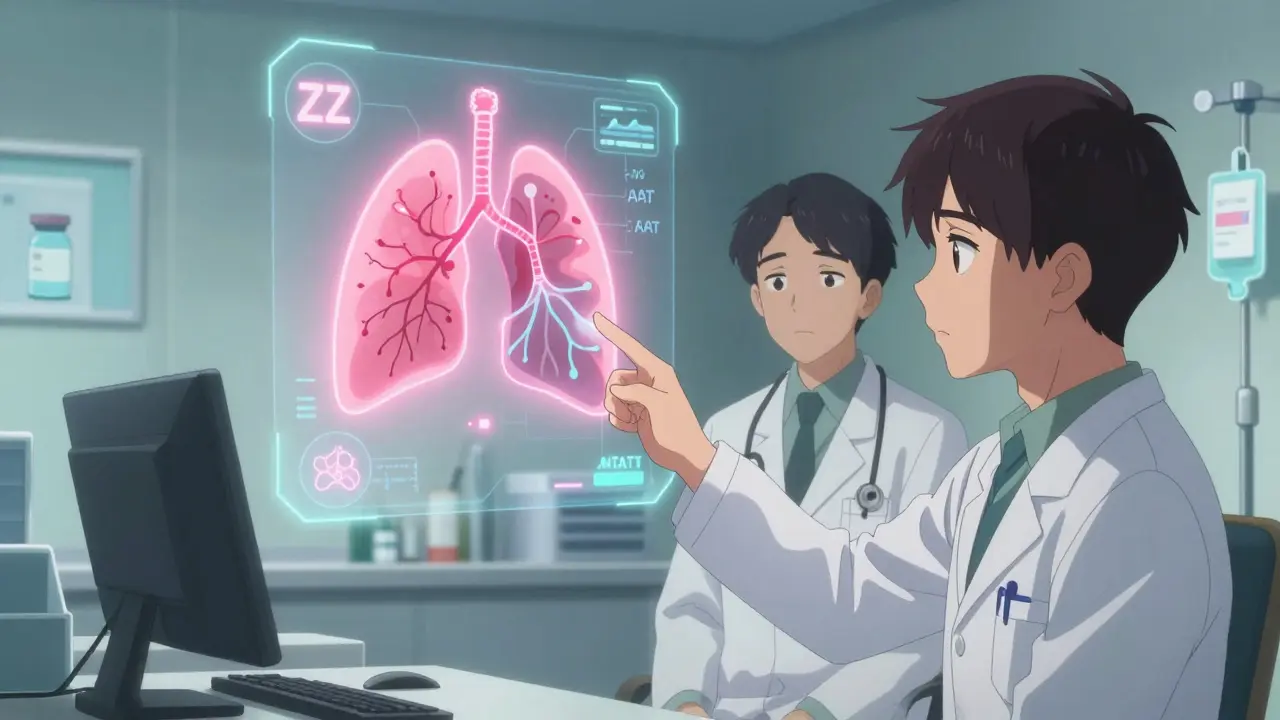
Testing is simple. First, a blood test checks your AAT level. If it’s below 11 μM (about 50 mg/dL), you need further testing. The next step is either genotyping (looking at your DNA) or phenotyping (checking the shape of the protein). Genotyping is faster and more accurate. It tells you exactly which gene variants you carry-MM (normal), MZ (carrier), ZZ (severe), SZ (moderate), or rarer combinations.
Results take 2-6 weeks. But the wait is worth it. Knowing your genotype changes everything. ZZ means high risk. MZ means you’re a carrier-but if you smoke, your risk of lung disease jumps. Even one bad copy matters.
Treatment: What Works and What Doesn’t
There’s no cure. But there is a treatment that slows lung damage: augmentation therapy. It’s not a miracle. It’s a replacement. You get weekly IV infusions of purified AAT protein from donated human plasma. Brands like Prolastin-C, Zemaira, and Aralast NP are FDA-approved. The goal? Keep your blood levels above 11 μM-the minimum threshold shown in labs to protect lung tissue.
It works. Multiple studies show it slows the decline of lung density on CT scans and reduces hospitalizations. But it doesn’t reverse damage. And it doesn’t help your liver. That’s the big gap. If your liver is already scarred, augmentation therapy won’t fix it.
The cost? $70,000 to $100,000 per year. Insurance often denies it at first. You’ll likely need your doctor to appeal. About 42% of initial claims get rejected. Persistence pays.
There’s new hope. In 2022, the FDA approved the first subcutaneous (under-the-skin) AAT treatment. It’s less invasive than IV infusions. More people might stick with it. Clinical trials are also testing gene therapy and drugs that stop the bad AAT protein from clumping in the liver. These could one day treat both lung and liver disease.

Lifestyle and Management
Treatment isn’t just about infusions. The most powerful thing you can do is quit smoking-now. If you’ve been diagnosed, don’t wait. Even if you’ve smoked for decades, quitting at 40 can add 15+ years to your life, according to patient reports.
Get vaccinated. Pneumococcal, flu, and COVID-19 vaccines are non-negotiable. Infections wreck already fragile lungs.
Pulmonary rehab helps. Breathing exercises, exercise training, and nutrition support improve quality of life. Spirometry tests every 6-12 months track progress. Keep records. Bring them to every appointment.
Don’t ignore your liver. Get regular liver function tests. Avoid alcohol. Watch for yellowing skin, swelling in the belly, or unexplained fatigue. These could mean liver damage is advancing.
The Hidden Burden
Living with AATD isn’t just physical. It’s emotional. Many patients describe a years-long ‘diagnostic odyssey’-feeling dismissed, blamed for their illness, or told they’re just ‘overreacting.’ One Reddit user wrote: ‘I was told I was too young to have COPD. Then I found out I had the gene. I felt like I finally had a name for my pain.’
Weekly infusions disrupt work, travel, and family life. Finding a vein that works after years of IVs can be brutal. Some patients develop scarred veins. Others need port implants. The physical toll is real.
And then there’s the family guilt. AATD is inherited. If you have it, your siblings, children, and parents might too. Yet only 22% of first-degree relatives are tested. That’s why genetic counseling is critical. Knowing your status lets your family make informed choices.
What’s Next for AATD?
Change is coming. Twelve U.S. states now screen newborns for AATD. Early detection means early intervention. Kids can be taught to avoid smoking. Parents can get tested. Liver damage can be monitored before it’s too late.
Researchers are working on oral drugs that help the liver release the trapped AAT protein. Others are exploring RNA therapies to silence the faulty gene. If these work, we could move from lifelong infusions to a single treatment that fixes the root cause.
The biggest challenge? Getting doctors to test. The Alpha-1 Foundation estimates 25,000-30,000 people in the U.S. have severe AATD and don’t know it. That’s 25,000 people living with preventable lung damage. Every test missed is another year of decline.
It’s time to stop guessing. If you have unexplained lung or liver disease, ask: Could this be AATD? The answer could change your life-and your family’s.
Scottie Baker
January 14, 2026 AT 03:25So let me get this straight-you’re telling me I could’ve avoided 10 years of breathing like I’m underwater if someone had just run a simple blood test? And now I’m stuck paying $80k a year for plasma from some stranger’s veins? Fuck this system.
Milla Masliy
January 15, 2026 AT 18:46I’m a nurse in Chicago and I’ve seen this too many times. A 32-year-old woman comes in wheezing, gets labeled as ‘anxious asthma,’ gets steroids for years-turns out she’s ZZ homozygous. Her brother had the same thing. No one tested the family until she found a Reddit thread. It’s not just medical ignorance-it’s class and race bias too. People without insurance or access to pulmonologists? They’re left to die slowly.
Randall Little
January 16, 2026 AT 13:58Interesting how the article mentions ‘no cure’ but doesn’t mention that augmentation therapy is basically a placebo for anyone who isn’t ZZ. MZ carriers? You’re not even supposed to get it. But insurance still denies it anyway. Meanwhile, the drug companies are making bank on the desperation of people who’ve been gaslit for a decade. #PharmaCapitalism
Anny Kaettano
January 18, 2026 AT 08:16For anyone newly diagnosed: you’re not broken. You’re not lazy. You’re not ‘overreacting.’ You have a genetic condition that’s been systematically ignored by medicine for decades. The fact that you’re here reading this means you’re already fighting harder than most. Start with pulmonary rehab-it’s not glamorous, but it’s life-changing. And please, please, get your family tested. You’re not just saving yourself-you’re giving them back time.
Angel Molano
January 18, 2026 AT 17:45Stop blaming doctors. If you had lungs failing at 38, you’d get tested too. It’s your responsibility to know your body. No one’s coming to save you.
Adam Rivera
January 19, 2026 AT 02:24My cousin got diagnosed last year after her kid had liver issues. Turns out she’s MZ. She quit smoking cold turkey, started the infusions, and now she’s hiking again. It’s not perfect, but it’s a second chance. If you’re reading this and you’ve got unexplained lung issues-go get tested. It’s a 10-minute blood draw. Don’t wait for your lungs to collapse.
Trevor Davis
January 19, 2026 AT 17:39My dad had this. He died at 52. They didn’t find out until after his transplant. He smoked for 30 years. They said it was ‘emphysema.’ He was never told about the gene. I’m 41 now. I got tested last month. ZZ. I’ve never smoked. I’m starting infusions next week. I don’t know if I’ll make it to 60. But I’m not going to pretend this isn’t real.
John Tran
January 20, 2026 AT 08:25Okay so like… imagine your liver is a tiny factory that keeps making defective Lego bricks that jam the conveyor belt, right? And meanwhile your lungs are just sitting there like ‘yo we need these protective shields but the factory’s on fire’ and the government says ‘eh we’ll get to it’ while the pharma bros are out here selling $100k vials of plasma like it’s artisanal kombucha? I mean… is this what human evolution looks like now? A glitch in the system where biology and capitalism collide in a tragic, slow-motion car crash? 🤔😭
Angel Tiestos lopez
January 22, 2026 AT 05:43Just got my results. ZZ. Never smoked. Never even liked cigarettes. I’m 29. I just got back from my first infusion. It took 3 hours. My vein collapsed. The nurse said ‘you’re lucky we found one.’ I cried in the car. I’m not angry at the system anymore. I’m just… tired. But I’m still here. And I’m gonna keep fighting. 💪❤️
Pankaj Singh
January 22, 2026 AT 06:22Typical American medical fraud. You’re just poor and lazy. Get a job. Stop blaming genes. If you can’t afford treatment, you don’t deserve it. The world doesn’t owe you oxygen.
jefferson fernandes
January 22, 2026 AT 06:45Let me just say this: if you’re under 45 and have COPD-like symptoms, get tested. Period. No exceptions. Your doctor might not know. But you can ask for a serum AAT level and genotyping. It’s covered by most insurances if you push. I’ve helped 17 patients get diagnosed. One of them is my sister. Don’t wait. Don’t hope. Act.
Acacia Hendrix
January 23, 2026 AT 07:05The literature on augmentation therapy’s efficacy is statistically underpowered and riddled with industry sponsorship bias. Moreover, the phenotypic heterogeneity of SERPINA1 variants renders population-wide screening ethically questionable without robust cost-benefit analyses. The current paradigm is not evidence-based-it’s a symptom of diagnostic inertia masked as medical progress.
Lance Nickie
January 25, 2026 AT 01:29So you’re telling me the cure is… more plasma? From humans? What’s next? Blood transfusions for bad karma?